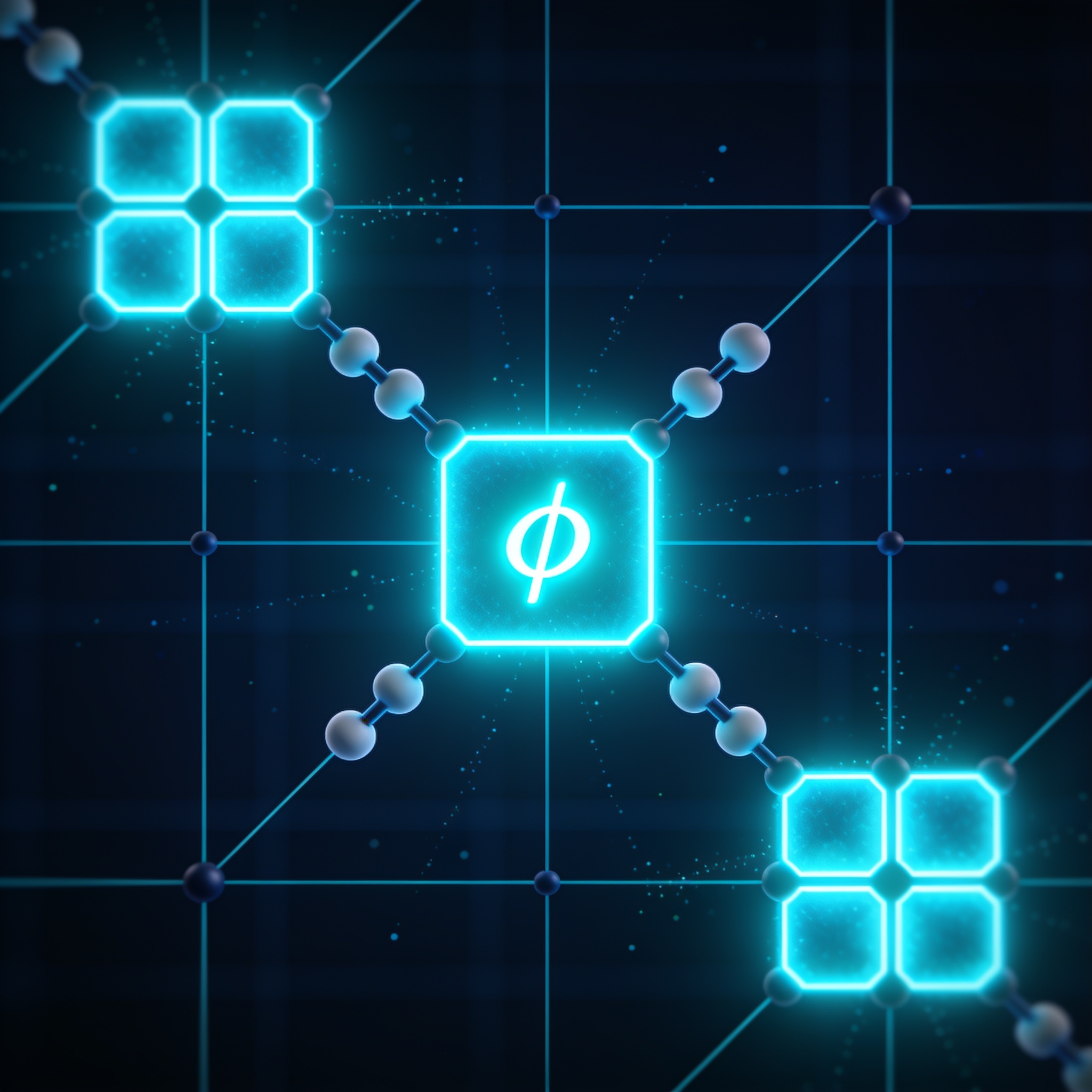
Take two electrons, glue them together so tightly they behave as a single bosonic particle. Intuition says all memory of their fermionic past should vanish. Yet in the quantum world, that memory endures—disguised, not destroyed. For decades, condensed-matter physicists have asked: how does the intrinsic Fermi statistics of microscopic constituents survive when confinement forces them into bosonic composites? A paper published on August 26, 2026, on the arXiv repository finally delivers an answer. [arXiv:2608.26264]
The Core Finding
Using a \(2+1\)D \(\mathbb{Z}_2\) lattice gauge theory in its strong-coupling limit, the researchers show that all statistical information collapses into a single number: a local hopping phase \(\varphi\) that equals 0 for bosons and \(\pi\) for fermions. The interactions between the dimers remain completely identical, independent of the underlying particle type.
"The statistics of the underlying matter is encoded entirely in a single local hopping phase \(\varphi\) — 0 for bosons, \(\pi\) for fermions — while interactions remain statistics-independent."Think of it like a secret handshake: the composite dimers look identical from the outside, but when they hop from one lattice site to another, a minus sign—the phase \(\pi\)—flips their wavefunction, revealing the fermionic DNA hidden inside.
By treating \(\varphi\) as a continuous parameter that smoothly interpolates between the two extremes, the team mapped out a rich ground-state phase diagram with tensor-network methods. They discovered a novel gapped phase in which dimer pairs crystallize into a regular pattern of resonating plaquettes, competing with repulsion between neighboring dimers. The phase angle itself drives a transition between a dimer superfluid and a dimer charge density wave, while the magnetic coupling binds adjacent dimers into resonating pairs. This is the first time that the internal quantum statistics of confined particles has been pinned to a single controllable angle that dictates macroscopic order.
The State of the Field
For years, researchers have known that lattice gauge theories can confine elementary charges into neutral bound states—meson-like dimers in condensed matter analogs. Work by pioneers such as Michael Levin, Xie Chen, and Frank Verstraete established that topological order and fractional statistics can emerge in such systems. Yet the fate of the elementary particle statistics inside bosonic bound states remained murky. Standard arguments said that if the composite is bosonic, all statistical signatures vanish. The new paper demolishes that assumption by showing that the statistics survive as an effective phase on the dimer hopping term, not on the constituents themselves.
The breakthrough was enabled by the maturity of tensor-network techniques—particularly infinite projected entangled-pair states (iPEPS)—that can treat the continuous phase angle as a free parameter and resolve ground-state phases with high accuracy. In the broader quantum computing landscape, quantum simulators capable of realizing \(\mathbb{Z}_2\) gauge theories with tunable matter fields are coming online. This paper provides the theoretical roadmap for detecting the statistical fingerprint in those machines.
From Lab to Reality
For scientists, this result unlocks a new tool: by engineering a hopping phase in a bosonic dimer model—using, for example, lattice shaking or Floquet engineering in ultracold atoms—one can scan the entire statistical axis from Bose to Fermi and watch how many-body phases transform. The predicted crystalline dimer pair phase becomes a concrete target for quantum simulators that natively realize bosonic degrees of freedom.
For engineers, the study proposes a quench protocol: prepare two identical dimer configurations, then abruptly change \(\varphi\) and watch the real-time evolution. Because all interactions are the same, any difference in the dynamics directly exposes the underlying statistics. This turns a static phase into a dynamical probe that can be implemented on neutral-atom, superconducting qubit, or trapped-ion platforms within the next few years—not decades. The ordered phases then leave clear signatures in correlation functions that simulators can measure.
For investors watching the quantum simulation market, estimated at $1.5 billion by 2030, such foundational insights are the raw material for benchmarking early hardware. Detecting emergent dimer phases provides a crisp early-use case for platforms that are still hunting for scientifically rigorous problems to demonstrate value beyond random circuit sampling.
What Still Needs to Happen
Two technical challenges stand between the theory and a full experimental realization. First, the \(\mathbb{Z}_2\) gauge symmetry must be protected with high fidelity. Even small gauge-breaking errors in a simulator can wash out the statistical phase. Groups led by Hannes Pichler in Innsbruck and Mikhail Lukin at Harvard are tackling this with tweezer arrays and dynamical decoupling protocols, but post-selection overheads remain high.
Second, reading out the real-time signatures of the quench requires measuring multi-point dimer correlation functions at the level of single lattice sites—a capability that quantum gas microscopes are just now achieving. The microscope group at the Max Planck Institute for Quantum Optics has demonstrated site-resolved imaging of atoms in optical lattices, but extending this to dynamic dimer operators while maintaining gauge invariance will take at least three to five years. This is not yet a decade away, but it is firmly in the realm of ambitious, near-term quantum simulation.
Conclusion
In short: emergent dimer statistics reduce to a single, tunable phase angle that dictates macroscopic quantum order and can be read out via a quench—a discovery that connects the microscopic world of particle identity to large-scale many-body phases.
FAQ
What is a dimer in this context?
A dimer is a tightly bound pair of charges—analogous to a meson in particle physics—that behaves as a single mobile bosonic particle on a lattice. In the paper, dimers emerge when fundamental matter particles are confined by a \(\mathbb{Z}_2\) gauge field.
How does the hopping phase encode statistics?
The dimer’s wavefunction picks up a phase factor \(e^{i\varphi}\) when it moves one lattice spacing. For bosonic constituents \(\varphi=0\); for fermionic constituents \(\varphi=\pi\), which introduces a sign change equivalent to swapping two identical particles. All other terms in the Hamiltonian are identical.
How does this compare to previous ways of detecting emergent statistics?
Earlier methods relied on braiding anyons or measuring topological entanglement entropy. This new approach uses a simple, local hopping phase that can be tuned continuously, making it far more accessible to analog quantum simulators without requiring full topological order.
When could this be commercially relevant?
Commercial relevance for quantum simulation is still pre-revenue, but a successful experimental realization within five years would validate quantum simulators as scientific instruments for studying gauge theories, potentially influencing the $1.5 billion simulation market in the 2030s.
Which industries would benefit most?
Fundamental physics research, materials science (understanding strongly correlated electron systems), and quantum computing hardware developers stand to benefit. The quench protocol also offers a new benchmark for validating quantum devices.
What are the current limitations of this research?
The study is theoretical and uses tensor-network methods. It assumes perfect \(\mathbb{Z}_2\) gauge symmetry and zero temperature. Experimental noise, gauge-breaking terms, and finite-temperature effects are not yet accounted for and must be addressed before laboratory implementation.