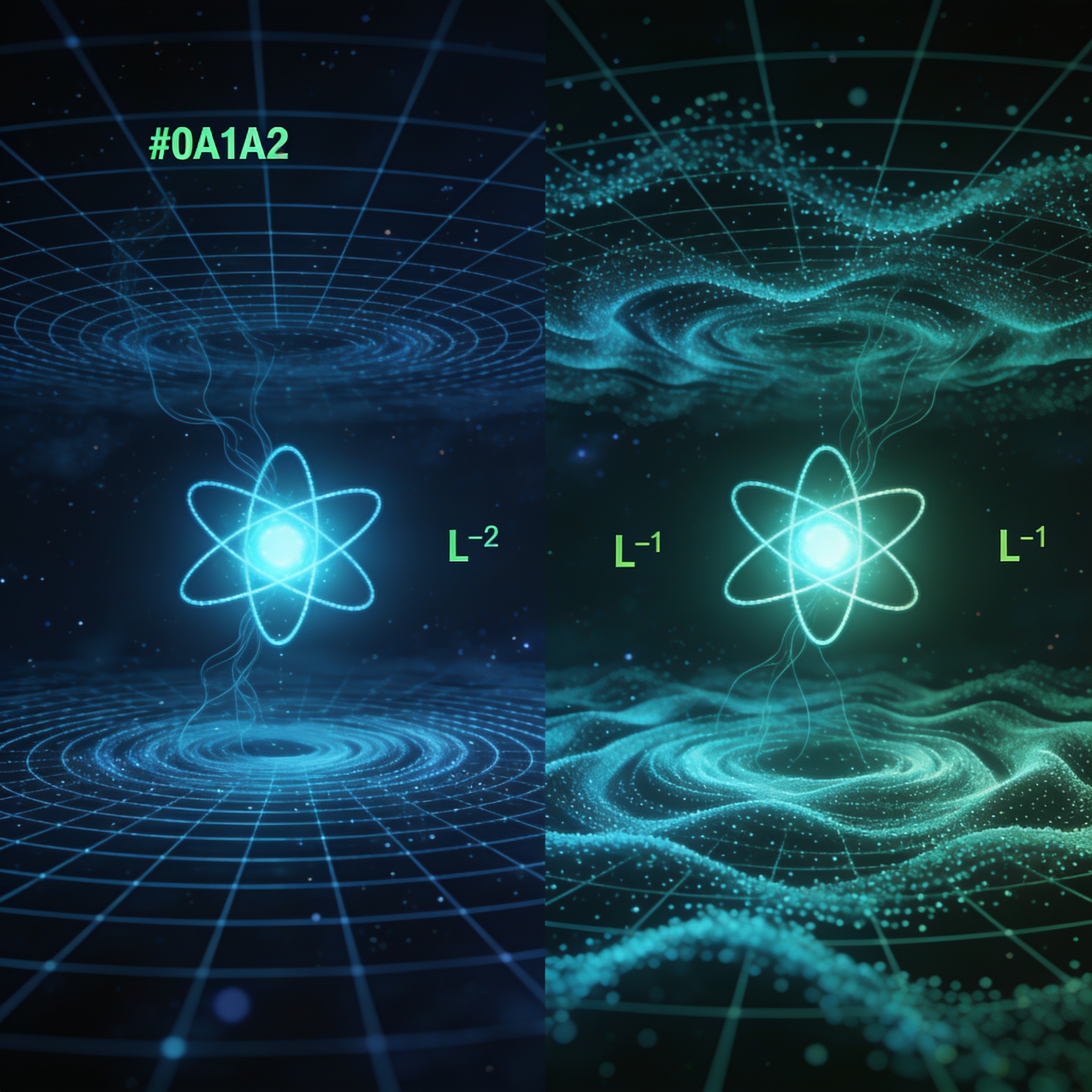
Three identical thermometers can read the same temperature yet sit in profoundly different physical realities. One floats in the expanding spacetime of de Sitter space, another rides a rocket accelerating through empty Minkowski vacuum, and the third rests motionless in a warm thermal bath. For decades, physicists have known that a single atom in each of these settings experiences identical local quantum fluctuations when the de Sitter Hubble constant \(H\), the acceleration \(a\), and the bath temperature \(\beta^{-1}\) satisfy \(a=H\) and \(\beta=2\pi/H\). But what happens when you place two atoms in each environment and watch how their quantum fluctuations correlate across a distance? That question had never been answered — until a paper posted on arXiv in August 2026 directly compared the two-atom cross spectra for all three scenarios, revealing that the long-distance behavior of these correlations unmasks the underlying spacetime structure. [arXiv:2608.26554]
The Core Finding
The authors derive the cross spectra — frequency-domain measures of correlation between two identical two-level atoms weakly coupled to a massless conformally coupled scalar field — in three settings: comoving atoms in the Bunch–Davies vacuum of de Sitter spacetime, transversely separated uniformly accelerated atoms in the Minkowski vacuum, and static atoms in a Minkowski thermal bath. They then extract the single-atom local spectra as the zero-separation limit, confirming uniformity. The key result is that while the local Wightman kernels and spectra are identical when \(a=H\) and \(\beta=2\pi/H\), the finite-separation cross spectra differ qualitatively.
"When \(a=H\) and \(\beta=2\pi/H\), the complete local Wightman kernels and local spectra are identical in all three cases."A genuine thermal bath introduces a \(\operatorname{sinc}(\Omega L)\) spatial factor, whereas de Sitter spacetime and the transversely accelerated vacuum produce a hyperbolic geometric factor. In the long-distance limit, the cross correlations in de Sitter and the accelerated vacuum decay as \(L^{-2}\), while those in the Minkowski thermal bath decay only as \(L^{-1}\). Think of it like three ponds with the same surface temperature: drop two pebbles in each, and the ripples' interference pattern reveals whether the pond is flat, expanding, or being stirred by an unseen engine.
Why Now
The relationship between acceleration, horizons, and thermality has been a central thread in theoretical physics since the 1970s, when Stephen Fulling, Paul Davies, and William Unruh showed that an accelerating observer in Minkowski vacuum perceives a thermal bath of particles. Bill Unruh's 1976 paper explicitly derived the effect, and the Unruh temperature \(T_U = a/2\pi\) became a cornerstone of quantum field theory in curved spacetime. Parallel work on de Sitter space by Gary Gibbons and Stephen Hawking in 1977 demonstrated that a cosmological horizon radiates with temperature \(T = H/2\pi\). Yet prior studies focused overwhelmingly on single-detector responses. The few attempts to examine two-detector correlations either treated each setting in isolation or failed to compare the functional forms of the cross spectra across all three. This paper fills that gap by providing a unified, analytic derivation that exposes the distinct spatial signatures. The broader landscape of quantum field theory in curved spacetime is currently experiencing a renaissance driven by tabletop analogue gravity experiments and advances in relativistic quantum information, making precise comparative predictions like these timely.
From Lab to Reality
For theorists, this work unlocks a sharper diagnostic toolkit: the \(L^{-2}\) versus \(L^{-1}\) decay distinction offers an operational way to discriminate between a genuine thermal environment and the thermal-like effects of acceleration or cosmological horizons, even when local probes cannot tell them apart. It also clarifies how the pulled-back cross correlations in the uniformly accelerated and thermal Minkowski configurations remain stationary, while the physical separation between two comoving atoms in de Sitter space evolves with cosmic expansion — a feature that could be used to test the equivalence principle in quantum settings. For experimentalists working with analogue gravity systems, such as Bose–Einstein condensates or superconducting circuits that mimic expanding spacetimes, the predicted cross-spectral shapes provide a concrete signal to hunt for. Although no immediate commercial application exists, the quantum sensing market, projected at $1.1 billion by 2030, could eventually incorporate horizon physics if analogue systems achieve sufficient control. For investors, the relevance lies in the foundational knowledge that underpins future quantum technologies operating in non-inertial or curved-spacetime regimes, such as satellite-based quantum communication.
What Still Needs to Happen
Two technical challenges stand out. First, the paper treats a four-dimensional massless conformally coupled scalar field; extending the analysis to electromagnetic fields or massive fields is non-trivial and may alter the decay exponents. Researchers in the analogue gravity community, including groups at the University of Nottingham and the Weizmann Institute, are actively developing experimental platforms where scalar field analogues can be probed, but achieving the required sensitivity to measure \(L^{-2}\) decay remains difficult. Second, the de Sitter case assumes the Bunch–Davies vacuum, a particular choice of quantum state. Other physically motivated vacua, such as the alpha-vacua, could yield different cross correlations, and no consensus exists on which vacuum is realized in our universe. Theoretical work by the quantum field theory group at the University of Waterloo is exploring state-dependent signatures in de Sitter correlators. Realistically, a direct laboratory test of these predictions is at least a decade away, as it requires either a controlled accelerating two-atom experiment with sub-nanometer precision or a cosmological observation that isolates the effect from astrophysical foregrounds.
Conclusion
In short: two-atom cross spectra in de Sitter spacetime and uniformly accelerated Minkowski vacuum decay as \(L^{-2}\) at long distances, while a thermal bath decays as \(L^{-1}\), providing a sharp operational distinction between horizon-induced thermality and genuine heat baths.
Frequently Asked Questions
What is de Sitter spacetime? De Sitter spacetime is the maximally symmetric solution of Einstein's equations with a positive cosmological constant, describing an exponentially expanding universe. It possesses a cosmological horizon that radiates at a temperature proportional to the Hubble constant \(H\). In this paper, it serves as the curved-spacetime setting where comoving atoms experience a thermal-like bath from the Bunch–Davies vacuum.
How does the two-atom cross spectrum differ from a single-atom spectrum? A single-atom spectrum measures the response of one detector to field fluctuations at its location. The cross spectrum captures the correlation between fluctuations at two spatially separated points, revealing how quantum or thermal noise is shared across distance. The paper shows that while single-atom spectra can be identical, the cross spectra expose the underlying physics through their spatial decay.
How does this compare to the Unruh effect? The Unruh effect predicts that a single accelerating detector in Minkowski vacuum sees a thermal bath at temperature \(a/2\pi\). This paper extends that to two detectors and compares the cross correlations with those in a genuine thermal bath and in de Sitter space. It finds that the Unruh and de Sitter cases share the same \(L^{-2}\) decay, distinct from the \(L^{-1}\) decay of a true thermal bath.
When could this be experimentally tested? A direct test is likely more than 10 years away. It would require either a precision two-atom interferometry experiment on an accelerating platform, or an analogue gravity simulation using cold atoms or superconducting circuits that can measure correlation decay with high spatial resolution. Current analogue experiments can probe single-detector thermality but not yet the subtle two-point cross spectra.
Which industries would benefit most from this research? No immediate industrial application exists. However, the fundamental understanding of quantum correlations in non-inertial and curved-spacetime settings could eventually inform quantum communication between satellites and ground stations, where relativistic effects matter. The quantum sensing industry, projected to reach $1.1 billion by 2030, may also benefit from new correlation-based diagnostic techniques.
What are the current limitations of this research? The analysis is restricted to a massless conformally coupled scalar field in four dimensions; real electromagnetic or fermionic fields may behave differently. It also assumes the Bunch–Davies vacuum for de Sitter, and other vacuum choices could alter the cross spectra. Finally, the paper is purely theoretical, with no experimental validation yet available.