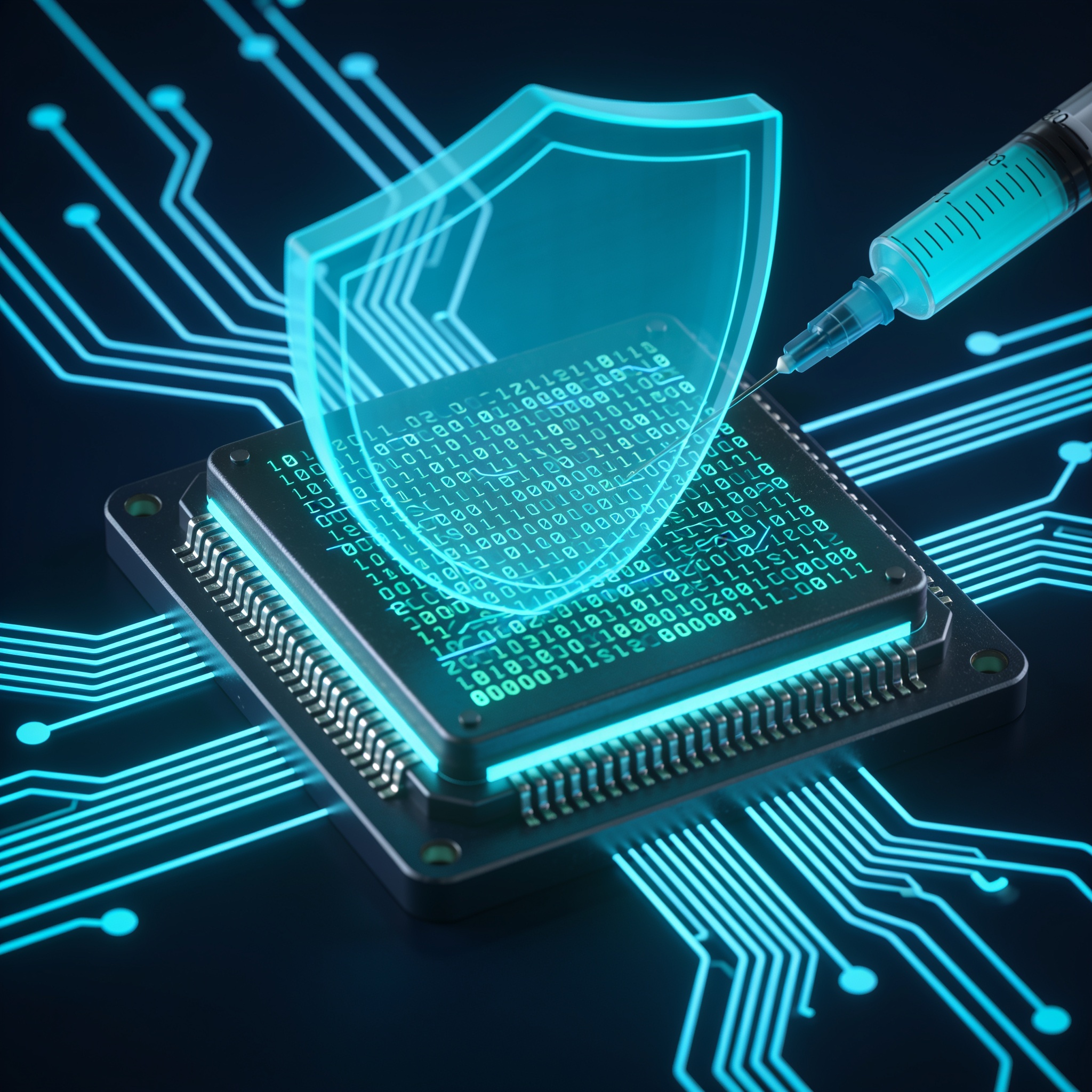
Cloud quantum processors promise revolutionary computing power, but they introduce a thorny security problem. When a user submits a quantum error correction circuit to a shared quantum computer, that circuit may run alongside untrusted workloads from other users. A malicious actor could inject faults—deliberate errors—into the physical qubits, hoping to corrupt the logical qubit that encodes the user's data. If the error correction encoder is fixed and public, the adversary has a reusable target: learn the mapping once, and every subsequent run is vulnerable. Until now, no one had quantified exactly how much protection a cloud provider could gain by changing that encoder on the fly, nor how to separate genuine error correction from mere postselection of lucky runs. In a paper posted to arXiv on August 27, 2026, a team of researchers tackles this gap head-on, introducing a rigorous framework to audit structured randomness in quantum error correction under a bounded cloud fault model. [arXiv:2608.26600]
The Core Finding
The researchers define a new metric called "accepted logical disturbance," which measures the harmful logical action that slips through error correction and gets accepted as a valid result. They derive the exact expectation of this disturbance under ideal Haar-random encoders—a theoretical gold standard. Then, they evaluate a practical, polynomial-cost family of seeded Clifford encoders. Using dense linear algebra and gate-level stabilizer simulations, they test two attack scenarios: faults chosen after the adversary learns the encoder, and faults chosen before the encoder is known. The result is striking. Reseeding the encoder—changing it for each run—slashes the mean accepted logical disturbance from 0.150 (when the adversary knows the encoder) to 0.020 (when the adversary must guess blind). That is an 86.7% reduction, driven primarily by the rejection of corrupted runs. Crucially, the fixed distance-three [[5,1,3]] code corrects every tested weight-one Pauli error, yet only 18.5% of the sampled encoders satisfy exact quantum error correction conditions. This gap reveals that postselected detection, not perfect correction, accounts for the integrity gain.
Reseeding reduces mean accepted logical disturbance from 0.150 for faults chosen after learning each encoder to 0.020 for one fault chosen before it is known.
Think of it like a door lock that reconfigures its internal pins after every use. A thief who picks the lock once gains no advantage for the next attempt because the mechanism has changed. Similarly, reseeding the encoder scrambles the physical-to-logical fault map, forcing the adversary to start over each time.
The State of the Field
Quantum error correction has long been the bedrock of fault-tolerant quantum computing. Codes like the surface code and the [[5,1,3]] perfect code can correct arbitrary single-qubit errors, but their performance assumes benign noise models. In cloud environments, however, co-located malicious workloads can inject adversarial faults that exploit the structure of the encoder. Previous work recognized that exact Haar-random encoders offer maximum security, but their circuit cost grows exponentially with the number of qubits, making them impractical. Efficient random ensembles, such as random Clifford encoders, provide average-case guarantees but leave the worst-case accepted corruption uncharacterized. This paper breaks new ground by explicitly modeling an adversary with bounded knowledge—either before or after encoder revelation—and quantifying the resulting accepted logical disturbance. The broader quantum computing landscape is rapidly shifting toward cloud access. IBM, Google, and Amazon already offer quantum cloud services, and multi-tenancy is becoming the norm. Security against fault-injection attacks is no longer a theoretical curiosity; it is an imminent engineering requirement.
From Lab to Reality
For scientists, this work provides a principled auditing framework. The accepted logical disturbance metric and the separation of postselected detection from exact correction give researchers a tool to benchmark and compare different encoder families under explicit threat models. It opens the door to designing new encoders that maximize integrity gain while remaining computationally efficient. For engineers building cloud quantum platforms, the implications are direct. Integrating a reseeding protocol into the compilation stack could shield user circuits from co-located adversaries without requiring expensive hardware changes. A polynomial-cost seeded Clifford encoder can be generated on the fly, and the resulting rejection of corrupted runs can be handled by standard postselection or by repeating the computation. For investors, the quantum error correction market is projected to reach $1.2 billion by 2030, driven by the need for reliable logical qubits in cloud services, finance, and pharmaceuticals. Technologies that harden error correction against adversarial faults will be essential differentiators for commercial quantum platforms.
What Still Needs to Happen
Several challenges stand between this proof-of-concept and deployment. First, the study uses the small [[5,1,3]] code, which corrects only a single error. Scaling the analysis to larger codes like the surface code with distance 5 or 7 is necessary to assess real-world fault-tolerant systems. The computational cost of simulating adversarial faults grows rapidly with code size, requiring new simulation techniques. Second, the bounded fault model assumes the adversary can inject only a limited number of faults per run. In practice, cloud environments may expose qubits to more complex, correlated fault patterns. Extending the framework to richer fault models, including those that adapt over multiple runs, is an open problem. Groups at MIT, Caltech, and the University of Sydney are actively researching fault-tolerant architectures and adversarial robustness. Industry labs at IBM Quantum and Google Quantum AI are also exploring secure multi-tenancy. Realistically, integrating reseeding into commercial cloud platforms is at least five to ten years away, pending advances in both hardware reliability and software security protocols.
Conclusion
In short: quantum error correction integrity can be boosted by 86.7% through encoder reseeding, quantifying the security gain against fault-injection adversaries for the first time and cleanly separating postselected detection from exact correction.