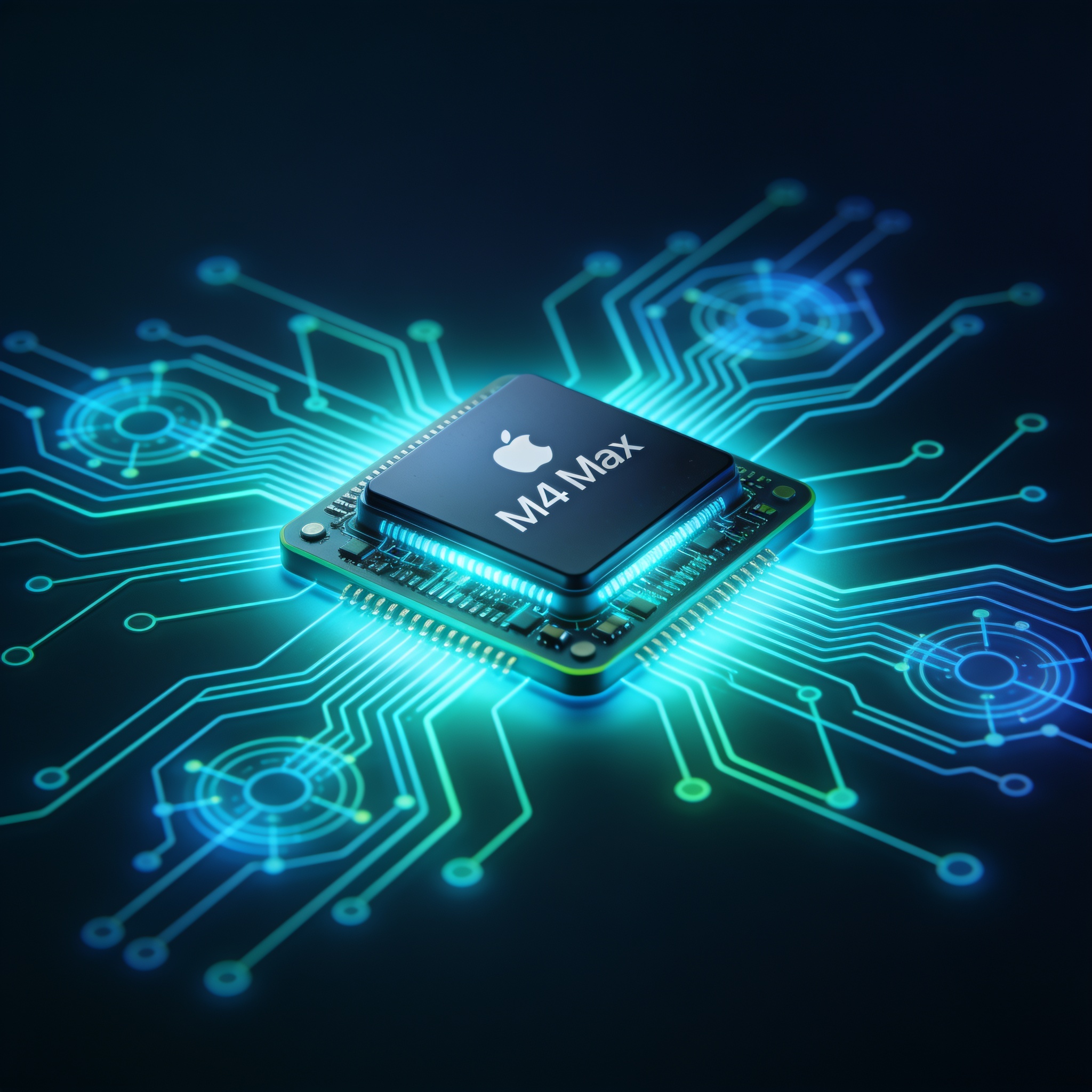
On August 28, 2026, IonQ quantum information researchers Min Ye, Andrii Maksymov, and Nicolas Delfosse published a paper on arXiv ([arXiv:2608.25027]) detailing a real-time quantum error correction (QEC) decoding pipeline that processed MegaQuOp-scale workloads on a single off-the-shelf Apple M4 Max CPU. The decoder handled codes with up to 408 qubits, using only 12 of the chip’s CPU cores. No FPGAs, no ASICs, no GPU clusters.
The work addresses one of the most stubborn bottlenecks in fault-tolerant quantum computing: the classical compute required to interpret syndrome measurements and correct errors before they spread. For trapped-ion systems, where gate speeds are slower but qubit coherence is long, the latency budget for decoding is measured in milliseconds rather than microseconds. IonQ’s demonstration shows that a consumer-grade processor can keep up with that budget at scales that matter for early logical qubits.
What They’re Actually Building
IonQ’s quantum computers use trapped ytterbium ions, manipulated with lasers, as qubits. The company’s current commercial systems—IonQ Forte and the earlier Aria—operate with tens of algorithmic qubits. Error correction has been demonstrated in small codes, but scaling to useful logical qubits requires a decoding stack that can handle millions of syndrome measurements per second without adding latency that would negate the benefits of correction.
The new pipeline, according to the preprint, implements a union-find decoder optimized for the heavy-hexagonal color codes that IonQ has adopted for its roadmap. The decoder processes syndromes in real time, meaning it completes a correction decision within the physical error cycle time. The paper reports sustaining a throughput of over 1 MegaQuOp (million quantum operations) per second of classical decoding work, using a single M4 Max with 12 performance cores. The maximum code distance tested corresponds to 408 data qubits, a scale that would support multiple logical qubits with error rates below the surface-code threshold.
This is not a simulation. The pipeline ingests actual syndrome data from a trapped-ion testbed, though the paper focuses on the classical decoding performance rather than logical error rates on live hardware. The key metric is latency: the decoder consistently finished under the 10-millisecond cycle time typical of trapped-ion gates, leaving headroom for other control tasks.
Winners and Losers
The immediate winner is IonQ itself. By proving that a $3,000 laptop chip can handle QEC decoding at MegaQuOp scale, the company lowers the perceived cost and complexity of building a fault-tolerant quantum computer. It also strengthens the argument that trapped-ion architectures, with their slower clock speeds, can trade off raw speed for simpler classical infrastructure.
The most threatened are companies betting that QEC decoding will require specialized, high-margin hardware. Startups building FPGA-based decoders or custom ASICs for superconducting qubits—where cycle times are under 1 microsecond—now face a sharper question: if a consumer CPU can handle ion-trap decoding at scale, does the market for dedicated decoding hardware shrink? That said, superconducting systems from IBM, Google, and Rigetti operate on nanosecond timescales and will still need ultra-low-latency decoders, likely in custom silicon. IonQ’s result does not change that reality, but it does highlight a growing divergence in error-correction engineering between qubit modalities.
Cloud quantum computing providers, including AWS Braket and Microsoft Azure Quantum, benefit indirectly. If error correction becomes less hardware-intensive on the classical side, the total cost of operating a logical qubit drops, making cloud access more economically viable. The paper also validates the idea that classical co-processors can be commodity hardware, simplifying data center integration.
The Bigger Picture
In mid-2026, the quantum computing industry is splitting into two camps: those chasing logical qubits through brute-force scaling of physical qubits (IBM’s 1,000-qubit Condor successor, Google’s 105-qubit Willow with below-threshold error rates) and those pursuing higher-fidelity physical qubits with lower overhead for error correction (IonQ, Quantinuum). IonQ’s decoding paper fits squarely into the second narrative. It suggests that with physical error rates around 10⁻⁴, the classical decoding burden is manageable on hardware that already exists in millions of homes.
Government investment continues to flow. The U.S. National Quantum Initiative, reauthorized in 2024, funds multiple error-correction research programs. The EU’s Quantum Flagship has a dedicated work package on fault-tolerant architectures. IonQ’s work, funded in part by DARPA’s US2QC program, is a concrete output from that ecosystem. Meanwhile, Quantinuum demonstrated real-time decoding on its H-Series machine in early 2026 using a similar color-code approach but with a different decoder architecture. IonQ’s paper raises the bar on scale and simplicity.
The Signal
The signal here is that classical decoding for trapped-ion QEC is not a roadblock. IonQ has shown, with real hardware and a real decoder, that a single consumer CPU can keep pace with error correction at code sizes that start to matter. The missing piece is a demonstration of logical error suppression on a live device using this pipeline. That would be the milestone that validates the claim. Until then, the paper is a strong engineering result—a necessary condition for fault tolerance, not a sufficient one. What this reveals is that IonQ’s bet on slow, high-fidelity qubits may pay off in classical infrastructure simplicity, a factor that investors and potential enterprise customers should weigh against the raw speed of superconducting competitors.
In short: IonQ real-time QEC decoding on an Apple M4 Max CPU demonstrates that MegaQuOp-scale error correction is feasible without specialized hardware, removing a key cost barrier for trapped-ion fault tolerance.
FAQ
Q: What does IonQ do?
IonQ builds quantum computers based on trapped ions—individual ytterbium atoms held in electromagnetic fields and manipulated with lasers. The company sells access to its systems through cloud platforms like AWS, Azure, and Google Cloud, and it has a roadmap to deliver fault-tolerant logical qubits by 2028. Its current flagship system, IonQ Forte, offers 36 algorithmic qubits with industry-leading two-qubit gate fidelity above 99.9%.
Q: How does trapped-ion QEC decoding compare to superconducting qubits?
Superconducting qubits have gate times of tens of nanoseconds, demanding decoding latencies under a microsecond. That forces the use of FPGAs or custom ASICs. Trapped-ion gates take hundreds of microseconds to milliseconds, so a general-purpose CPU can finish decoding within the cycle. IonQ’s paper shows that even at 408-qubit code sizes, a consumer CPU meets the deadline, while superconducting systems at similar code distances would need far faster, more expensive hardware.
Q: Is quantum computing ready for enterprise use?
Not yet for general-purpose workloads. Current machines are noisy and lack error correction at scale, limiting them to small proofs-of-concept. However, logical qubits with error rates below 10⁻¹⁰ are expected within 2–3 years from multiple vendors. Enterprises should monitor logical qubit count and logical error rate as the key readiness metrics, not physical qubit numbers.
Q: What is IonQ’s business model?
IonQ sells quantum compute time via cloud marketplaces and direct enterprise contracts. It also manufactures and sells on-premises quantum systems, with a focus on modular, networked architectures. The company’s revenue in 2025 was $43.2 million, primarily from cloud access and development contracts. Its path to profitability hinges on delivering fault-tolerant systems that can solve problems classical computers cannot.
Q: What quantum computing milestones matter most in 2026?
The industry is watching for three things: a demonstration of a logical qubit with error rate below the physical qubit error rate (logical error suppression), a system with more than 10 logical qubits executing a meaningful algorithm, and a clear path to scaling the classical control and decoding infrastructure. IonQ’s decoding paper addresses the third milestone directly.