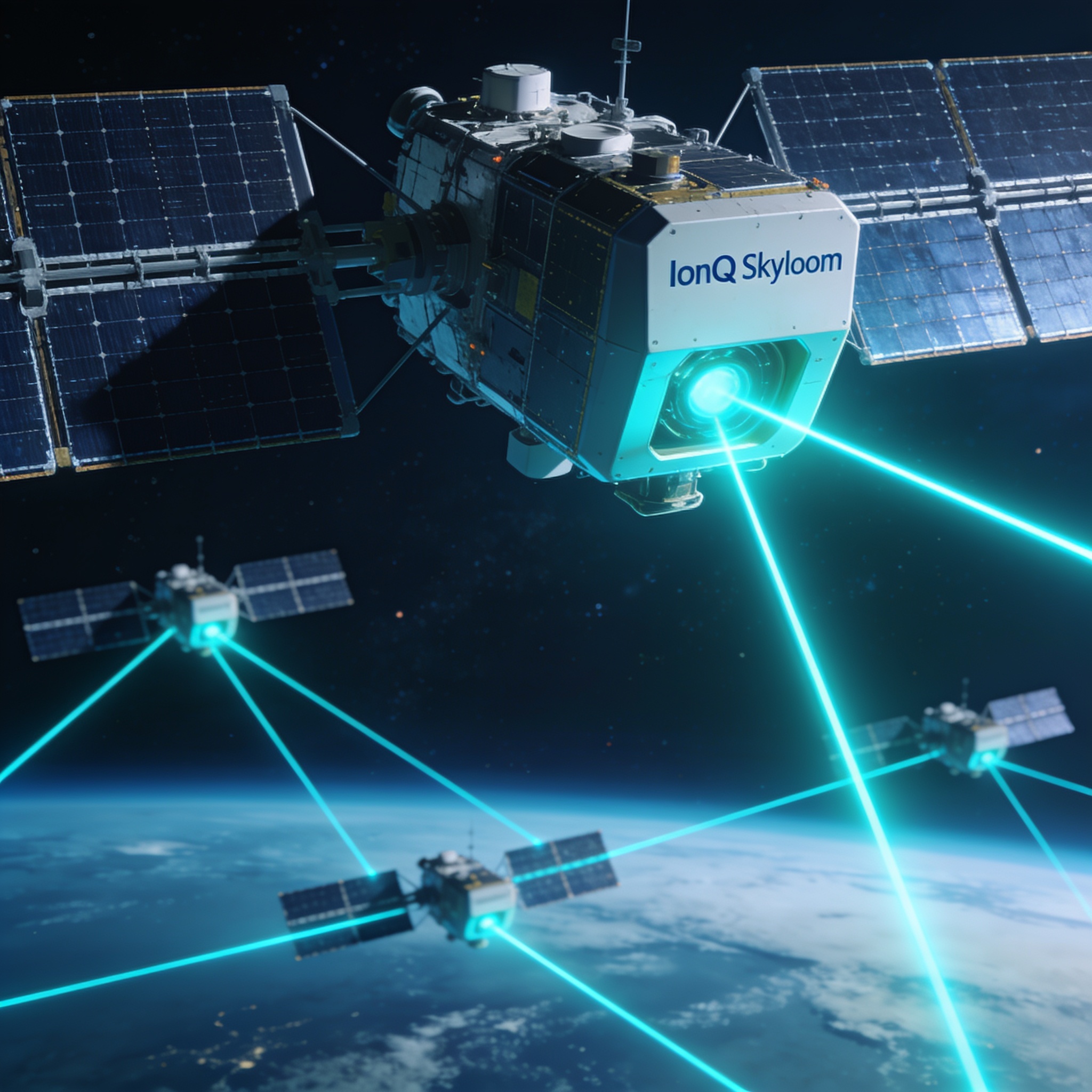
On August 24, 2026, IonQ (NYSE: IONQ) announced that its wholly owned subsidiary Skyloom Global has reached 84 operational optical communication terminals (OCTs) in low-Earth orbit. The latest batch was launched aboard a SpaceX Falcon 9 from Vandenberg Space Force Base, integrated onto York Space Systems satellites supporting the U.S. Space Development Agency’s Proliferated Warfighter Space Architecture (PWSA). IonQ closed its acquisition of Skyloom in Q3 2025 for approximately $170 million in stock and cash—a bet that space-based optical links would one day serve as the backbone for a global quantum network.
The PWSA constellation depends on laser inter-satellite links to create a resilient, high-bandwidth mesh in LEO. Reaching 84 terminals puts Skyloom among a handful of suppliers meeting strict SDA production and delivery timelines. While the terminals are entirely classical today, the operational heritage and manufacturing volume are critical for IonQ’s long-term ambition to host entangled-photon sources on the same optical platforms, enabling satellite-based quantum key distribution and, eventually, quantum internet connections between trapped-ion quantum computers.
What They’re Actually Building
Skyloom’s OCTs are free-space laser communication terminals designed for satellite crosslinks. Each terminal can sustain data rates up to 10 Gbps using a combination of coarse pointing mechanisms and fast-steering mirrors for tracking. The terminals operate in the near-infrared, a wavelength band compatible with both classical comms and future quantum channels. IonQ has discussed plans to insert compact entangled-photon sources into later versions of the terminal, turning each OCT into a node that can distribute quantum entanglement over hundreds of kilometers in space.
Importantly, the 84 terminals are not quantum. No entanglement generation, no single-photon detection, no QKD has been demonstrated. The roadmap from Skyloom’s classical modem to a quantum-capable payload faces significant engineering challenges: maintaining polarization stability across thermal cycles, adding quantum-grade detectors with low background noise, and integrating an entanglement source that can survive launch vibration. IonQ has not published a timeline for a quantum-specific terminal, though its CEO has publicly targeted 2027–2028 for in-orbit entanglement distribution demonstrations.
Compared to peer optical terminal suppliers, Mynaric has shipped over 200 CONDOR Mk3 terminals for SDA’s Tranche 1 and has started Tranche 2 deliveries. Tesat-Spacecom’s SCOT80 terminals also fly on multiple PWSA spacecraft. Skyloom’s 84-unit milestone places it as a credible third player, especially if IonQ’s balance sheet allows aggressive pricing to secure future SDA spirals. The key differentiator is the parent company’s quantum roadmap—Mynaric and Tesat are not actively pursuing in-space entanglement distribution.
Winners and Losers
IonQ wins a tangible revenue stream from defense customers, diversifying beyond its nascent quantum computing-as-a-service model. The Skyloom unit is expected to contribute tens of millions in annual revenue from SDA contracts, lowering IonQ’s overall cash burn. More strategically, the flight heritage builds confidence for integrating quantum payloads in the next upgrade cycle, potentially accelerating the company’s quantum networking timelines.
Competitors in the space optical communications market—Mynaric, Tesat, and CACI (which acquired SA Photonics)—face intensified competition for SDA’s Tranche 2 and beyond. A well-funded entrant like IonQ can afford to invest in volume manufacturing, which might compress margins. For quantum-networking startups such as SpeQtral and Arqit (which pivoted away from satellite QKD hardware), IonQ’s move signals that a major quantum computing company is willing to vertically integrate the space segment, potentially rendering standalone satellite QKD solutions less attractive to integrators.
The upside extends to quantum software and networking orchestration layers—companies like Aliro Quantum and Qrypt could benefit from a larger base of optical terminals that can be upgraded to support entanglement-based protocols. Foundational quantum network testbeds run by DOE national labs might also find Skyloom terminals a practical platform for entanglement distribution experiments, bypassing the need for custom-built smallsats.
The Bigger Picture
The announcement lands in a year when government spending on space-based optical communications is surging—the SDA expects to have over 300 satellites equipped with laser links by 2027 across multiple Tranches. IonQ’s acquisition of Skyloom was an early sign that quantum computing firms see space infrastructure as a strategic adjacency, not a distraction. The European Commission’s EuroQCI initiative plans to deploy a satellite QKD network by 2027, and China’s Micius satellite already demonstrated intercontinental entanglement distribution years ago. Yet no commercial entity has combined a mass-produced optical terminal platform with an in-house quantum payload roadmap at this scale.
Comparable milestones in the quantum-satellite space include SpeQtral’s 2024 launch of the Sigyn microsatellite for QKD demonstrations and QEYnet’s planned 2026 mission. But neither has the manufacturing capacity to produce dozens of terminals. IonQ’s move signals that the quantum networking race is increasingly about supply chains and space heritage, not just specialist prototypes.
The Signal
The signal here is that IonQ is methodically building a space hardware business that generates cash and provides a manufacturing foundation for quantum networking payloads. The 84 terminals are not quantum; they’re classical. But proving you can produce, deliver, and operate dozens of precision optical terminals on orbit is a necessary prerequisite before putting entangled-photon sources on them. The real validation will be a successful in-orbit entanglement distribution measurement between two Skyloom terminals—something IonQ has not committed to a firm date for. Until then, investors should treat this as a classic space comms play with a quantum option, not a quantum computing breakthrough.
In short: IonQ’s Skyloom now operates 84 on-orbit optical terminals, a scale that justifies the $170M acquisition but falls short of quantum entanglement.