Quantum theory has always been two-faced. A doctoral dissertation titled "Quantum Processes under Epistemic Constraints," posted to arXiv on 13 August 2026, with institutional affiliation listed only as "See paper metadata," attacks a narrower version of the problem. When no one is looking, a quantum state evolves smoothly and deterministically under the Schrödinger equation; when an experimenter checks, the state appears to jump into a definite outcome with probabilities set by the Born rule. Which face to use, and when, has remained an unresolved operational question in quantum foundations. The usual measurement problem asks why we see definite outcomes at all. This dissertation does not try to answer that question directly. Instead it reframes the problem by treating the definite, intersubjectively agreeable conditions of experiments as primitive. The one question it answers is this: given quantum mechanics and those experimental conditions, when does the Born rule actually apply, and when should a physicist keep evolving the state unitarily? [arXiv:2608.18159]
The Core Finding
The dissertation isolates and formalizes a concept it calls "epistemic constraints." These are not hidden variables or observer-dependent states. They are, in the author's words:
epistemic constraints are the definite, intersubjectively agreeable, ordinary-language conditions under which experiments are described
Think of it like the difference between tracking a single billiard ball with Newton's laws and describing a gas with statistical mechanics. The switch from one description to the other is not derived from the atoms; it is imposed by the kind of question the experimenter is asking and the apparatus being used. In the same way, the dissertation keeps epistemic constraints as primitive and then asks what new physical conclusions follow from combining them with quantum mechanics. The central new quantity is the probability of instantiability of the Born Rule. This is not an error rate or a fidelity number; it is a formal probability that the conditions required for a Born-rule measurement are instantiated in a given physical process. When that probability is satisfied, the Born rule applies. When it is not, a unitary transformation remains the appropriate description. This gives a precise answer to the question of when to apply one rule or the other.
The State of the Field
Before this dissertation, responses to the measurement problem generally split into two camps. Interpretations such as Hugh Everett's many-worlds, David Bohm's pilot-wave, and Christopher Fuchs's QBism, along with collapse models like that of Giancarlo Ghirardi, Alberto Rimini, and Tullio Weber, tried to solve or dissolve the anomaly. Reconstruction programs, including those initiated by Lucien Hardy and by Giulio Chiribella, Giacomo Mauro D'Ariano, and Paolo Perinotti, tried to derive quantum mechanics from informational axioms. The dissertation's diagnosis is that these projects either derive epistemic constraints from inside quantum mechanics or posit them in order to derive quantum mechanics. In contrast, the Bohrian Program developed here keeps epistemic constraints primitive and refuses to reduce one to the other.
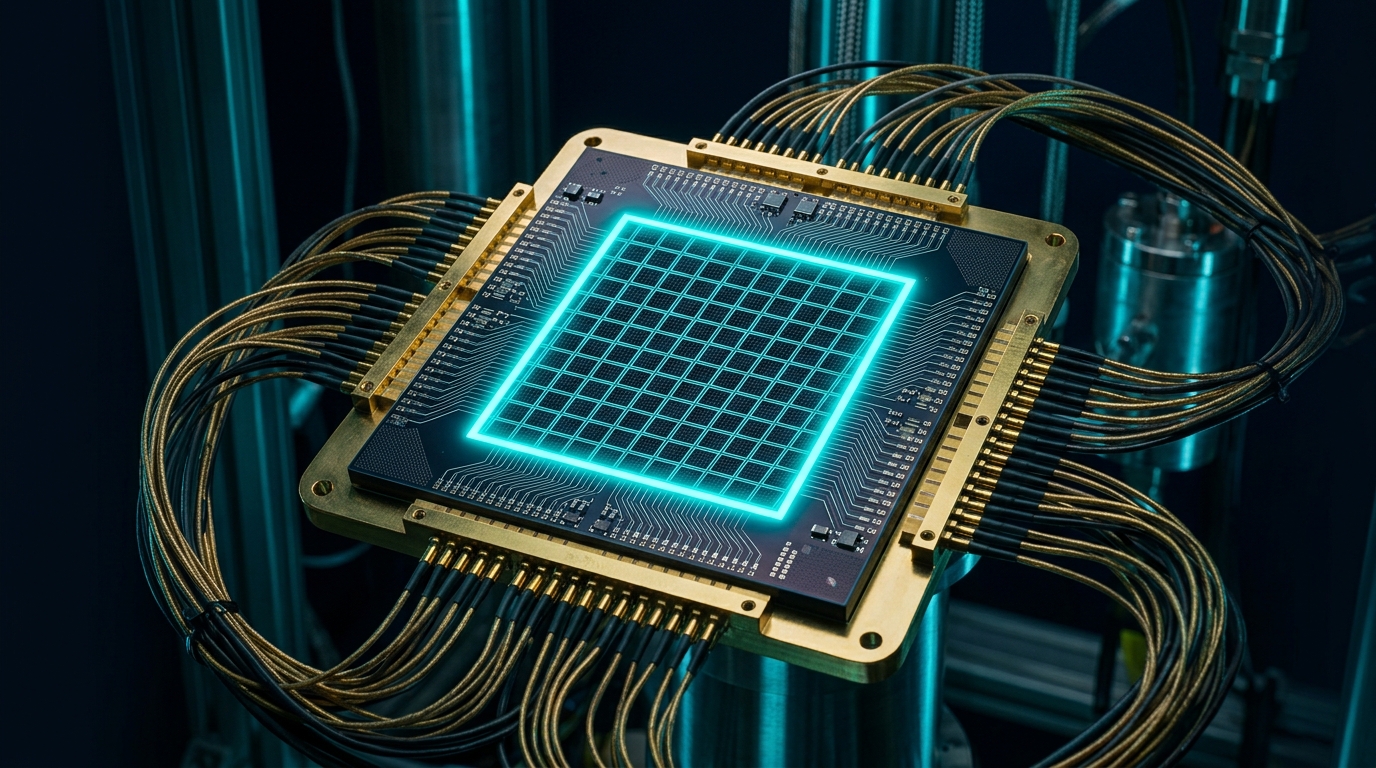
The broader quantum computing landscape in 2026 makes this more than a philosophy-of-science argument. IBM, Google, and others have demonstrated repeated rounds of quantum error correction on superconducting qubits. Surface code logical qubits are the dominant architecture for fault tolerant quantum computing. Those demonstrations depend on a repetitive loop: unitary stabilizer measurements extract syndrome data, then classical logic decides whether to apply a correction. The boundary between unitary evolution and measurement is not a philosophical detail in that loop; it is an operational choice that affects whether a logical qubit is being protected or accidentally projected. The dissertation's criterion bears directly on that choice.
From Lab to Reality
For scientists, the dissertation offers a conceptual tool to distinguish when a stabilizer readout in a surface code should be modeled as a measurement that updates the logical qubit state, and when it should be modeled as a unitary entangling operation. That distinction matters for designing fault tolerant quantum computing protocols because treating a unitary step as a measurement can introduce logical errors. For engineers, the criterion could eventually inform control software for logical qubit processors, deciding at run time whether a syndrome extraction is a legitimate measurement or a unitary continuation. This is a necessary ingredient for autonomous quantum error correction stacks that do not require a human physicist to declare the measurement context by fiat.
For investors, the affected market is not a standalone "quantum error correction product" but the fault tolerant quantum computing market. Industry trackers estimated the overall quantum computing market at roughly $1.3 billion in 2024, with fault tolerance as the main bottleneck to commercial usefulness. The quantum error correction segment, embedded in hardware and software contracts, is projected to grow into the low billions by the early 2030s as logical qubit demonstrations mature. The dissertation's framework is foundational rather than immediately productizable; its economic impact would flow through better protocol design, error modeling, and control software if it becomes operational.
What Still Needs to Happen
The first challenge is operationalization. The dissertation defines a probability of instantiability, but translating that into a measurement protocol for a real quantum processor requires an independent way to estimate the probability from experimental data. No such estimator exists yet. The second challenge is empirical differentiation. The framework must show that its Born-rule boundary makes distinct predictions from standard quantum mechanics in a regime that near-term devices can access; otherwise it remains a formal clarification rather than a testable physical theory. Groups at Google Quantum AI, IBM Quantum, Delft University of Technology, and the University of Innsbruck are building the fault tolerant qubit platforms and repeated error correction demonstrations where such tests could eventually run. This is not a two-year milestone. If the framework survives conceptual scrutiny, experimental tests are probably a decade or more away because they require high-quality logical qubits and sub-threshold error correction.
Conclusion
The dissertation changes the conversation by making epistemic constraints primitive and asking what follows when they are combined with quantum mechanics. It does not solve the measurement problem in the traditional way; it supplies a criterion for the boundary between unitary evolution and Born-rule sampling. That boundary sits at the heart of quantum error correction, because every syndrome extraction in a fault tolerant logical qubit is a choice about what counts as a measurement. When the field can make that choice formally rather than by convention, fault tolerant quantum computing protocols will be cleaner to design and harder to misinterpret.
In short: quantum error correction depends on a principled boundary between unitary evolution and Born-rule measurement, and this dissertation supplies a formal probability for that boundary.