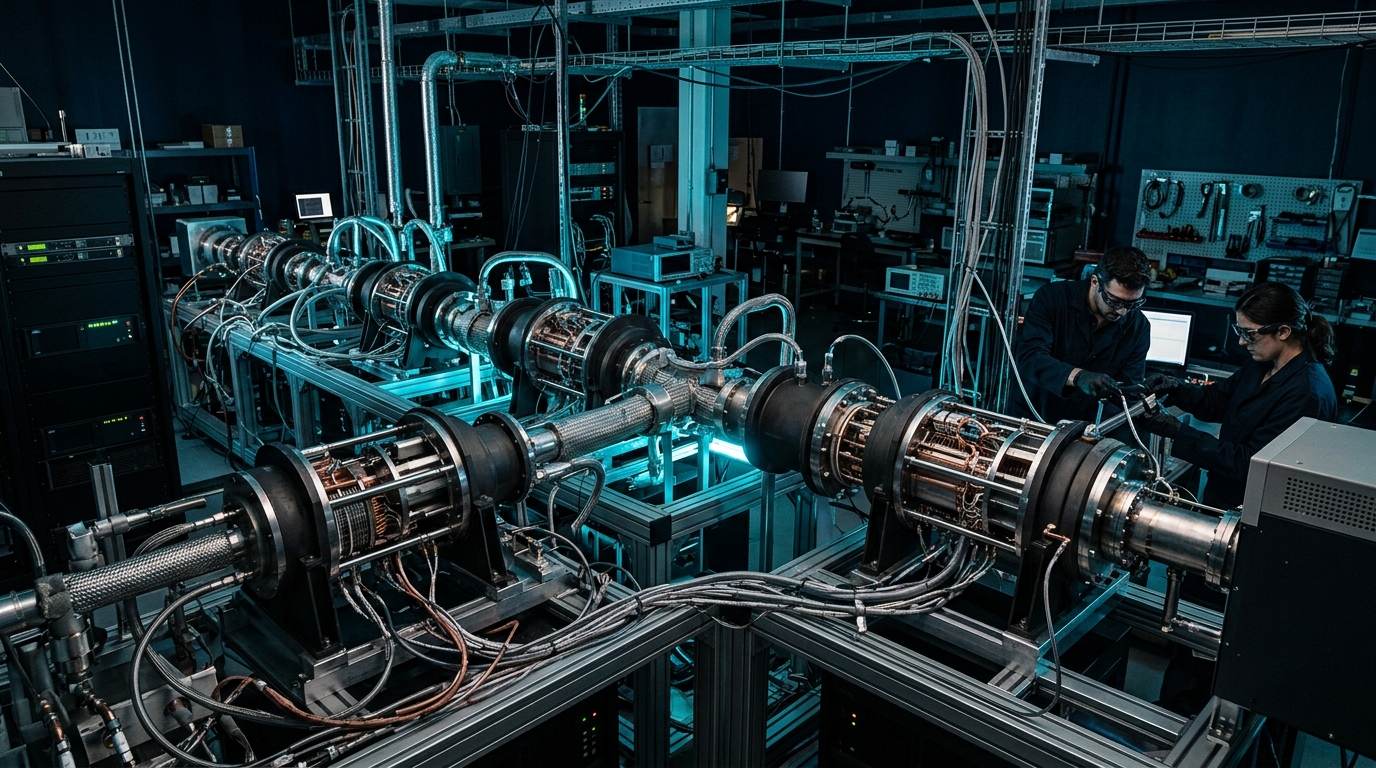
IBM has linked and cooled two modular cryogenic cell prototypes at its Poughkeepsie, New York quantum facility, the company announced August 19, 2026. The hardware milestone feeds directly into IBM Quantum Starling, the fault-tolerant superconducting quantum system IBM has scheduled for 2029. IBM did not disclose qubit counts, gate fidelities, or logical error rates tied to the linked cells.
The announcement is an engineering result, not a scientific breakthrough. Two connected cryostats reaching cooldown proves mechanical and thermal integration. It does not prove that quantum information can move between chips with high fidelity.
What They're Actually Building
IBM builds superconducting transmon qubits that operate at roughly 15 millikelvin inside dilution refrigerators. The modular cryogenic cell program targets a basic constraint: a single dilution fridge cannot house enough physical qubits and control wiring to reach fault-tolerant quantum computing. Linking multiple cells is an attempt to scale modular, multi-chip quantum architectures instead of building one enormous refrigerator.
The exact interconnect design was not disclosed. IBM said the two prototype cells were joined and cooled in Poughkeepsie, completing a key cooldown test. In a modular architecture, separate cryostats must share vacuum, thermal anchors, and control signals without adding heat load or electromagnetic noise. Those are hard systems-engineering problems, but they are distinct from qubit quality problems.
IBM's published roadmap places Starling in 2029 as the fault-tolerant engineering target after the Heron family. IBM previously demonstrated 127-qubit Eagle in 2021, 433-qubit Osprey in 2022, 1,121-qubit Condor in 2023, and 133-qubit Heron with improved gate performance. The longer-range target is 100,000 qubits by 2033, per IBM's public roadmap. Modular cryogenic cells sit between current Heron-class systems and Starling.
For comparison, Google Quantum AI's Willow processor demonstrated below-threshold quantum error correction on a 105-qubit superconducting chip in December 2024. Quantinuum's trapped-ion systems have shown high-fidelity logical qubits using QCCD. IBM's announcement is about infrastructure: the equivalent of proving a server rack can hold multiple servers, not proving the processors work.
Winners and Losers
IBM is the direct winner. The company now has test hardware for a modular superconducting architecture, which de-risks the Starling roadmap. Investors and enterprise customers get a concrete indicator that IBM is working on the physical packaging needed for 2029, rather than only publishing qubit roadmaps.
Cryogenic hardware suppliers and control electronics vendors also benefit. Companies that build dilution refrigerators, high-density cabling, and cryo-CMOS components gain if modular cryostat cells become standard. This includes firms like Bluefors and Oxford Instruments on the commercial side, as well as IBM's internal supply chain.
Competing superconducting qubit builders face higher hardware expectations. Google Quantum AI remains farther ahead on logical error correction, but its public modular cryostat story is less specific. Rigetti must show a comparable packaging path for its superconducting systems. IonQ, Quantinuum, and PsiQuantum use trapped-ion or photonic architectures that do not face the same dilution refrigerator constraints, which insulates them somewhat from this particular milestone.
For the software and cloud market, the effect is indirect. IBM's Qiskit ecosystem and IBM Quantum Network benefit from a credible long-term hardware story, but near-term enterprise quantum revenue is unlikely to move. The investment moat is in systems integration, not in a new quantum capability that produces revenue in 2026.
The Bigger Picture
In 2026, the quantum computing industry is split between two challenges: achieving useful logical error correction and building modular hardware that can scale. IBM's linked cryogenic cells address the second challenge. The announcement follows a pattern of hardware vendors showing physical packaging progress before they show fault-tolerant calculations.
Government support remains a relevant backdrop. The U.S. National Quantum Initiative and the CHIPS and Science Act have funded quantum hardware infrastructure, while the EU Quantum Flagship continues to push sovereign quantum stacks. IBM's Poughkeepsie facility is one of the few corporate sites where this kind of cryogenic integration can be tested at scale.
Recent comparable milestones set the calibration. Google's Willow result in late 2024 established the error-correction state of the art. Quantinuum has repeatedly published logical qubit experiments with trapped ions. PsiQuantum has raised large sums to build modular photonic systems. IBM's two-cell cooldown is less scientifically flashy but addresses the same scaling problem from the hardware side.
The Signal
The signal here is that IBM is treating modularity as a production engineering problem, not a future option. Linking two cryogenic cells and cooling them is necessary plumbing for a multi-chip Starling system. The specific milestone that would validate this claim is a multi-chip quantum circuit executed across linked cells with two-qubit gate fidelity high enough for error correction below threshold.
What this reveals is that IBM's 2029 target is becoming a hardware integration timeline, not just a qubit-count projection. That is a meaningful distinction for technical investors and CTOs. But the result is incremental: no one should describe it as fault tolerance.
In short: IBM modular cryogenic cells are now linked and cooled—necessary plumbing for the 2029 Starling fault-tolerant target, not yet quantum error correction.
The milestone is real, incremental, and essential. Enterprise technology buyers should track it as hardware readiness, not as a trigger to move quantum workloads into production.