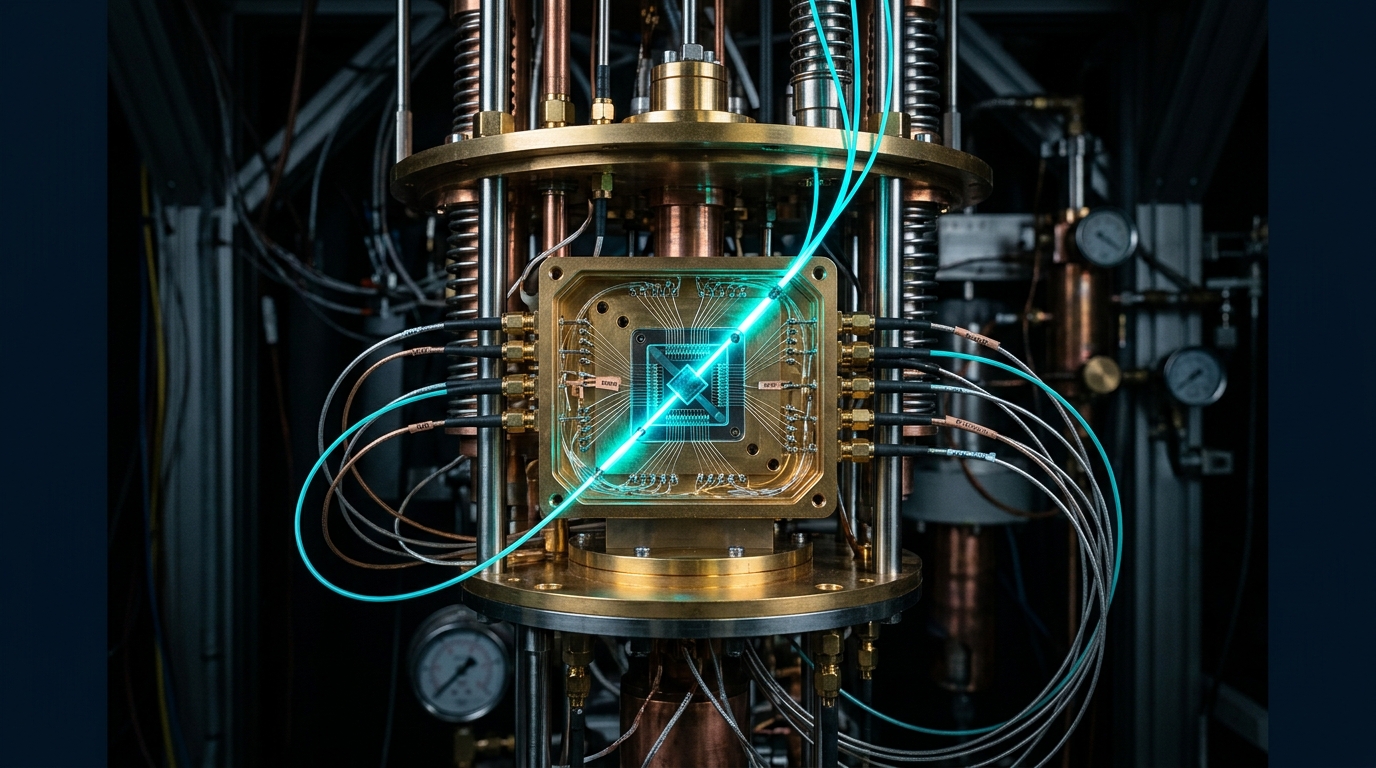
The most destructive defects in a diamond quantum processor are the ones that hide inside the spectral line of another defect. A substitutional hydrogen defect can sit almost exactly where a vacancy signal appears, stealing coherence before gate fidelity measurements expose the problem. That finding, reported in an August 2026 preprint, lands at the same moment an algorithm designer asks how to read a qubit's Bloch vector in O(1) time without collapsing it. Both signals describe the same wall: the spin bath is now the limiting layer of the quantum chip.
The connection is not superficial. A materials team uses double electron-electron resonance spectroscopy—DEER—to track paramagnetic defects in CVD diamond after electron irradiation and annealing. A separate Quantum Computing StackExchange thread asks how to formalize an oracle for the Abrams-Lloyd algorithm that reads a qubit's Bloch vector through state tomography. This matters because both efforts are trying to solve the same operational problem: extracting information from a single qubit while the environment constantly perturbs it. The timing is not coincidental. As qubit counts rise, the coherence time of each qubit becomes the currency that decides whether any algorithm, nonlinear or otherwise, ever runs on a quantum processor.
How It Works
The arXiv preprint, posted on August 18, 2026 under DOI 10.1002/adfm.202532037, uses nitrogen-vacancy centers in diamond as nanoscale probes. Double electron-electron resonance spectroscopy measures the magnetic dipole-dipole coupling between an NV center and nearby electron spins. Those nearby spins—the spin bath—rub against the NV qubit and destroy its phase coherence. The group, whose author metadata is not included in the abstract, tracks a composite S=1/2 signal called the X ensemble after electron irradiation. Electron irradiation knocks carbon atoms off lattice sites, creating vacancies and interstitials. That is the starting population for the spin bath.
Annealing the diamond from 650°C to 1200°C changes the defect population. Initially, the X ensemble contains a mixture of V− vacancies and interstitial spins. Those disappear around 650°C. Vacancies then migrate, form clusters that persist to 1000°C, and vanish only after 1200°C annealing. The paper also resolves two hydrogen-related S=1/2 species: NVH− and a substitutional hydrogen defect that overlaps the vacancy line. CVD diamond grows in a hydrogen-rich plasma, so hydrogen incorporation is expected; the DEER data make it visible. In the authors' words,
“the crystals reach the quality required for advanced quantum sensing applications.”
Think of the spin bath as a room full of competing radio transmitters while a single qubit tries to hold one frequency. DEER spectroscopy identifies which transmitters are closest and which frequencies they use. The result is a fabrication protocol that maps, anneals, and verifies the magnetic environment before a quantum processor is built. The model includes independent couplings from P1 centers, V− vacancies, divacancies, and interstitials, which lets fabricators adjust annealing schedules instead of guessing.
Who's Moving
The preprint names no corporate partner and no funding amount. But the techniques sit inside a well-populated field. Jörg Wrachtrup at University of Stuttgart pioneered single-spin detection in diamond. Ronald Hanson at TU Delft has used NV centers for entanglement at distance. Mikhail Lukin at Harvard has pushed diamond-based quantum systems toward networks. These researchers are not listed as authors of the August 2026 paper, but their prior work forms the methodological spine.
On the processor side, IBM (NYSE: IBM) still holds the public superconducting qubit record with its 1,121-qubit Condor quantum chip, unveiled in December 2023. That qubit count makes spin-bath defects across the die a first-order problem. Alphabet's Google (NASDAQ: GOOGL) drives the contrasting approach with its 105-qubit Willow quantum chip, which demonstrated below-threshold surface code error correction in December 2024. Neither company uses diamond NV centers as its main platform, but both now compete against the same physics: coherence time, gate fidelity, and the cryogenic environment inside a dilution refrigerator.
Element Six, the synthetic diamond manufacturer owned by De Beers Group, supplies high-purity CVD diamond to several quantum sensing groups. Its material appears in many peer-reviewed spin bath studies, though the August 2026 preprint does not specify the diamond source. The absence of a named supplier is itself notable: spin bath quality is becoming a procurement specification.
Why 2026 Is Different
In the next 12 months, DEER-optimized CVD diamond will move from preprint to pilot-line material qualification. Within three years, spin-bath mapping should become a standard step before dicing a quantum chip, much as defect metrology already is for silicon. By 2031, the qubit count on a quantum processor will be meaningless unless each qubit's coherence time survives contact with a verified, annealed spin bath.
The shift is concrete because the defect physics now has a route to elimination. The preprint's model includes independent couplings from P1 centers, V− vacancies, divacancies, and interstitials. That model, built from DEER spectra, lets fabricators adjust annealing schedules instead of guessing. The measurement side still lags: the Abrams-Lloyd question remains open because state tomography in O(1) time assumes an oracle that standard quantum mechanics does not provide.
No single market size figure accompanies these two sources. But the material pathway matters more than a revenue number: high-T2 diamond already meets advanced sensing requirements, and the same spin bath metrology transfers to other solid-state qubit platforms. The next quantum processor generation will be judged by defect maps, not just by qubit count.
The Measurement Gap
The Abrams-Lloyd algorithm, also called the nonlinear quantum search algorithm, assumes an oracle can extract exact amplitude information from a 1-qubit system in O(1) time without collapsing the state. A StackExchange user on August 18, 2026 asks how to formalize that oracle through state tomography. The question cuts to the same problem the DEER paper attacks from the physical side: you cannot interrogate a qubit without disturbing the spin bath around it.
Standard state tomography works by repeated measurements and statistical inference. That is not O(1) for exact amplitude extraction, and it collapses the state. The asked-for oracle sits outside linear quantum mechanics. High-coherence diamond removes some environmental noise, but it does not resolve the formal gap. Any usable quantum processor must eventually reconcile the physical spin bath with the logical oracle abstraction.
In short: a quantum processor only reaches high T2 coherence after its spin bath is mapped, annealed, and verified at the nanoscale.