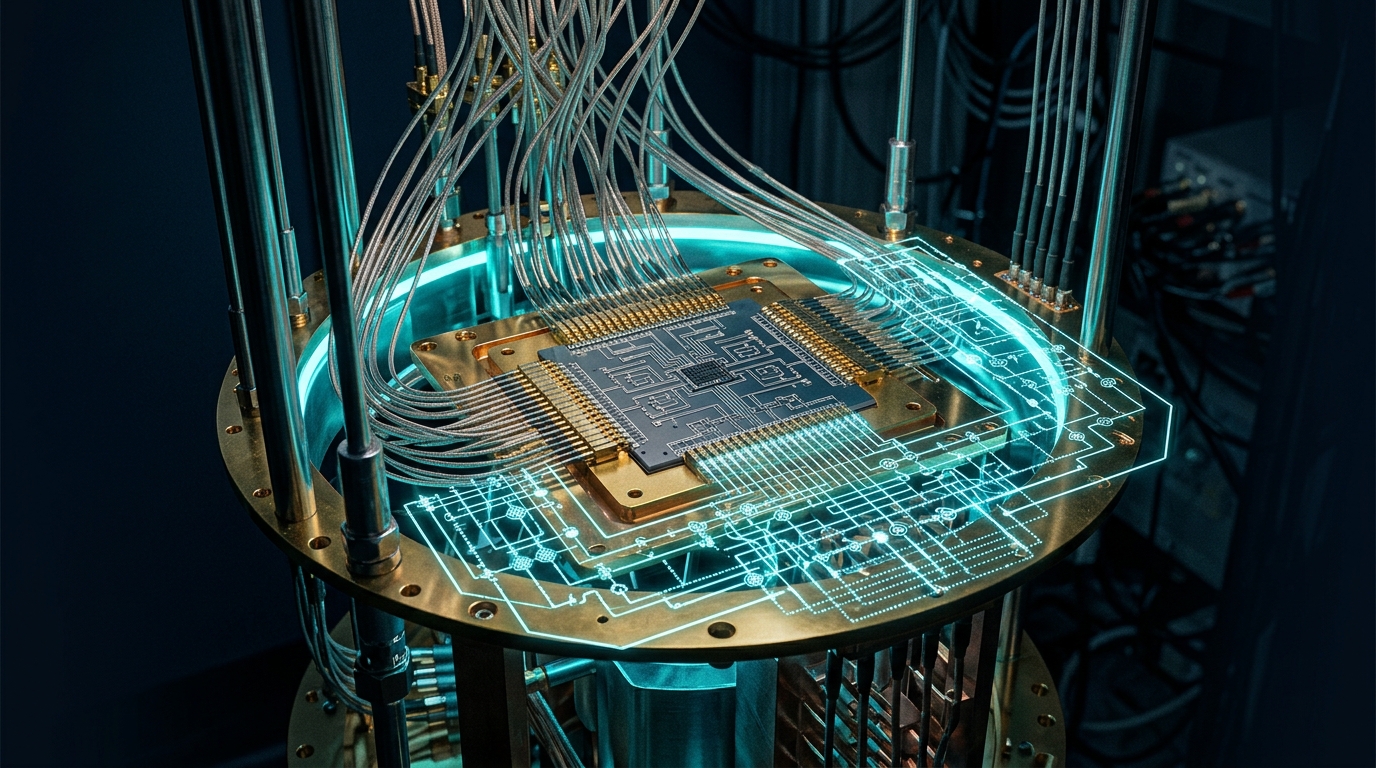
Quantum error correction consumes the computational budget of a fault-tolerant machine before a single logical gate executes. That is not conjecture; it is visible in the control stacks of every 2026-era superconducting and trapped-ion processor. On 18 August 2026, an arXiv preprint on satellite-assisted urban air mobility scheduling, of all things, laid out a geometry-aware reinforcement learning method that maps directly onto this bottleneck. A separate Quantum Computing StackExchange thread asked how to formalize an oracle that reads a Bloch vector in O(1) time without collapsing the system. Both signals point to the same hard problem: extracting information from a fragile physical system without destroying the encoded answer.
The two sources are not from the same field, but they collide on scheduling. The arXiv preprint ([arXiv:2608.17612]), “Geometry-Aware DRL for Multi-Subband Scheduling in Satellite-Assisted UAM Networks,” proposes GeoSetPPO, a permutation-invariant set-attention PPO agent that assigns base stations, subbands, and powers to fast-moving drones. The StackExchange question asks how an Abrams-Lloyd oracle can read a qubit’s Bloch vector in O(1) time without collapsing it. This matters because quantum error correction requires exactly that operation: a syndrome measurement reads partial information about a qubit without revealing or destroying the logical state. The timing is not coincidental. Fault-tolerant quantum computing has moved from physics demonstrations to real-time resource allocation, and the control electronics now need schedulers that can handle combinatorial decisions under latency budgets measured in microseconds.
How It Works
Quantum error correction encodes one logical qubit into many physical qubits and performs repeated parity checks called syndrome measurement rounds. Peter Shor at MIT laid the foundation in 1995 with the first quantum error-correcting code; John Preskill at Caltech later framed the field around fault-tolerant quantum computing. A surface code patch, for example, uses data qubits for encoding and ancilla qubits to detect errors. Each syndrome round produces a graph of correlated error events. A decoder must interpret that graph and decide which qubits to reset or track, all before decoherence destroys the logical state.
The StackExchange question is not an isolated curiosity. It grapples with a non-demolition amplitude readout: an oracle that reads the Bloch vector of a 1-qubit system through state tomography in O(1) time. In standard quantum mechanics, tomography requires an ensemble of identical states, so the request is not physical as stated. But the need it expresses is real. Quantum error correction satisfies that need through syndrome measurement: partial, non-demolition readout that extracts error information without revealing the logical qubit state.
The GeoSetPPO preprint attacks an analogous combinatorial problem in the classical domain. Ground stations steer narrow three-dimensional beams across shared subbands while a satellite offers an orthogonal-band fallback. The scheduler must choose base station association, subband assignment, and transmit powers for many moving vehicles. The paper’s abstract states:
multiple ground stations (GSs) employ narrow three-dimensional beams and share spectrum across multiple subbands.The method uses set attention to make permutation-invariant decisions, then a per-slot successive convex approximation module resolves continuous power allocation.
That two-stage structure matters. In quantum error correction, a similar split exists between discrete syndrome scheduling and continuous physical calibration. A surface code decoder must decide which ancillas to measure, which qubits to flag, and how to route measurement results through a real-time controller. The GeoSetPPO approach shows that set-based representations outperform MLP- and Transformer-based PPO on exactly the kind of combinatorial scheduling problem that emerges in large surface code arrays. In the larger evaluated network, GeoSetPPO reduced scheduling latency from 40.84 ms to 2.90 ms relative to the previous algorithm-based method. The same permutation-invariant logic applies to ancilla scheduling, layer synchronization, and Topological Qubit error graph matching.
The GeoSetPPO agent uses two-stage training: it first evaluates rewards under uniform power, then under SCA-based power allocation. That strategy reduces training cost and improves stability. For a quantum error correction decoder, the same two-stage idea maps to training on simple parity-check simulators before transferring to hardware-calibrated qubit fidelity models.
Who’s Moving
International Business Machines Corporation (NYSE: IBM) ships the 1,121-qubit Condor processor and continues to invest in its IBM Quantum System Two architecture, which pairs superconducting qubits with classical control. Alphabet Inc. (NASDAQ: GOOGL), through Google Quantum AI, demonstrated below-threshold performance with its 105-qubit Willow processor in December 2024 and has published surface code results that set the current qubit fidelity benchmark. Quantinuum, the Honeywell Quantum Solutions and Cambridge Quantum Computing merger, demonstrated logical qubits on its H2 trapped-ion device and raised $300 million in 2024 at a $5 billion valuation from JPMorgan Chase, Mitsui, and Amgen. Microsoft Corporation (NASDAQ: MSFT) continues to pursue topological qubits as a lower-overhead alternative.
Startups are moving into the scheduling gap. Riverlane, based in Cambridge, United Kingdom, raised $75 million in Series C funding in 2024 to commercialize its Deltaflow quantum error correction decoder. Quantum Machines, based in Tel Aviv, supplies real-time quantum control electronics that already handle syndrome measurement cycles for superconducting and trapped-ion systems.
The reason these companies care about a drone scheduling preprint is simple: the decoder is now the bottleneck. A large surface code controller must process syndrome measurements from thousands of ancilla qubits in microseconds. IBM’s Condor processor, Google’s Willow processor, and Quantinuum’s H2 device all generate error data faster than current software decoders can consume.
On the academic side, Barbara Terhal at QuTech and Daniel Lidar at the University of Southern California continue to refine surface code decoders. The GeoSetPPO preprint itself does not list individual authors in its metadata, but its scheduling primitives are the same primitives a fault-tolerant control stack must execute.
Why 2026 Is Different
By August 2027, real-time syndrome scheduling will move from FPGA prototypes into vendor control stacks. The next 12 months are about closing the loop between decoders and qubit reset pulses without software intervention. By 2029, logical qubit arrays will exceed 100 logical qubits, and the scheduling latency budget will drop below 10 microseconds per syndrome round. By 2031, fault-tolerant quantum computers will run thousands of surface code cycles per hour, and the difference between a good scheduler and a poor one will be measured in logical error rates per million operations. McKinsey & Company’s 2023 Quantum Technology Monitor projected $106 billion in quantum computing value by 2040; the control and scheduling layer is the silent gatekeeper for that market.
Five years out, the market rewards will go to companies that treat quantum error correction as a logistics problem, not a physics problem. The GeoSetPPO latency reduction from 40.84 ms to 2.90 ms shows that learned schedulers can compress combinatorial search below the timescales that matter for real-time control. In a surface code machine, the equivalent compression moves syndrome processing from FPGA offload to on-chip real-time, unlocking larger logical qubit arrays.
Conclusion
In short: quantum error correction has become a real-time combinatorial scheduling problem, and geometry-aware set attention from satellite networks gives the clearest 2026 blueprint for solving it. The systems that schedule syndrome measurements fastest will be the systems that reach fault-tolerant operation first.
Frequently Asked Questions
What is quantum error correction? Quantum error correction is a set of encoding and measurement protocols that protect a logical qubit from decoherence and control noise. It spreads one logical qubit across many physical qubits and uses syndrome measurement to detect errors without reading the logical state. The most common implementation is the surface code, which arranges qubits on a two-dimensional lattice. IBM, Google Quantum AI, and Quantinuum all use quantum error correction to build fault-tolerant machines.
How does quantum error correction compare to classical error correction? Classical error correction uses redundancy and majority voting on copied bits. Quantum error correction cannot copy qubits because of the no-cloning theorem, so it measures parity checks that reveal error syndromes without collapsing the logical qubit. The overhead is much higher: a fault-tolerant logical qubit requires hundreds or thousands of physical qubits. Classical ECC typically adds only a few extra bits.
When will quantum error correction be commercially available? The core techniques already operate in research processors from Google Quantum AI and Quantinuum. Commercially useful fault-tolerant systems will arrive between 2029 and 2031, when logical qubit arrays exceed 100 logical qubits and error rates drop below one per million operations. In 2026, vendors are integrating real-time decoders into control stacks.
Which companies are leading in quantum error correction? International Business Machines Corporation, Alphabet/Google Quantum AI, and Quantinuum lead in superconducting and trapped-ion demonstrations. Microsoft Corporation pursues topological qubits as an alternative. IBM’s Condor processor, Google’s Willow processor, and Quantinuum’s H2 device are the 2026 reference systems.
What are the biggest obstacles to quantum error correction adoption? The main obstacles are physical qubit overhead, qubit fidelity, decoder latency, and syndrome measurement speed. Control electronics must compute corrections in microseconds while keeping qubits coherent. Surface code thresholds require per-gate error rates below 1 percent, and current best devices operate just under that boundary.