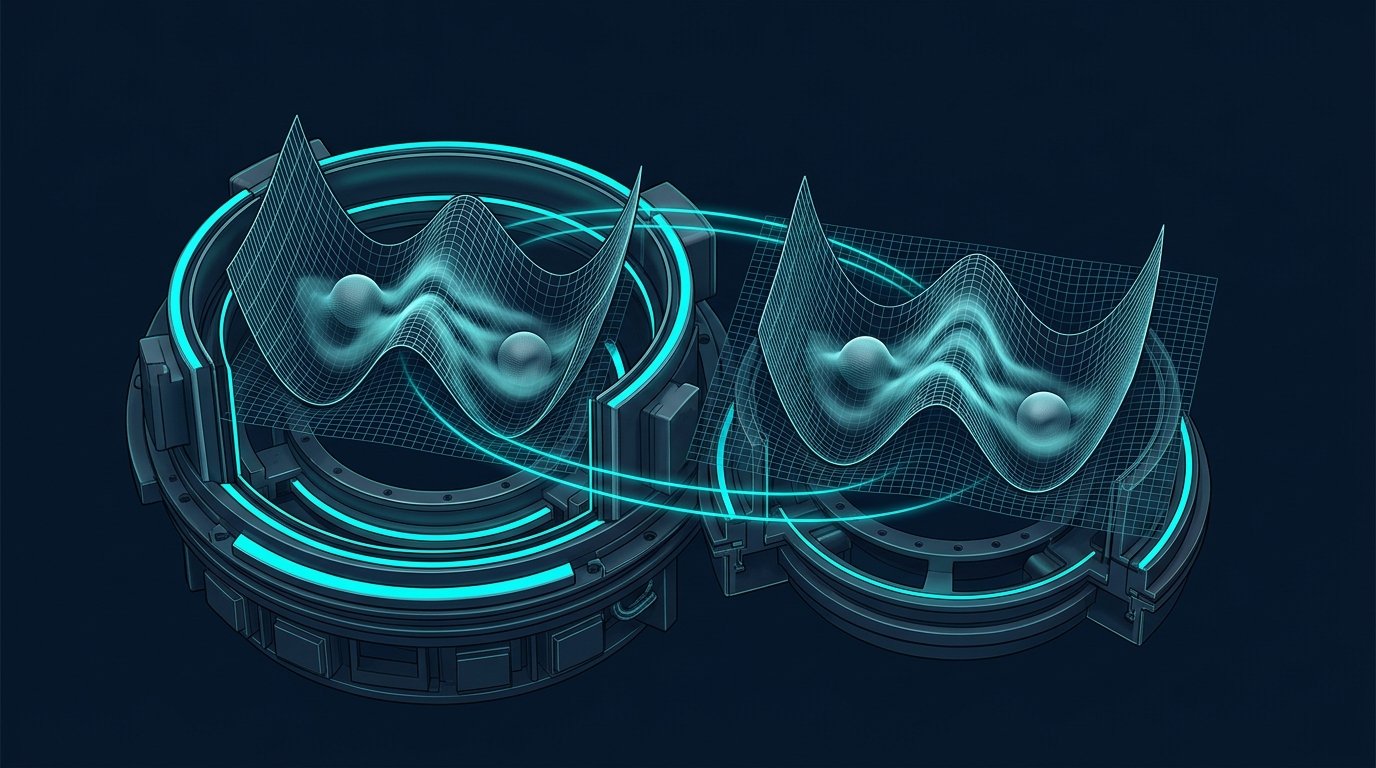
Gravity itself can generate quantum correlations between two massive particles, no electromagnetic interaction required. An arXiv preprint posted on August 13, 2026 quantifies how those correlations distribute into collective and localized coherence inside two gravitational cat states. For quantum error correction, that distribution determines how much usable entanglement remains when thermal noise and decoherence arrive. [arXiv:2608.13493]
This matters because Quantum Teleportation, as The Quantum Insider explained on August 14, 2026, is not Star Trek matter transfer. The protocol transfers a quantum state—spin, polarization, or energy level—from one carrier to another using pre-shared entanglement and a classical channel. The arXiv preprint measures the same resource that teleportation consumes: non-classical correlations and basis-independent coherence. The timing is not coincidental. The quantum computing industry shifted from physical qubit counts to logical qubits, making coherence accounting the new bottleneck.
Quantum Teleportation Is Entanglement Management
The Quantum Insider’s explainer on August 14, 2026 makes the distinction plain: teleportation moves quantum state, not matter. The sender holds one member of an entangled pair; the receiver holds the other. A Bell-state measurement on the sender’s side destroys the original state and produces two classical bits. Those bits tell the receiver how to rotate the entangled partner so it becomes the exact original quantum state. The process consumes one entangled pair per teleported qubit state.
That consumption is why coherence and entanglement are finite resources. Quantum error correction is the accounting system that tracks those resources. The new preprint gives a basis-independent way to measure coherence in gravity-entangled systems, which means the metric stays valid no matter what local basis the qubits are measured in.
How It Works
The preprint studies two massive particles confined in a double-well potential and coupled through their mutual Newtonian gravitational interaction. Each particle sits in a superposition of left and right wells. When both particles are superposed, gravity can entangle them, producing two gravitational cat states. An analogy: two tuning forks mounted on a shared beam transfer vibrations without touching; gravity plays the beam that couples the two masses.
The authors quantify entanglement with Bures distance and quantum discord, the latter capturing non-classical correlations beyond entanglement. For coherence, they use the square root of the quantum Jensen–Shannon divergence from the maximally mixed state. That measure is invariant under arbitrary unitary transformations, so it is genuinely basis-independent. The total coherence C_T splits into collective coherence C_C, which tracks correlations between the two subsystems, and localized coherence C_L, the intrinsic coherence inside each particle.
"C_L is more robust against thermal fluctuations than C_C"
Temperature T, gravitational coupling Δ, and the single-particle energy scale w govern the coherence distribution. Increasing Δ strengthens collective coherence because gravitational coupling boosts inter-particle correlations. Raising T degrades collective coherence faster than localized coherence. The result is a redistribution, not a simple loss: total coherence C_T moves between two operational budgets. That distinction matters for quantum error correction because logical qubits must budget coherence between local gates and entangling stabilizer measurements.
The paper finds that increasing the gravitational coupling parameter Δ preferentially enhances collective coherence by strengthening gravitationally induced inter-particle correlations. The arXiv posting does not list author names or institutional metadata, which is unusual. The gravitational-entanglement protocol underpinning the work traces to independent 2017 proposals by Sougato Bose at University College London, and Chiara Marletto and Vlatko Vedral at the University of Oxford. The paper itself does not mention quantum error correction explicitly; it is a coherence-distribution study whose metric has immediate consequences for fault tolerant quantum computing.
Quantum Error Correction Payoff
Quantum error correction encodes a logical qubit across many physical qubits. Surface code architectures detect errors through repeated syndrome measurement, then correct them with classical control. Each stabilizer measurement consumes entanglement between data qubits and ancilla qubits. If the input state has low qubit fidelity or asymmetric decoherence, the logical error rate climbs even when physical gate fidelity stays constant.
The gravitational cat state result matters because it separates two error correction resources. Localized coherence C_L supports high-fidelity single-qubit gates. Collective coherence C_C supports entangling gates and stabilizer checks. A system that loses one while retaining the other still fails. The August 13 metric provides a direct measurement of both budgets in a gravity-coupled system, which has not been done with a basis-independent coherence measure before.
Who's Moving
No company sells gravitational cat state hardware. The work is upstream, but it lands in a competitive quantum error correction field. IBM (NYSE: IBM) operates the 1,121-qubit Condor superconducting processor and centers its roadmap on fault tolerant quantum computing through IBM Quantum System Two. Alphabet (NASDAQ: GOOGL) owns Google Quantum AI, whose 105-qubit Willow processor demonstrated below-threshold Surface Code error suppression in December 2024. Google DeepMind’s AlphaQubit decoder performs syndrome measurement decoding at scale.
Quantinuum, a private trapped-ion company, operates the H2 processor, which offers 32 fully connected physical qubits. The company has demonstrated logical qubit error correction with reduced overhead. Quantinuum raised a $300 million equity round in January 2024 to accelerate fault-tolerant hardware. Jay Gambetta at IBM Quantum and the broader superconducting qubit ecosystem now treat logical qubit count and error rate, not raw physical qubit count, as the industry’s scoreboard.
Competing platforms include trapped ions, superconducting circuits, neutral atoms, photonic fusion, and emerging Topological Qubits. The gravitational cat state work adds a measurement framework that crosses all platforms because it isolates basis-independent coherence, a resource every physical qubit type loses to decoherence.
Why 2026 Is Different
In 2026, the quantum industry no longer competes on raw qubit numbers. Within 12 months, IBM and Google run multi-logical-qubit circuits on surface code architectures. Within three years, quantum processors teleport logical qubit states between separate systems as a standard interconnect operation. Within five years, fault tolerant quantum computing reaches commercial workloads in chemistry and materials. McKinsey & Company’s quantum economics model projects $1.3 trillion in value by 2035.
The gravitational cat state paper adds a new variable. Gravity generates collective coherence through Newtonian coupling, giving error correction engineers a design axis distinct from electromagnetic gates. The basis-independent metric also gives quantum teleportation networks a tool to certify entangled resources before transmission. That moves coherence from a secondary property to a first-class engineering parameter in quantum error correction.
Quantum teleportation and quantum error correction are the same physics. Both require protecting quantum states from decoherence long enough to act on them. The August 13 gravitational cat state preprint supplies a basis-independent accounting system for coherence, while the August 14 teleportation explainer reaches a wider audience. The two signals form a single message: the race is now for fault-tolerant logical qubits, not physical qubit count.
In short: quantum error correction gains a gravitational coherence benchmark in two gravitational cat states; increasing Δ strengthens collective entanglement while localized coherence survives thermal noise.