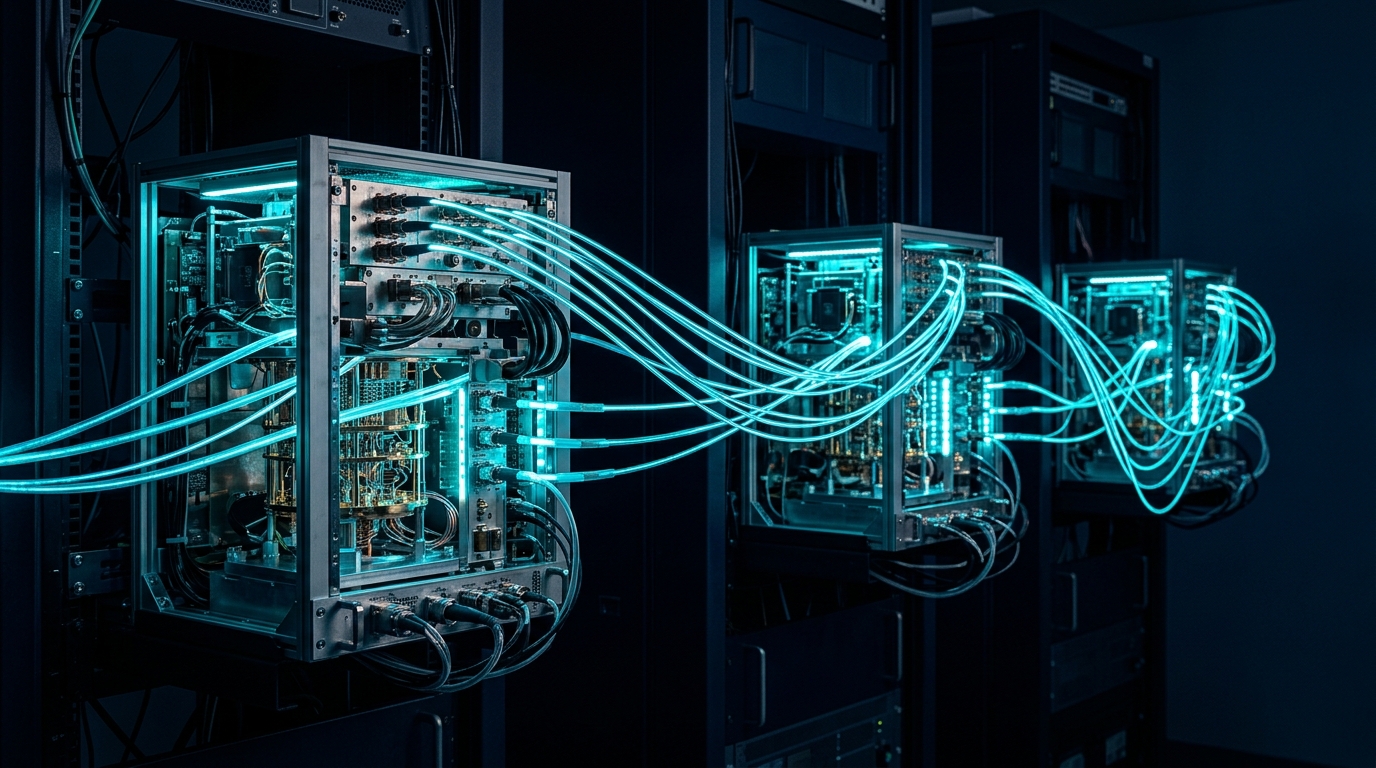
The fastest route to fault-tolerant quantum computing runs through many small processors linked together, not one enormous chip. Quantum error correction no longer hinges on squeezing another percentage point from single-qubit fidelity; it hinges on suppressing the cost of operations that cross from one module to another. A synthesis preprint dated 13 August 2026 puts a precise asymptotic price on that cost: O(nk) inter-block transversal CNOTs for n logical qubits in k blocks. A second result from the same day shows why a similar cost calculus now reaches photonic platforms, where lossy interferometers need exact gradient rules.
The two results are not from the same hardware ecosystem. One targets distributed gate-based quantum computers; the other targets Fock boson sampling. This matters because both address the same quantum error correction bottleneck: non-local and lossy operations dominate the error budget once logical qubits become the unit of computation. The timing is not coincidental: in 2026, fault tolerant quantum computing has crossed from single-chip demonstrations to multi-module engineering, and compilation tools for restricted connectivity are now the limiting factor.
How It Works
The distributed synthesis work, posted to arXiv as [arXiv:2608.13543], formalizes a compiler for Clifford circuits under arbitrary restrictions on both local and non-local connectivity. The authors, whose names are not listed in the preprint metadata, use block-matrix Gaussian elimination to reduce a distributed CNOT or Clifford circuit to a form that minimizes non-local gates. The abstract states the core claim in one line:
"We give an asymptotically optimal synthesis method for distributed CNOT and Clifford circuits, based on block-matrix Gaussian elimination."
Clifford circuits are the workhorse of fault-tolerant quantum computing because they can be simulated classically and form the backbone of stabilizer codes. But the phrase "Clifford only" hides a real constraint: each non-local gate in a distributed architecture consumes shared entanglement or a physical inter-module channel. The synthesis method treats both local and non-local connectivity as arbitrary restrictions, which means it applies to block codes, network topologies, and distributed quantum processors alike.
That method then extends to Clifford+RZ circuits by generalizing the Pauli exponential circuit representation, which lets the compiler integrate with existing T-count optimization passes. Think of the compiler as a logistics optimizer: it reorders quantum operations so that the most expensive shipments across chip boundaries happen only when mathematically unavoidable.
The application matters because CSS codes — Calderbank-Shor-Steane codes, the family that includes the Surface Code surface code — separate parity checks into X and Z types. The authors encode n logical qubits in k code blocks and implement CNOT circuits using O(nk) inter-block transversal CNOTs plus intra-block Pauli measurements. Transversal gates act qubit-wise across blocks, so no physical operation reaches beyond the block's immediate partner. That preserves fault tolerance while keeping the non-local overhead bounded.
The result is not just another compiler pass. It is an asymptotic statement: for n logical qubits in k blocks, O(nk) inter-block transversal CNOTs suffice. That scaling matters because it prevents non-local overhead from multiplying faster than the logical qubit count. It also integrates with T-count optimization, which reduces the most expensive non-Clifford gates in a fault-tolerant circuit.
The surface code is the leading quantum error correction architecture because it tolerates high physical error rates and uses only nearest-neighbor checks. Surface code syndrome measurement extracts X and Z parity information without collapsing the encoded logical qubit. In a distributed surface code, a syndrome measurement that crosses between two modules becomes more expensive than a local check. The new synthesis method directly reduces how many such inter-block checks a Clifford circuit requires.
That is the difference between a fault tolerant quantum computing system that scales and one that drowns in non-local overhead.
The photonic result answers a different question: how to compute gradients of Fock boson sampling transition probabilities when photons are lost in an interferometer. Fock boson sampling uses single photons as computational tokens, so loss is not a small perturbation; it is a dominant error channel. The authors derive th-order parameter-shift rules using a robust photon loss model. This is the same parameter-shift logic used in variational quantum algorithms, but adapted to lossy photonic circuits.
A parameter-shift rule lets a photonic platform estimate gradients without finite-difference approximations that amplify noise. The robust loss model assigns a transmission probability to each mode, and the rule computes exact derivatives from the same lossy circuit evaluations. They also show that Gaussian boson sampling does not generally admit this gradient recipe unless the transmission matrix factorizes as a diagonal loss matrix premultiplied by a pure unitary. That distinction matters for anyone training photonic quantum processors or using them as sampling engines.
Photon loss, like a non-local gate, is an overhead that must be mathematically managed rather than ignored.
Those results rest on a foundation built by named researchers. Peter Shor (MIT) introduced the first quantum error-correcting code in 1995. Barbara Terhal (Delft University of Technology) established surface code error thresholds and syndrome measurement bounds. John Preskill (Caltech) argued that logical qubits, not physical qubits, are the appropriate metric for progress.
Their work explains why syndrome measurement latency and decoherence across interconnects now determine system performance more than single-qubit fidelity.
Who's Moving
International Business Machines Corporation (NYSE: IBM) unveiled its 1,121-qubit Condor processor in December 2023 as a physical-qubit milestone, but its 2026 roadmaps emphasize quantum error correction with modular blocks. Alphabet Inc.'s Google Quantum AI (NASDAQ: GOOGL) demonstrated below-threshold surface code scaling with its Willow chip in December 2024. Quantinuum, majority owned by Honeywell International Inc. (NASDAQ: HON), raised $300 million at a $5 billion valuation in January 2024 to industrialize trapped-ion logical qubits; its H2 system has repeatedly shown qubit fidelity above the surface code threshold.
Microsoft Corporation (NASDAQ: MSFT) remains the outlier with Topological Qubits topological qubits, a technology that promises hardware-level quantum error correction but has not yet demonstrated a logical qubit at scale. The photonic gradient result has no single corporate champion, but Xanadu Quantum Technologies Inc. and PsiQuantum Corp. both invest in photonic quantum platforms where loss models and gradient estimation are production concerns. The Quantinuum round included JPMorgan Chase, Mitsui & Co., Amgen, and Honeywell.
QuEra Computing and Atom Computing are also pursuing neutral-atom architectures where modular arrays act as logical qubit blocks. Their hardware naturally matches the distributed compilation framework because individual atom arrays can be spaced apart and linked with photonic interconnects. The synthesis technique gives those platforms a direct cost model for inter-block gates.
The distributed synthesis method is not yet tied to one company's hardware. That is intentional. Any vendor building multi-module superconducting, trapped-ion, or neutral-atom machines must solve the same non-local gate minimization problem. A compiler that assumes arbitrary local and non-local connectivity becomes a cross-platform tool, much like the surface code itself moved from a theory paper to a shared engineering template.
Why 2026 Is Different
The 2026 difference is tooling. Three years ago, error correction demos proved that physical qubits could hold a logical qubit below threshold; today, the question is how many logical qubits can be packed across modules without losing the threshold advantage. The distributed Clifford compiler answers a part of that question with a concrete asymptotic bound. The photonic gradient result answers the adjacent question for platforms where loss, not gate error, is the primary failure mode.
In the next 12 months, the distributed synthesis method will move from arXiv into open-source compilation stacks such as Qiskit and TKET. That matters because distributed quantum error correction experiments now need compilation passes that handle restricted inter-module connectivity, not just restricted on-chip connectivity. By 2029, distributed surface code architectures will run quantum error correction cycles across superconducting modules linked by microwave-to-optical transducers. By 2031, the same techniques will support 1,000-logical-qubit systems built from 10 or more modules.
International Data Corporation (IDC) projects global quantum computing spending will reach $7.6 billion by 2027, including hardware, software, and services. Within that number, compilation and quantum error correction software becomes a critical line item because every non-local gate eliminated is an error correction cycle saved. The arbitrage is no longer physical qubit count; it is logical qubit yield per non-local operation. A logical qubit that requires fewer inter-block CNOTs is a logical qubit that survives longer against decoherence.
Quantum error correction has always been a theory of overhead. The 13 August 2026 results sharpen that theory into two concrete recipes: one for compiling distributed Clifford circuits with asymptotically optimal non-local gate counts, and one for computing photonic gradients under loss. The companies that integrate these methods into their compilation and calibration stacks will set the pace for fault tolerant quantum computing in the late 2020s. In short: quantum error correction scales by making distributed non-local operations cheaper, and the 2026 synthesis result proves an O(nk) cost.