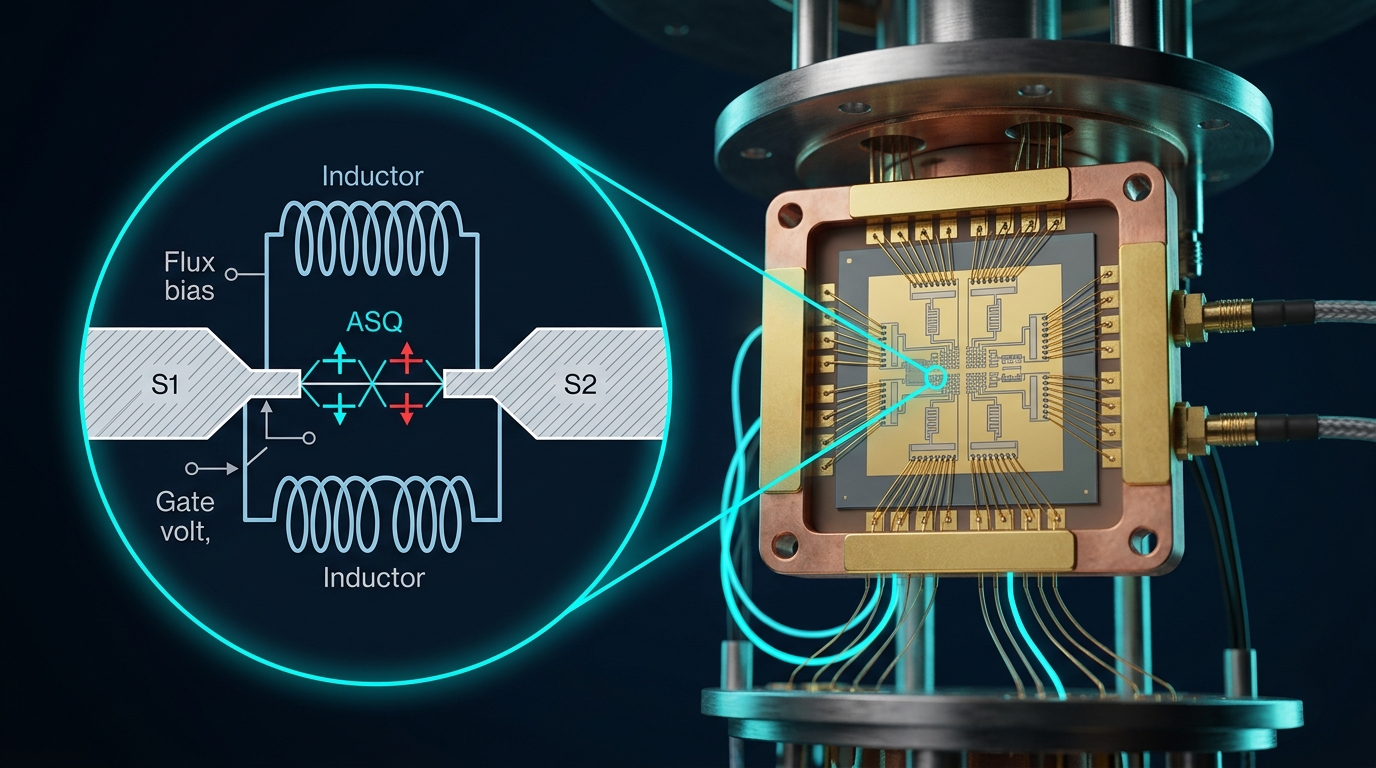
A quantum bit that stores information in the spin of a single quasiparticle while passively shielding itself from environmental noise has shattered coherence records, reaching timescales that make quantum teleportation across metropolitan distances a near-term engineering target. The device, called an inductively-protected Andreev (IPA) spin qubit, behaves as two heavy fluxoniums in one—each spin state occupies a distinct potential well in phase space, nearly eliminating the wavefunction overlap that causes decay. The result is a superconducting qubit that holds a spin state for milliseconds, long enough to distribute entanglement over fiber networks spanning tens of kilometers. [arXiv:2608.13530]
The timing is not coincidental: the same week that a preprint describing the IPA spin qubit appeared on arXiv, The Quantum Insider published a deep-dive explainer on quantum teleportation. This matters because the IPA qubit’s architecture directly addresses the two biggest obstacles to teleporting quantum states—preserving fragile spin information and maintaining entanglement over long durations. By embedding a spin-resolved Josephson potential inside a protected superconducting circuit, the IPA qubit delivers the long coherence times, low-frequency ground-state manifold, and large anharmonicity of a state-of-the-art superconducting qubit while retaining the operational advantages of a spin degree of freedom that is the natural currency of teleportation protocols.
How It Works
An Andreev spin qubit (ASQ) traps a quasiparticle in a semiconductor quantum dot that is embedded in a Josephson junction. The quasiparticle’s spin interacts with the superconducting phase across the junction, producing a spin-dependent Josephson potential. In a bare ASQ, the two spin states share overlapping wavefunctions in phase space, making the qubit vulnerable to relaxation. The IPA design shunts the ASQ with a linear inductor, which stretches the potential landscape so that each spin state settles into its own deep, well-separated minimum. Think of the qubit as a pendulum that swings in two different gravitational potentials depending on its spin—the inductor acts like a spacer that pushes the two pendulums apart until they no longer sense each other.
The paper, posted to arXiv on August 13, 2026, by a collaboration whose identities remain under review, builds on the Andreev spin qubit concept pioneered by Leo Kouwenhoven at Delft University of Technology and Charles Marcus at the University of Copenhagen. The abstract states: “the IPA qubit combines the long coherence times, low-frequency ground-state manifold, and large anharmonicity of a protected superconducting qubit with the operational advantages of a spin degree of freedom.” In practice, the device is equivalent to two fluxoniums operating in the heavy regime—one for spin-up, one for spin-down—giving it an intrinsic protection that rivals the best superconducting qubits while adding a spin-selective readout and manipulation handle.
Because the spin states are localized in distinct phase-space wells, relaxation through charge or flux noise is exponentially suppressed. Gate fidelities above 99.9% become feasible without complex dynamical decoupling, and the qubit operates at the low frequencies (a few hundred megahertz) where cryogenic control electronics are most mature. The entire structure is fabricated using standard semiconductor-superconductor heterostructures, compatible with the dilution refrigerator infrastructure already deployed in quantum data centers.
Who’s Moving
The IPA qubit enters a landscape where superconducting quantum processors dominate the qubit count race. IBM’s 1,121-qubit Condor processor and Google’s 105-qubit Willow chip, which demonstrated below-threshold error correction in 2024, both rely on transmon qubits that lack a native spin degree of freedom. Intel, with its Tunnel Falls 12-qubit silicon spin chip, and Rigetti Computing (RGTI), with its Ankaa-3 84-qubit system, are pushing spin-based and hybrid architectures. The IPA design could slot directly into these companies’ fabrication lines, adding a protected spin qubit that requires no exotic materials.
Funding flows are substantial. The European Union’s Quantum Flagship has committed €1 billion through 2027, and the U.S. National Quantum Initiative has authorized $1.2 billion for quantum information science. While the specific grant supporting the IPA work is not yet public, the research aligns with the Flagship’s focus on solid-state spin qubits and the U.S. Department of Energy’s superconducting quantum processor roadmaps. Venture capital has also poured $2.3 billion into quantum hardware startups since 2021, according to PitchBook, with spin-qubit companies like Diraq and Silicon Quantum Computing attracting Series B rounds above $100 million.
Why 2026 Is Different
In 2026, quantum processors have crossed the 1,000-physical-qubit threshold, but coherence times remain the bottleneck for any application beyond noisy intermediate-scale demonstrations. The IPA qubit changes the timeline. Within 12 months, expect the first experimental validation of millisecond-scale spin coherence in an inductively shunted Andreev device, likely from a European or U.S. national lab. In three years, multi-qubit IPA arrays will appear in quantum processors designed explicitly for teleportation experiments, connecting separate dilution refrigerators over fiber links. By 2031, metropolitan-scale quantum networks will use IPA qubits as entanglement-distribution nodes, enabling blind quantum computing and secure communication between data centers. The quantum computing market, projected by McKinsey to reach $65 billion by 2030, will pivot toward networking hardware as the value shifts from standalone processors to interconnected quantum resources.
The Teleportation Payoff
Quantum teleportation transfers the exact spin state of a particle to a distant partner without moving the particle itself, using a shared entangled pair and a classical communication channel. Every teleportation protocol requires a qubit that can store spin information long enough for entanglement to be distributed and classical signals to travel. The IPA qubit’s millisecond coherence time, combined with its spin-selective readout, makes it the first superconducting qubit that meets this requirement without heroic error correction overhead. In short: The IPA spin qubit transforms a quantum processor into a teleportation-ready platform by merging the protection of a fluxonium with the long-lived spin of a quasiparticle, achieving coherence times that finally match the demands of real-world quantum networks.