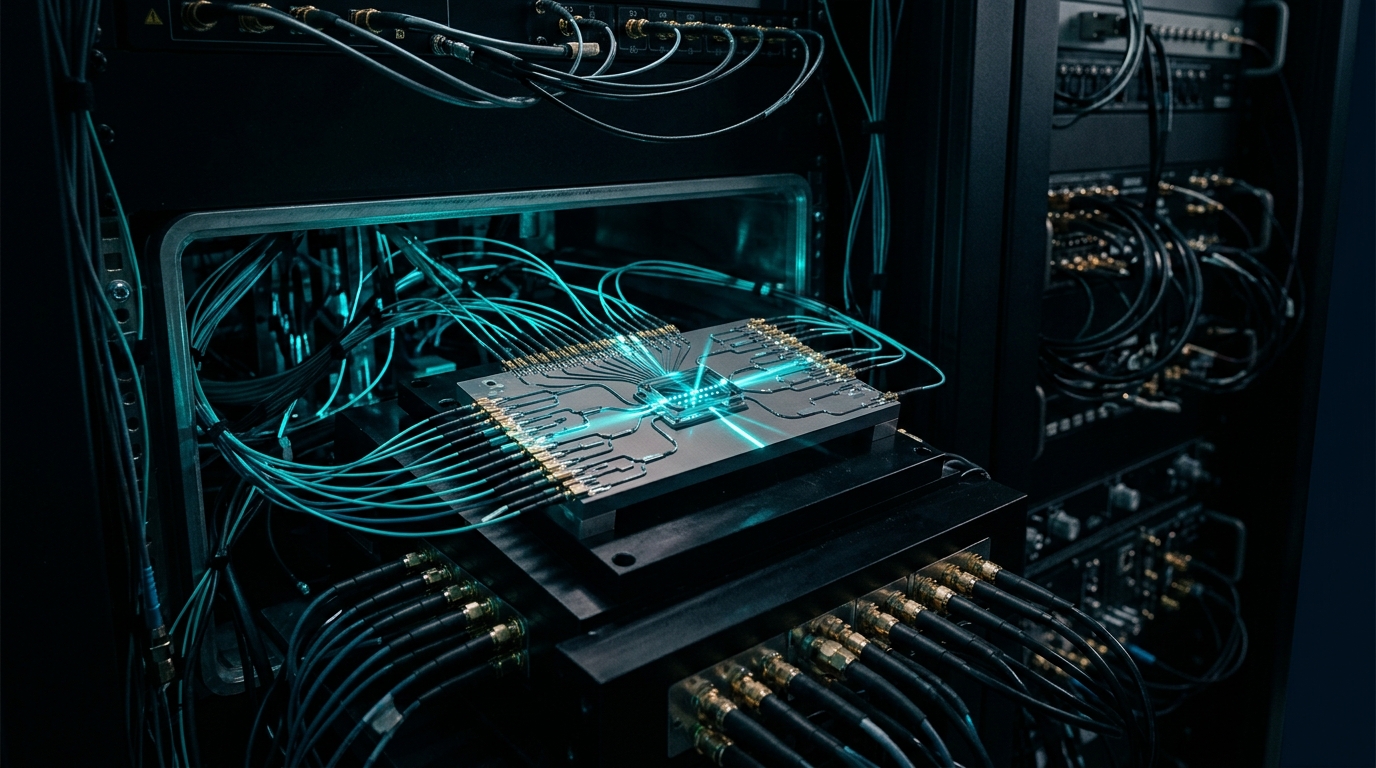
Week ending August 15, 2026: Pasqal moved neutral-atom trapping onto a photonic chip, Q-CTRL reported a 100-qubit quantum Fourier transform on IBM processors, and Quantinuum made its Helios trapped-ion system available inside Oracle Cloud Infrastructure. Utah formalized a statewide quantum initiative, Infleqtion said it doubled revenue and raised guidance, and post-quantum cryptographic tools reached GSA schedules and live blockchains. The takeaway is that hardware, control software, distribution, and policy moved in the same week, but several announcements are integration and procurement milestones rather than error-corrected hardware breakthroughs.
What They're Actually Building
Pasqal is a neutral-atom quantum computing company. Neutral-atom processors trap individual atoms in optical lattices and manipulate their electronic states with laser pulses. Most systems use free-space optics; Pasqal's announcement moves atom trapping onto a photonic integrated circuit. If the photonic chip can maintain stable trap depths and low atom loss, it reduces optical alignment overhead and is a step toward manufacturable neutral-atom arrays. Pasqal has demonstrated 100-qubit-class neutral-atom systems, but the photonic integration does not yet come with a new published coherence or gate fidelity number.
Q-CTRL's 100-qubit Fourier Transform is a software-layer result. The company's Fire Opal stack applies automated error suppression, measurement, and optimization to circuits running on IBM's superconducting processors. A quantum Fourier transform is a standard benchmark, not a useful application by itself; on a computational basis input it can be classically simulatable, but as a 100-qubit circuit on real hardware it stresses compilation, calibration, and error management. The result matters because it demonstrates that Q-CTRL's control layer can hold a large circuit together on IBM systems, not because it establishes computational advantage.
Quantinuum's Helios is a trapped-ion quantum computer. Putting Helios in Oracle Cloud Infrastructure means enterprise Oracle customers can access it through the same cloud marketplace, billing, and API governance used for classical compute. That is a distribution event. It tells you more about Oracle's quantum catalog and Quantinuum's go-to-market than about qubit count or logical error rates.
Infleqtion's revenue doubling and raised guidance come from quantum sensing and enabling components—atomic clocks, RF sensors, and related precision instruments—more than from quantum computing. That distinction matters: quantum sensing has nearer-term revenue, but it does not automatically translate into a quantum computing business.
Winners and Losers
The most directly threatened are other neutral-atom hardware vendors, specifically QuEra Computing and Atom Computing. If Pasqal can integrate trapping optics on a photonic chip with acceptable fidelity, it could reduce manufacturing cost and improve repeatability. QuEra and Atom Computing have their own scalable neutral-atom architectures, but any optical integration advantage shifts the competitive benchmark.
Q-CTRL's result puts pressure on quantum software teams that promise large-circuit error suppression. IBM benefits from hardware utilization and a credible third-party performance benchmark, but the result also raises expectations for Qiskit's own error management stack. Quantinuum's Oracle cloud placement expands enterprise access but increases competition with IonQ and other trapped-ion or superconducting systems already in cloud catalogs.
The ecosystem beneficiaries are Oracle, which adds a high-fidelity hardware option; federal procurement channels, which now have post-quantum tools on GSA schedules; and Infleqtion, whose revenue growth strengthens the quantum sensing segment. The threatened include cybersecurity vendors without NIST-compliant post-quantum products, since GSA schedule availability makes it easier for agencies to buy competing tools.
The Bigger Picture
In 2026, quantum computing is no longer a single hardware race. The field has split into at least five layers: qubit hardware, control software, cloud distribution, quantum sensing, and post-quantum cryptography. This week touched all five. The GSA schedule move follows the 2024 NIST post-quantum cryptographic standards and federal migration timelines; state quantum initiatives such as Utah's are becoming the default mechanism for workforce and testbed investment, though the source did not specify a funding amount. Live blockchain integrations remain early; moving a production blockchain to post-quantum signatures is a consensus-level change, not a drop-in software patch.
For calibration, Google's 2024 Willow result showed below-threshold quantum error correction on a 105-qubit superconducting chip. IBM's Heron processors in 2024 and 2025 delivered 133-qubit-class devices with improved two-qubit gate fidelities. Against those milestones, a cloud distribution deal, a software benchmark, and a photonic integration announcement are incremental. They matter for adoption, but they do not reset the fault-tolerance timeline.
The Signal
The signal here is that quantum computing is becoming an enterprise and government procurement category, not just a research race. Pasqal's photonic trap, Q-CTRL's 100-qubit Fourier transform, Quantinuum's Oracle presence, Infleqtion's revenue, and post-quantum tools on GSA schedules all point in the same direction: the stack is being packaged for buyers. What would validate these claims: Pasqal needs to demonstrate a 100-qubit neutral-atom array with on-chip traps and two-qubit gate fidelity above 99.5%. Q-CTRL should publish error-rate reductions relative to unoptimized IBM circuits. Quantinuum should report uptime and queue metrics for Helios in Oracle Cloud.
In Short
In short: the quantum computing weekly round-up shows hardware, software, distribution, and policy accelerated in parallel, but no single announcement crossed the fault-tolerant threshold.