For decades, quantum sensing has promised to detect signals far fainter than any classical instrument can perceive. But that promise came with a steep price: extracting useful information from a quantum sensor typically demands an exponentially growing number of measurements, or a large-scale quantum processor that remains years away. Now, a collaboration of physicists has shown that a single qubit, paired with an ordinary classical sensor, can slash the number of measurements needed by a factor of ten million. The work, posted on arXiv in August 2026, answers a question that has lingered at the edge of quantum metrology: can a minimal quantum resource deliver an exponential advantage in learning classical signals? [arXiv:2608.13521]
The Core Finding
The team’s central insight is that coupling a single controllable qubit to a conventional sensor—such as a microwave cavity—creates a quantum-enhanced measurement protocol that exponentially reduces the sample complexity of signal-learning tasks. Think of it like using a single quantum compass that, by interacting with the magnetic field in a clever sequence, can map the entire field landscape with far fewer readings than a classical compass would need. As the authors write,
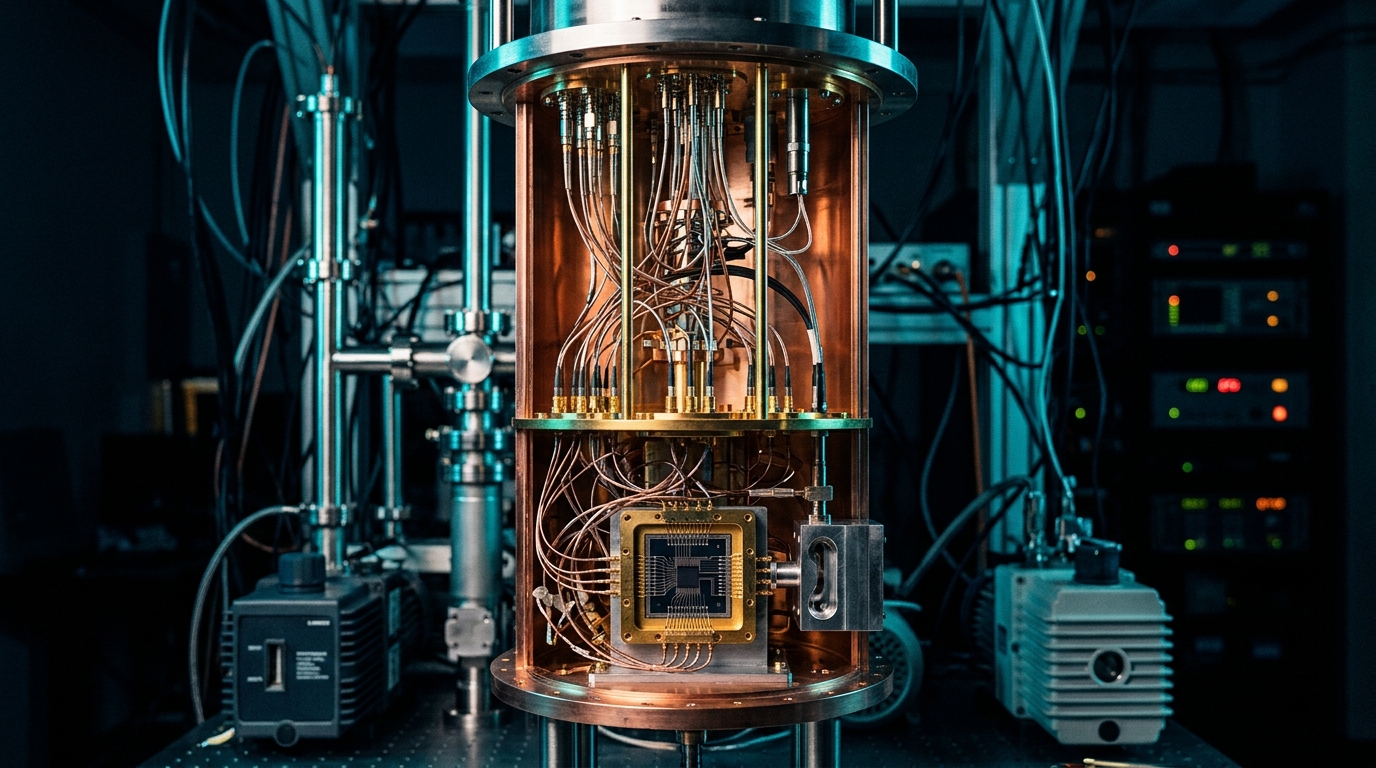
coupling a single controllable qubit to an otherwise conventional sensor can exponentially reduce the number of measurements required to learn classical signals.In experiments with a superconducting cavity–qubit architecture, they demonstrated a 107-fold reduction in the number of measurements needed to learn Fourier amplitudes and time-varying signals. The underlying theory, called Quantum Phase-Space Inference (QΨ), provides a unifying framework that derives tight lower bounds and optimal algorithms while certifying the quantum advantage.
The State of the Field
Quantum sensing has long relied on squeezed states, entangled photons, or nitrogen-vacancy centers to beat classical limits. The quantum Fisher information formalism has been the gold standard for quantifying the ultimate precision of a quantum sensor. However, those approaches often require preparing fragile multi-particle entangled states or operating at the Heisenberg limit, which is notoriously susceptible to noise. In 2023, researchers demonstrated quantum advantage in sensing with a single qubit for specific tasks like magnetic field estimation, but those gains were modest and task-specific. The new work leaps beyond by targeting the sample complexity of learning entire signals—Fourier coefficients, temporal correlations—rather than just a single parameter. The broader quantum computing landscape is grappling with error correction and scaling, but this result shows that even a single, imperfect qubit can unlock exponential practical gains when used as a controller for a classical sensor. It shifts the conversation from building large fault-tolerant machines to extracting value from near-term quantum devices.
From Lab to Reality
For scientists, the QΨ framework opens a systematic way to design optimal quantum-enhanced experiments for any sensing task with given constraints. It goes beyond quantum Fisher information by incorporating the full measurement process and producing certificates of advantage. For engineers, the immediate applications are in weak-signal detection: the paper includes simulations showing orders-of-magnitude improvements in dark matter searches using haloscopes, and in wireless communication where channel estimation can be performed with far fewer pilot signals. The quantum sensing market, projected to reach $1.2 billion by 2030 according to industry analysts, could see a new class of hybrid quantum-classical sensors that retrofit existing infrastructure with a single qubit controller. In the lab, the superconducting cavity–qubit setup operates at millikelvin temperatures, but the protocol is agnostic to the physical platform; trapped ions, quantum dots, or even room-temperature defects could host the qubit. The key is the ability to control the qubit and couple it to the sensor’s observable.
What Still Needs to Happen
Two major challenges stand between this demonstration and widespread adoption. First, the exponential advantage was shown for learning Fourier coefficients and time-varying signals in a controlled cryogenic environment; extending it to arbitrary, noisy, real-world signals—such as those in radar or biomedical imaging—requires robust error mitigation and adaptive protocols that can handle decoherence. The current experiment used a high-coherence superconducting qubit with a lifetime of hundreds of microseconds, but field-deployable sensors will face much harsher conditions. Second, the QΨ theory assumes perfect knowledge of the sensor’s response function; calibrating that function in situ without destroying the quantum advantage is an open problem. Groups at MIT, the University of Chicago, and Delft University of Technology are actively working on quantum control techniques and error-robust sensing protocols that could address these issues. Realistically, a commercial device that leverages this single-qubit advantage for, say, portable dark matter detectors or next-generation wireless receivers is at least five to ten years away.
In short: a single qubit can deliver an exponential quantum advantage in learning classical signals, reducing measurement counts by up to 10 million-fold.