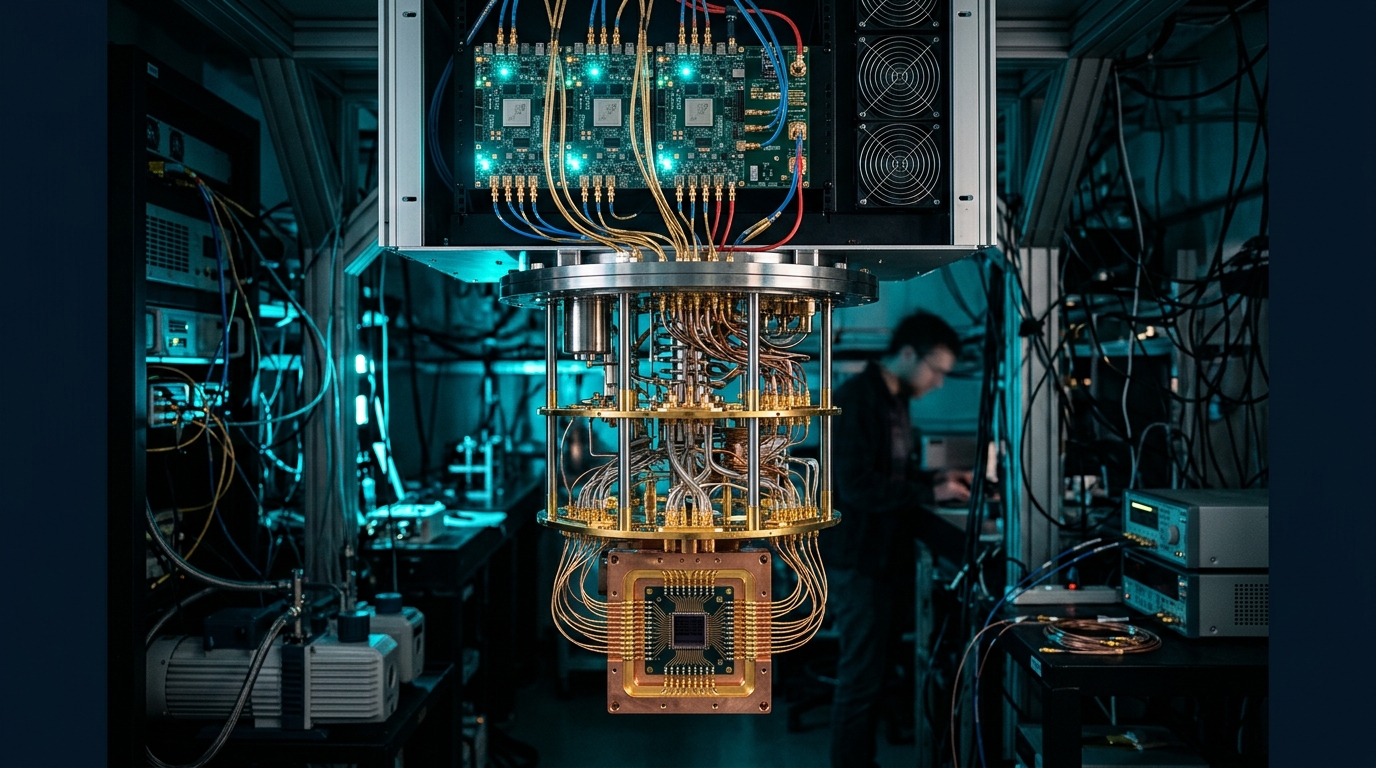
Controlling a hundred superconducting qubits with a single wire sounds like a wiring engineer’s dream—and a physicist’s nightmare. The dream is frequency multiplexing: cramming multiple qubit control tones onto one cryogenic microwave line. The nightmare is the RF budget. A shared source has finite bandwidth, limited dynamic range, and unavoidable nonlinearities. Clipping, jitter, crosstalk, and quantization noise can corrupt the delicate rotations that define quantum algorithms. For years, compilers treated each tone as if it lived in an ideal, isolated world, ignoring the messy reality of the amplifier chain. That fiction has now been retired. [arXiv:2608.10013]
A team at IBM Quantum has developed an RF-budgeted frame-compilation and validation workflow that forces multitone scheduling to respect the actual constraints of the RF source, from the digital baseband to the cryogenic output. The method, described in a paper posted to arXiv on August 8, 2026, combines qubit‑control identity (QID) records, a circuit‑informed model of an RFSoC (radio frequency system-on-chip) transmit chain, and full qutrit dynamics simulations in QuTiP. The takeaway is not just that it works; it quantifies how many qubits you can aggregate per frame, how rotation angle and pulse length shape the error landscape, and how a 12‑qubit Bernstein‑Vazirani layer collapses into three validated four‑tone frames at 240 ns.
Frequently Asked Questions
What is frequency‑multiplexed qubit control?
It is a technique that sends microwave control pulses for multiple superconducting qubits through a single physical cable by assigning each qubit a distinct carrier frequency. The pulses are combined into a multitone signal at room temperature, amplified, and delivered to the qubit chip. This drastically reduces the wiring needed to control large quantum processors. The challenge is that the shared RF chain introduces distortions that can corrupt the individual qubit operations.
How does RF‑budgeted frame compilation work?
The compiler reads qubit‑control identity records that specify each qubit’s frequencies, pulse shapes, and drive scales, along with an RF‑chain profile that captures amplifier compression, crosstalk, and spurious tones. It then partitions the required gates into frames, ensuring that the combined multitone signal never exceeds the budget. Each candidate frame is propagated through a MATLAB/Simulink model of the RFSoC chain, and the resulting effective drives are fed into QuTiP simulations that measure rotation error and leakage. Only frames that meet fidelity targets are accepted.
How does this compare to conventional qubit control methods?
Conventional control assigns one cable per qubit or uses static frequency multiplexing without real‑time budget awareness. Those methods ignore the nonlinearities of the amplifier and the DAC, risking clipping and crosstalk that degrade gate fidelity as the number of tones increases. The new approach actively models the entire RF chain and simulates the full qutrit dynamics, catching errors that a simple two‑level gate model would miss. It quantifies, for the first time, how many qubits can be aggregated per frame under realistic hardware constraints.
When could this be commercially relevant?
Commercial quantum computing systems that use RFSoC‑based control electronics could integrate this compiler within two to three years. The technique is immediately relevant for research labs building next‑generation multiplexed readout and control setups. As quantum processors scale toward thousands of qubits, wiring reduction becomes a hard requirement for cryogenic packaging, and RF‑budgeted compilation will be a standard component of the control software stack.
Which industries would benefit most?
The immediate beneficiaries are the quantum computing hardware manufacturers—IBM, Google, Rigetti, and others developing superconducting quantum processors—as well as test‑and‑measurement companies that supply control electronics. In the longer term, any industry that relies on large‑scale quantum error correction, such as pharmaceutical companies simulating molecular interactions or financial institutions solving optimization problems, will benefit from the higher qubit counts that multiplexed control enables.
What are the current limitations of this research?
The study uses decoherence‑free simulations and does not include hardware validation on a real quantum processor. The QuTiP qutrit simulations are computationally intensive and would need to be accelerated for real‑time compilation on hundreds of qubits. The effective crosstalk matrix and RF‑chain profile must be calibrated and updated periodically, which remains an open experimental challenge. The work also assumes fixed anharmonicity and no frequency collisions, which real transmons can exhibit.
Follow frequency‑multiplexed qubit control Intelligence
BrunoSan Quantum Intelligence tracks frequency‑multiplexed qubit control and 44+ quantum computing signals daily —
ArXiv papers, Nature, APS, IonQ, IBM, Rigetti and more. Updated every cycle.
Explore Quantum MCP →