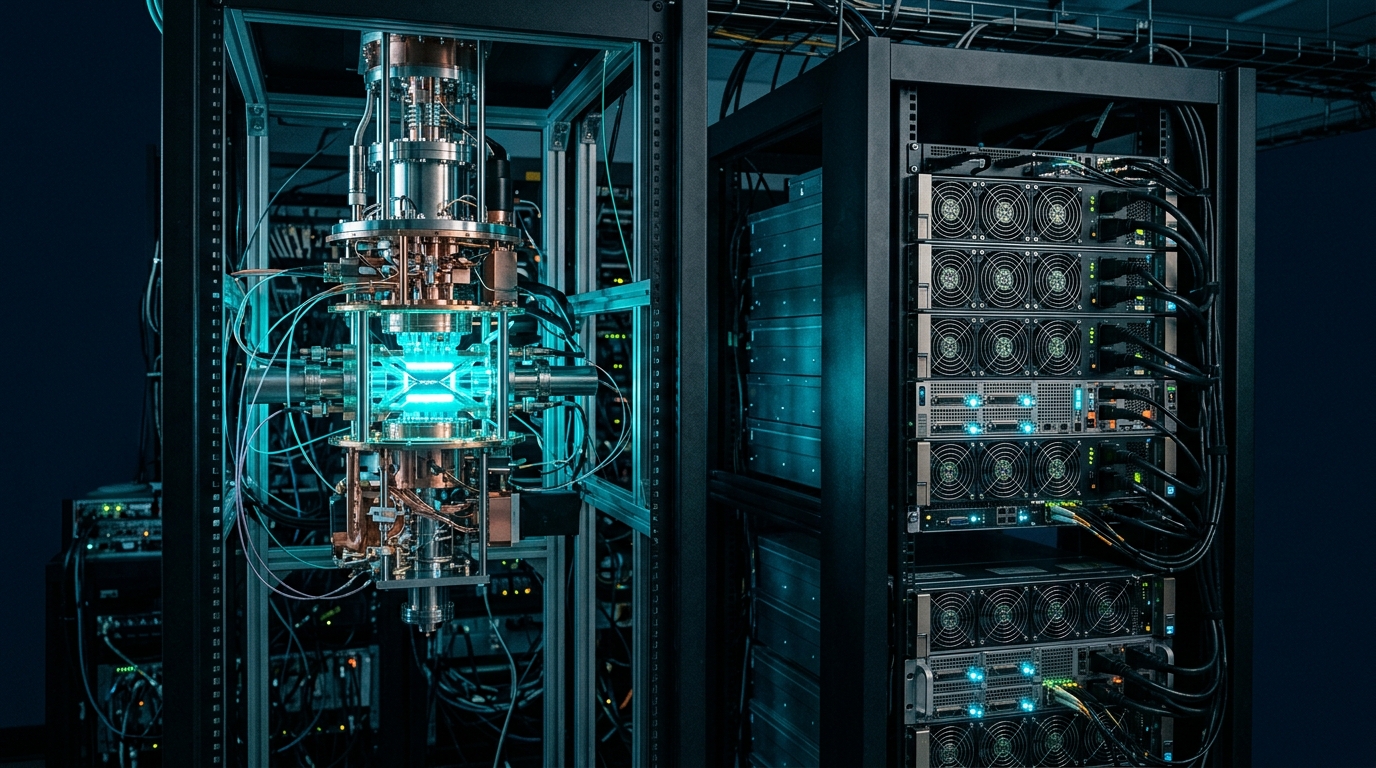
Quantinuum and Oracle Corporation disclosed a multi-year partnership on August 11, 2026, to deploy Quantinuum’s Helios quantum computer directly inside a U.S.-based Oracle Cloud Infrastructure (OCI) AI data center. The agreement makes Helios—a 98-physical-qubit trapped-ion machine—available to OCI customers through a planned quantum cloud service, coupled with Oracle’s existing high-performance computing (HPC) and GPU clusters. No financial terms or deployment timeline were disclosed.
Oracle’s decision to co-locate hardware rather than simply resell cloud access to a remote machine marks a departure from standard quantum-as-a-service distribution. The architecture places quantum processors in direct, low-latency proximity to classical supercomputing resources, a design choice both companies argue is necessary for the hybrid quantum-AI loops that large pharmaceutical and financial services customers are beginning to test in production pipelines.
What They're Actually Building
Helios is Quantinuum’s third-generation trapped-ion quantum computer, succeeding the H1 and H2 systems. The machine uses ytterbium ions suspended in an electromagnetic field, manipulated via laser gates to execute quantum logic. Trapped-ion architectures trade raw qubit count for gate fidelity: Quantinuum reported a two-qubit gate fidelity of 99.8% on the H2 system in 2025, a figure that remains industry-leading among commercially available machines.
The Helios deployment doubles the H2’s 56-qubit register to 98 physical qubits. While this count is modest compared to IBM’s roadmap targeting 100,000 qubits by 2033 or Google’s 1,000-qubit-class processors by 2027, Quantinuum’s bet rests on qubit quality, not quantity. The company’s error-correction demonstrations on H2—including the repeated creation of logical qubits with error rates below the break-even threshold—provide the technical backbone for the Helios pitch. The Oracle partnership effectively tests whether error-corrected logical operations can be productized inside enterprise workflows, years before the broader industry expects fault tolerance at scale.
Inside the OCI data center, Helios will sit on a specialized floor slab with vibration isolation and cryogenic infrastructure. The integration point is Oracle’s cluster networking fabric, which lets classical HPC nodes invoke quantum circuits with sub-millisecond round-trip latency. This co-location architecture mirrors the hybrid approach IBM and the Cleveland Clinic have demonstrated with on-premise deployments since 2023, though Quantinuum’s error-correction maturity changes the workload scope: the intended applications are iterative loops where a classical AI model proposes molecular configurations, a quantum solver evaluates energy landscapes, and the result feeds back into the AI training cycle.
Winners and Losers
The most immediate competitive pressure falls on IBM Quantum Network partners that have staked their hybrid strategies on remote cloud access. IBM’s 1,133-qubit Condor-class processors are larger in raw size, but operate without logical error correction; Quantinuum’s error-corrected logical qubits, even at lower counts, target workloads where gate fidelity is the binding constraint. Google Quantum AI, which has focused on superconducting processors internally, is racing toward its own error-correction milestone but has not announced an enterprise co-location deal of equivalent scope.
IonQ, Quantinuum’s primary competitor in trapped-ion hardware, benefits indirectly: the deal validates that enterprise cloud providers see trapped-ion systems as acceptable for production data-center environments, a narrative that IonQ’s own partnership with Amazon Braket has been pushing since 2024. AWS may feel pressure to match Oracle’s on-premise integration depth, though Quantum Brilliance’s diamond-NV room-temperature approach and Xanadu’s photonic path offer alternative co-location architectures that sidestep the vibration and cryogenic constraints of ion traps entirely.
For the quantum software layer, the partnership is a tailwind for hybrid orchestration platforms. Q-CTRL, Classiq, and Strangeworks all sell tools that abstract circuit execution across back-ends; a major new quantum node inside OCI’s AI pipeline expands their addressable market. Oracle’s own quantum software capability remains thin, suggesting near-term dependency on third-party middleware. The investment angle: Quantinuum’s private valuation, last marked at roughly $5.4 billion in its 2024 Honeywell-anchored round, gets a commercial distribution catalyst that most of its peers lack.
The Bigger Picture
In 2026 quantum computing is stuck in what engineers call the “error-correction transition.” Logical qubits exist in the lab, but no vendor has delivered a service-level agreement (SLA) that guarantees logical error rates to an enterprise customer. The U.S. government has poured $2.5 billion into quantum R&D through the CHIPS and Science Act and the Quantum Leadership Act of 2025, with specific carve-outs for co-located quantum-HPC testbeds. The Quantinuum-Oracle deal mirrors a similar Department of Energy architecture at Oak Ridge National Laboratory, where Quantinuum installed an H2 system in 2025 to test hybrid materials-science workloads.
Comparable data-center deployments remain rare. IBM placed a Quantum System Two at the Cleveland Clinic in 2023 under a 10-year partnership, aiming at biomedical applications. The Cleveland deployment has since published preliminary results in Nature on protein-ligand binding energy estimation, but has not yet demonstrated a commercially relevant quantum advantage over classical methods. Quantinuum’s ability to generate higher-fidelity logical qubits raises the ceiling, but the company must now demonstrate that error-corrected quantum computation scales beyond proof-of-concept molecular fragments into the larger active sites that drug-discovery pipelines actually care about.
The Signal
The signal here is distribution, not discovery. Quantinuum already demonstrated logical qubit operations with error rates below the surface-code threshold on its H2 hardware. The Oracle deal answers the question of where customers will actually use those logical qubits—not in a physics lab, but in the same physical rack row as the GPUs running their transformer training jobs. This is step-function progress for trapped-ion commercialization, and it forces competitors to show equivalent enterprise integration, not just higher qubit counts. The specific milestone that would validate this partnership is an end-to-end hybrid workflow—classical AI proposing drug candidates, quantum solver evaluating them with logical error correction, results fed back within a single SLA-bound job—completed by a named pharmaceutical partner and published with performance benchmarks. Without that, Helios in a data center is just expensive floor space.
In Short
Quantinuum’s Helios deployment inside OCI’s AI data center positions error-corrected quantum computing as an enterprise-accessible resource, not a lab curiosity.