The Einstein-Podolsky-Rosen argument, which for 90 years claimed quantum mechanics is incomplete, now falls to the theory’s own bare formalism—no hidden variables, no many worlds, just the math. Within days, a startup in Hefei announces a 16-qubit on-chip photonic chip that exploits exactly the kind of correlations EPR questioned. This convergence delivers a sharp boost to quantum error correction, the linchpin of fault tolerant quantum computing.
This matters because the new theoretical result, published on arXiv on August 7, 2026, strips away all extraneous interpretive baggage and shows that quantum mechanics is self-consistent from within. The timing is not coincidental: the same measurement-based paradigm that the paper validates is now being etched into silicon photonics. On August 11, Hefei Guizhen Chip Technology Co., Ltd. and the University of Science and Technology of China (USTC) published details of a 16-qubit on-chip measurement-based quantum computing architecture, a direct hardware realization of a model that relies on entangled measurements driving computation.
How It Works
The paper, which carries the arXiv identifier [arXiv:2608.10006], revisits the 1935 EPR challenge with a scalpel. It isolates two elements essential to the EPR reasoning: the fact that observables in an EPR state are always associated with non-commuting operators, and the nature of the correlated information obtained through measurement. Then it wields only the core rules of quantum mechanics.
“From these two points alone, and relying strictly on the core rules of quantum mechanics, we demonstrate how to overturn the alleged EPR incompleteness without invoking any extraneous propositions.”The result is a proof that the standard formalism alone suffices—no supplementary concepts, no interpretations, no additions.
This self-consistency result provides the conceptual bedrock for measurement-based quantum computing (MBQC). In MBQC, a large entangled cluster state is prepared first, and computation proceeds solely through single-qubit measurements and feed-forward of classical outcomes. The correlations that EPR found so puzzling are exactly what make the scheme work: measuring one qubit determines the effective gate applied to another, far across the cluster. The new proof shows that trusting those measurement outcomes requires nothing beyond quantum mechanics itself, strengthening the logical foundation of every MBQC architecture.
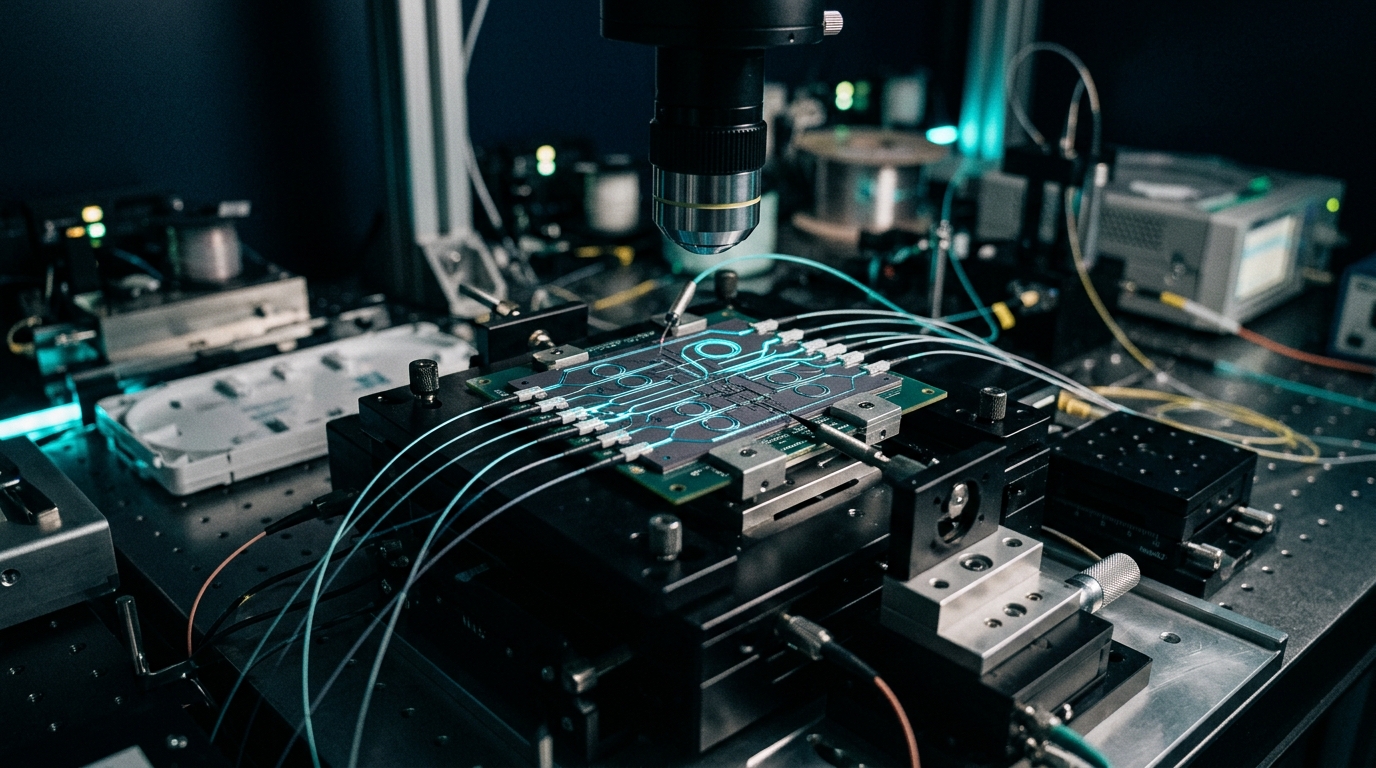
The USTC photonic chip, developed under Professor Ren Xifeng at the CAS Key Laboratory of Quantum Information, encodes 16 qubits in a planar optical circuit. The team generates a continuous cluster state using squeezed light sources and performs adaptive measurements on the chip. This is not a lab table experiment; it is a monolithically integrated photonic circuit, a step toward scalable, manufacturable quantum processors. The chip’s output is a sequence of measurement results that realize a quantum circuit, all without any two-qubit gates in the traditional sense. Because the computation is driven by measurement, the architecture is inherently aligned with quantum error correction strategies that rely on syndrome measurements—the same kind of correlation-based measurements that the EPR paper and the new self-consistency proof analyze.
Who’s Moving
Hefei Guizhen Chip Technology Co., Ltd. (硅臻芯片) is a startup emerging from the dense quantum ecosystem of Hefei, home to USTC and the Chinese Academy of Sciences’ quantum flagship. The company worked directly with Professor Ren Xifeng’s group to co-design the 16-qubit MBQC chip. While the startup has not disclosed a commercial product name, the chip is a fully integrated photonic processor that demonstrates the core MBQC cycle.
The measurement-based model itself was invented in 2001 by Robert Raussendorf (now at the University of British Columbia) and Hans Briegel (University of Innsbruck). Their cluster-state framework has since become a major fault-tolerant architecture, pursued by photonic quantum computing companies such as PsiQuantum and Xanadu. IBM’s 1,121-qubit Condor processor, by contrast, uses the circuit model with superconducting qubits. The photonic MBQC approach has a different error profile: photon loss is the dominant decoherence, demanding quantum error correction codes tailored to loss, such as bosonic codes or surface codes adapted for photonic qubit fidelity. China’s National Quantum Initiative has poured over $10 billion into quantum research since 2020, and the Hefei chip is a direct fruit of that strategy.
Why 2026 Is Different
In 2026, two independent threads—a foundational self-consistency proof and a manufacturable photonic MBQC chip—land in the same week. The convergence marks a shift from debating quantum theory’s completeness to fabricating processors that assume its validity and exploit its correlations. Within 12 months, expect scaling to 50 or more qubits on a single photonic chip. In three years, a fault-tolerant logical qubit built from photonic microchips will likely emerge, with a logical error rate below the physical error threshold. In five years, the first commercial photonic quantum computers with error correction will begin solving problems in optimization and chemistry that are intractable for classical machines. The global quantum computing market is projected to reach $65 billion by 2030, according to a 2025 McKinsey report, and photonic MBQC is poised to capture a significant share because it sidesteps the cryogenic overhead of superconducting qubits.
From Paper to Processor
The self-consistency proof and the 16-qubit chip together close a loop that began in 1935. The EPR argument questioned whether quantum mechanics could fully describe physical reality. The paper shows that the formalism, taken on its own terms, leaves no room for incompleteness. The photonic chip then demonstrates that those same formal elements—entangled states, non-commuting observables, and measurement-induced correlations—can be etched into silicon to perform protected computation. The link between the two is not philosophical; it is operational. Every syndrome measurement in a surface code is a miniature EPR correlation, and the new proof assures that the information extracted is sufficient to correct errors without any hidden variables creeping in.
In short: quantum error correction now stands on a stronger theoretical foundation, and a 16-qubit photonic MBQC chip proves that measurement-driven computing is no longer a paper concept.