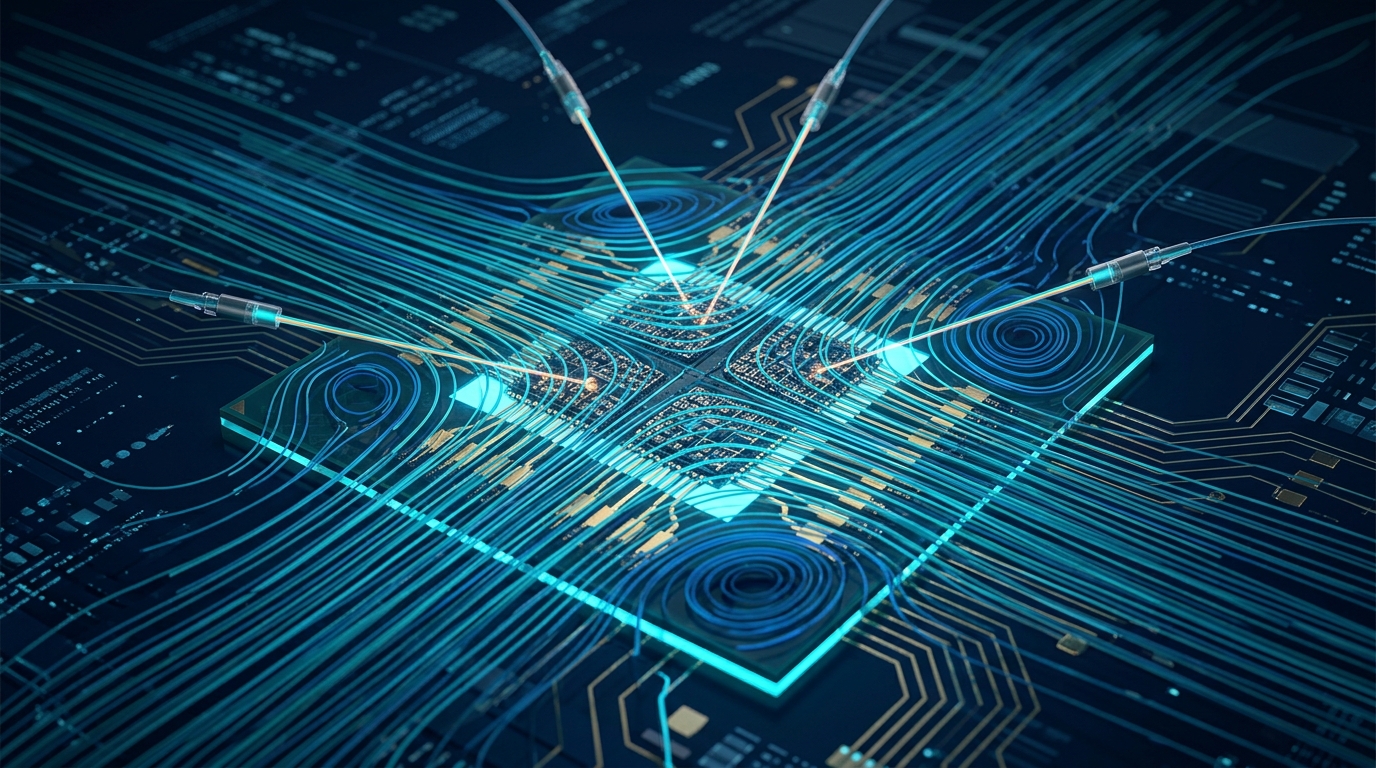
The same mathematics that describes how turbulence tears apart a smoke ring now explains how a quantum computer loses its computational power—and exactly when that loss begins. A diagnostic derived from the hydrodynamics of the quantum wavefunction locates the very first stirrings of decoherence, long before a qubit’s state flips. On August 8, 2026, a paper posted to the arXiv made that diagnostic explicit, turning the language of fluid flows into a real-time test for when a supposedly error‑corrected logical qubit starts to come apart. [arXiv:2608.10019]
The Connection
This matters because the timing is not coincidental. Three days after the paper appeared, the US government’s Quantum Resilience Clock—mandated by Executive Order 14412—became operational, openly displaying the shrinking window before fault‑tolerant quantum computers can crack classical encryption. The new diagnostic, titled “Local Complex Dependence and Separability in Madelung Hydrodynamics,” accelerates the very error correction that makes such a clock necessary. It gives hardware teams a direct, experimental handle on how cross‑particle correlations evolve, effectively wiring a hydrodynamic early‑warning system into the error‑correction loop of a quantum processor.
How It Works
The starting point is the Madelung transformation, which writes the wavefunction as an amplitude and a phase, turning the Schrödinger equation into a set of fluid‑like equations for a density field and a velocity field. The paper’s anonymous authors consider a many‑particle pure state and examine the mixed cross‑particle derivatives of the logarithm of the wavefunction. The real part of those derivatives recovers one‑half of the Holland‑Wang local dependence function—a measure of density correlations introduced by Peter Holland and C. Y. Wang in the early 2000s. The imaginary part is the cross‑Jacobian of the Madelung velocity field, a quantity that encodes how the quantum fluid’s flow shears across particles.
“Under Schrodinger evolution with a real scalar potential, the initial growth of a cross block from a separable state is sourced by the corresponding mixed Hessian of the potential and is purely imaginary to first order in time.”
Think of it as a quantum stethoscope: the velocity‑field Jacobian picks up the faint, imaginary swirls that precede the breakdown of entanglement, just as a pressure sensor detects eddies before a pipe bursts. When all cross blocks vanish throughout a node‑free product region, the state is locally multiplicatively separable—there is no entanglement. The moment interactions or hardware imperfections turn on a real scalar potential, those cross blocks develop an imaginary component that is directly driven by the mixed Hessian of the potential. The diagnostic therefore links the geometry of the confining fields and the qubit‑qubit couplings to the initial moment of entanglement loss, giving error‑correction engineers a specific target to monitor.
In a surface‑code architecture, syndrome measurements detect bit and phase flips by repeatedly reading out a lattice of auxiliary qubits. The Madelung diagnostic complements this discrete protocol with a continuous, local measure of the correlations that error correction is meant to preserve. By weakly tracking the cross‑particle velocity gradients, a controller can catch the tell‑tale imaginary signal before it coalesces into a full‑blown error, triggering a corrective pulse while the logical qubit still holds. The technique is a local separability and dependence diagnostic, not a basis‑independent entanglement measure, which means it can be extracted from the same mid‑circuit measurement primitives that today’s superconducting and trapped‑ion processors already support.
Who’s Moving
IBM’s 1,121‑qubit Condor processor, unveiled in late 2023, and its modular Heron architecture provide the dense, flexible mid‑circuit measurement required to exploit a hydrodynamic monitor. Google’s 105‑qubit Willow chip, which demonstrated below‑threshold error correction in 2024, already logs the phase‑space data that a Madelung analysis would consume. Quantinuum’s H2 trapped‑ion system, with two‑qubit gate fidelities above 99.9%, can access the same cross‑particle gradients through native all‑to‑all connectivity. Jay Gambetta, IBM Quantum vice president, has repeatedly stressed that the road to utility‑scale quantum computing runs through real‑time error detection, not just lower physical error rates.
On the policy side, Yoon Auh, founder of BOLTS Technologies, confirmed that the Quantum Resilience Clock went live on August 11, 2026, as a direct consequence of Executive Order 14412. The clock publicly counts down to 2029, when all federal civilian agencies must complete their migration to post‑quantum cryptography, and to 2031 for critical infrastructure. The timelines were built on assumptions that large‑scale, fault‑tolerant machines would not arrive before the mid‑2030s. Diagnostics that shorten the error‑correction development cycle—like the one just published—put pressure on those deadlines. DARPA’s Underexplored Systems for Utility‑Scale Quantum Computing (US2QC) program and the $1.8 billion quantum allocation in the CHIPS and Science Act are already fueling the hardware teams that will turn the paper’s insights into firmware.
Why 2026 Is Different
In the next twelve months, expect the first integration of Madelung‑style diagnostics into the calibration workflows of superconducting processors. By 2029, logical qubit counts should be doubling every 18 months; a few hundred error‑corrected logical qubits—enough to run Shor’s algorithm on 2048‑bit integers—could arrive as early as 2030 if overhead continues to shrink. The Quantum Resilience Clock assumes a 2035 break‑even point for cryptographically relevant machines. A hydrodynamic diagnostic that spots decoherence before it corrupts a logical qubit compresses that timeline by years, not months. The commercial quantum computing market, currently valued at roughly $1.5 billion, is projected to reach $65 billion by 2030 once fault‑tolerant systems begin to unlock material simulation and logistics optimization.
No major hardware vendor is ignoring the Madelung framework. The imaginary part of the cross block is an observable that can be extracted from the same IQ‑plane data that tomographic routines already collect. The only missing piece was the theoretical link between those signals and the onset of separability breakdown—the piece the August 8 paper supplies. Once the diagnostic is embedded in real‑time firmware, every shot on a quantum processor can carry a live entanglement‑health score, allowing the controller to decide mid‑circuit whether to apply a correction or to abort and retry. That decisiveness is what turns a physics experiment into an industrial product.
Conclusion
In short: quantum error correction now has a hydrodynamic tool that catches entanglement loss before it corrupts logical qubits, accelerating the path to cryptographically relevant machines.