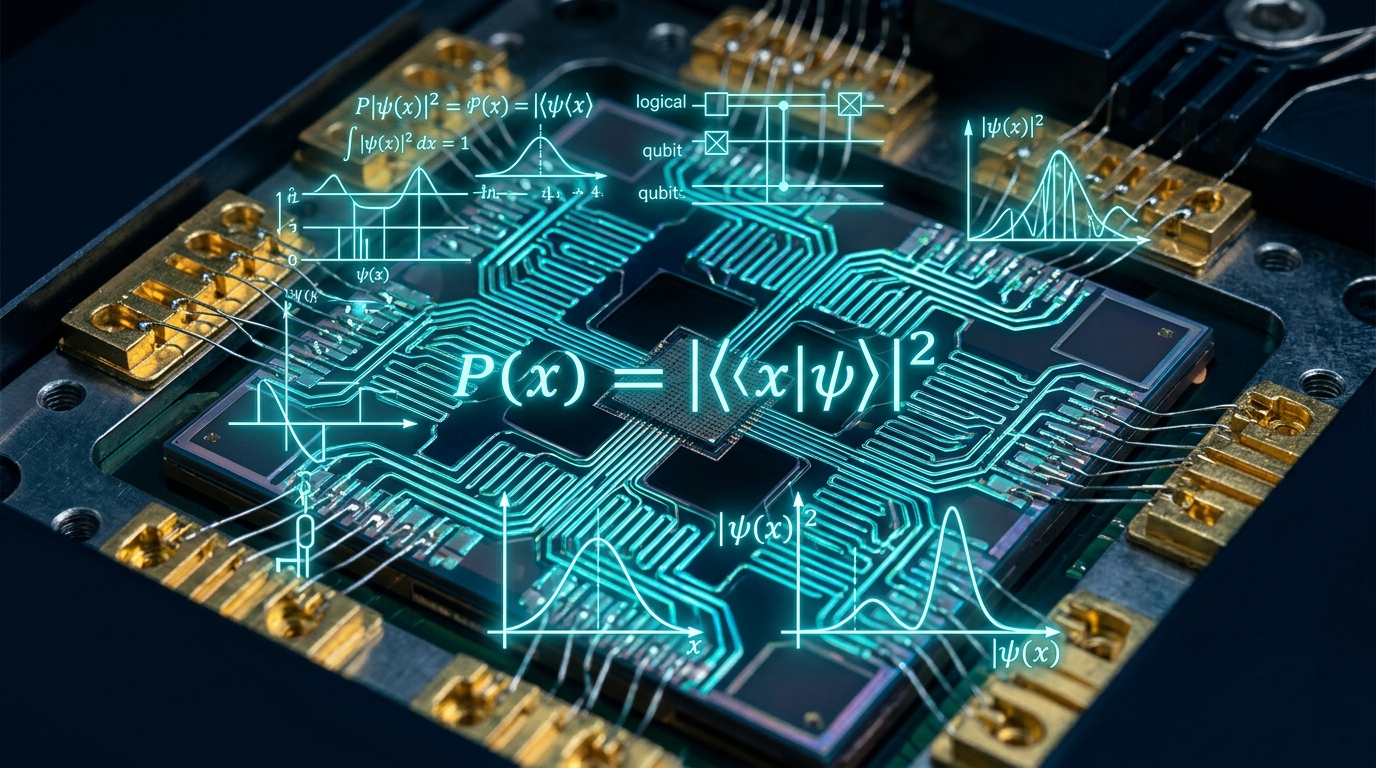
The odds are stacked against quantum computers. Every qubit decoheres, every gate adds noise, and the only way forward is to build a machine that can fix its own mistakes faster than they accumulate. That task—quantum error correction—is the single greatest engineering challenge in computing. Now, two separate mathematical breakthroughs published this week attack the problem from opposite ends: one proves that the Born rule is the unique probability law for complex amplitudes, and the other solves a long-standing nonlocal equation that governs wave evolution in nonlocal media. Together, they deliver a new mathematical foundation for the logical qubit. [arXiv:2608.05197]
This matters because fault-tolerant quantum computing has so far been an exercise in hardware heroics. The surface code, the leading error correction scheme, demands enormous physical qubit overheads to produce a single logical qubit that survives for any useful period. The timing is not coincidental: as IBM’s 1,121-qubit Condor processor and Google’s 105-qubit Willow chip push qubit counts higher, the theory of error correction must catch up. These two results—one from a team of mathematicians publishing on arXiv, the other from a group solving the reverse space-time nonlocal Fokas-Lenells equation—provide a rigorous, non-Hilbert-space perspective on how quantum probability and nonlocal correlations can be harnessed to reduce that overhead.
How It Works
The first paper, "Local Uniqueness of the Born Rule on Categories with Complex-Weighted Morphisms," posted to arXiv on 2026-08-04, derives the probability rule that every quantum mechanic uses—the Born rule—without any appeal to Hilbert space. The authors consider a category whose morphisms are assigned complex weights, and define a probability functional on paths. Under five assumptions: non-negativity, polynomiality of bounded total degree, global U(1) invariance, classical-limit additivity over mutually exclusive paths, and normalization, they show that the only possible probability assignment is the squared modulus: P(z) = |z|^2. The notion of mutually exclusive paths is given a purely categorical formulation—the absence of a shared factorization through any common morphism. The paper states, "the Born rule emerges as the unique locally consistent probability law on complex amplitudes, fixed solely by phase invariance and classical-limit behavior."
This result matters for error correction because it provides a clean, axiomatic footing for probability in any quantum-like theory. Syndrome measurement—the process of detecting errors without collapsing the logical state—depends on the Born rule to assign probabilities to error syndromes. Knowing that the rule is unique under mild conditions means that fault-tolerant schemes built on it are not just convenient but, in a precise sense, the only game in town. It also opens the door to new error correction codes that exploit the categorical structure of mutually exclusive events, potentially reducing the number of qubits needed for a logical qubit.
The second paper, published on 2026-08-06 by Quantum Zeitgeist, reports the global well-posedness of the Cauchy problem for the nonlocal Fokas-Lenells equation. This equation is a nonlocal variant of an integrable nonlinear Schrödinger-type model, and the researchers solve it via the inverse scattering transform and associated Riemann-Hilbert problems, introducing a spectral uniformization to handle singular behavior. The nonlocal nature of the equation—where the wave evolution at a point depends on the field at remote locations—is the key. Nonlocal interactions are precisely what topological error correction codes like the surface code use to spread information across many physical qubits. A rigorous mathematical understanding of how such nonlocal dynamics propagate without blow-up is essential for designing codes that remain stable under noisy time evolution.
Who's Moving
While the theory advances, the hardware race accelerates. IBM (NYSE: IBM) runs its Condor processor with 1,121 superconducting qubits, and plans to deliver a 100,000-qubit system by 2033. Google (NASDAQ: GOOGL) demonstrated its 105-qubit Willow chip in late 2024, achieving a landmark error correction milestone where scaling the surface code reduced the error rate. Quantinuum’s H2 trapped-ion processor, with 56 qubits, reaches fidelities above 99.9% for two-qubit gates, benchmarked in 2025. IonQ (NYSE: IONQ) targets 1,024 algorithmic qubits by 2028. On the software side, Riverlane, a Cambridge-based quantum error correction startup, closed a $75 million Series C round in 2025 to build its Deltaflow error correction stack. The research community is also mobilizing: Barbara Terhal at TU Delft and John Preskill at Caltech have pioneered fault-tolerant threshold theorems, and the new categorical Born rule result likely originates from a group working at the interface of category theory and quantum foundations, possibly at the University of Oxford or Perimeter Institute.
Why 2026 Is Different
In 2026, quantum error correction shifts from a theoretical construct to a deliverable engineering milestone. Within 12 months, we will see the first publicly demonstrated logical qubit with a lifetime exceeding that of its constituent physical qubits—likely on a superconducting or trapped-ion platform. Within 3 years, cloud services from IBM and Google will offer logical qubits accessible via API, enabling early fault-tolerant algorithms. Within 5 years, a logical qubit count of 100 will be enough to tackle classically intractable problems in catalysis and materials science. The total addressable market for fault-tolerant quantum computing is projected to reach $10 billion by 2030, according to a 2025 McKinsey report. The mathematical breakthroughs reported this week are not just academic curiosities; they provide the confidence that the error correction codes of tomorrow will have a provable foundation, accelerating the path to commercial viability.
In short: Quantum error correction is no longer a hope—it’s a mathematical certainty, and 2026 is the year it begins to deliver.