Multibeam Corporation has appointed 25-year finance veteran David J. Lam as interim Chief Financial Officer, effective immediately, following the close of financing agreements that bring the company's total strategic funding and financing to as much as $205 million. The hire, announced August 6, 2026, comes as the quantum computing startup moves from stealth research to a more structured operational phase, with the capital intended to advance its hardware platform toward commercialization.
The appointment of a CFO—even on an interim basis—typically signals that a company is preparing for the financial rigors of institutional investment, government contracts, or a future public listing. For Multibeam, it marks a transition from a founder-led finance function to professionalized leadership, a necessary step for a company managing a nine-figure war chest.
What They're Actually Building
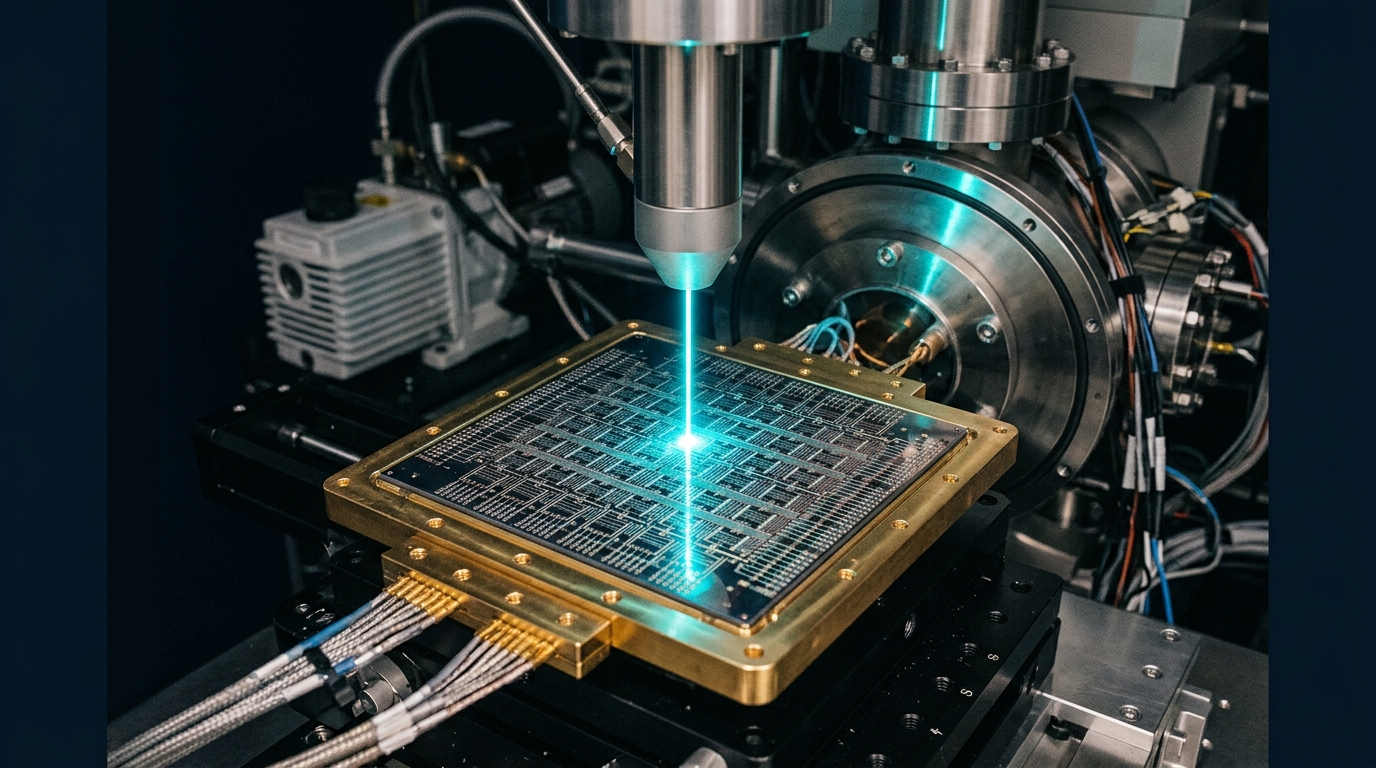
Multibeam is developing a solid-state quantum computing platform that uses multibeam electron optics to address individual qubits. The approach draws on precision electron-beam technology from the semiconductor lithography industry, aiming to achieve high-fidelity single- and two-qubit gates through parallel beam addressing. While the company has not publicly disclosed detailed qubit counts, gate fidelities, or error rates, its architecture is designed to scale beyond 1,000 qubits with low crosstalk—a key differentiator from approaches that rely on laser-based or microwave-based qubit control.
This electron-beam method is a niche within the broader quantum computing landscape. It sits alongside trapped-ion systems (IonQ, Quantinuum), superconducting circuits (IBM, Google), neutral atoms (QuEra, Atom Computing), and silicon spin qubits. The advantage Multibeam claims is the ability to address large arrays of qubits in parallel without the need for complex cryogenic wiring or individual laser beams, potentially reducing system complexity. However, the technology is still in its early stages—no publicly reported quantum volume or algorithmic benchmarks exist—and the road to fault tolerance will require demonstrating error rates below the threshold for surface codes or other error-correction protocols.
For calibration: IBM's road map targets 100,000 qubits by 2033, while IonQ has demonstrated 35 algorithmic qubits on its Aria system. QuEra's neutral-atom machine reached 48 logical qubits in 2025. Multibeam's electron-beam approach is younger, and the $205 million funding suggests investors are betting on its potential to leapfrog scalability bottlenecks, but the risk remains high.
Winners and Losers
The immediate winner is Multibeam, which now has the financial runway to accelerate hardware development and attract talent. Its investors—including the undisclosed strategic partners that participated in the financing—also gain from portfolio diversification in a market where quantum computing is still searching for a dominant architecture.
The losers are other early-stage quantum hardware startups competing for the same pool of institutional capital. In a funding environment where later-stage rounds are concentrating among a few players, a $205 million injection raises the bar for Series B and C rounds. Companies like Silicon Quantum Computing, Quantum Motion, and any other stealth-mode hardware startup may find it harder to attract large checks without comparable proximity to a technically differentiated platform.
For the broader quantum ecosystem, the funding and CFO hire signal that the market is not yet consolidating behind a single qubit modality. If Multibeam's electron-beam architecture can demonstrate a practical path to error correction, it could disrupt the trapped-ion and superconducting camps, potentially reshaping the competitive landscape. Cloud-access providers such as Amazon Braket and Microsoft Azure Quantum would benefit from adding a new hardware backend, while quantum software companies could see a new target for their optimization algorithms.
The Bigger Picture
The $205 million in strategic funding and financing places Multibeam among the better-funded private quantum computing companies in 2026. For context, Quantinuum raised $300 million in 2025, IonQ went public via SPAC in 2021 and has a market cap around $2 billion, and PsiQuantum has raised over $600 million. Multibeam's funding—likely a mix of equity and debt instruments—is on par with the $200 million Series D that Atom Computing closed in early 2025.
Government interest in quantum computing remains high. The U.S. CHIPS and Science Act continues to fund quantum research hubs, and the Department of Energy has earmarked billions for quantum information science. Multibeam's appointment of a CFO with deep experience in government contracting (Lam previously supported the company in securing financing) suggests the startup may be positioning itself to tap into these federal programs. Similarly, the EU's Quantum Flagship and other national initiatives are pouring billions into the sector, creating a competitive market for quantum hardware.
The CFO hire itself is a corporate governance move, not a technical milestone. But it aligns with a broader trend of quantum startups maturing their executive teams as they approach late-stage funding rounds. IonQ hired a CFO before its SPAC merger; Rigetti Computing brought on a new CFO in 2022 ahead of its public listing. The pattern is familiar: a company secures a large funding round, then brings in financial leadership to manage scaling, audits, and investor relations.
The Signal
The signal here is that Multibeam is moving from a research-heavy startup to a company that must now deliver on technical milestones with financial discipline. The $205 million is real, but the CFO hire is a standard operational step; what matters is whether the company can demonstrate a working quantum processor with a path to fault-tolerant operations within the next 18–24 months. Until then, the electron-beam approach remains a high-risk, high-reward bet. The absence of published technical benchmarks means the market is still taking the company's claims on faith bolstered by the size of its war chest. The next real test will be whether Multibeam can show quantum error correction or a commercially relevant algorithmic advantage.
In short: Multibeam's $205 million funding milestone and CFO appointment are a corporate scaling signal, but the quantum computing industry still awaits proof that its electron beam architecture can deliver practical qubits.