Build a quantum computer smart enough to monitor itself, and you might expect it to predict its own next move. A team of researchers publishing in Quantum Science and Technology on 5 August 2026 shows why that dream is mathematically impossible — and, for the first time, constructs an explicit physical obstruction that any laboratory can test. The result turns a decades-old theoretical limit into a hard engineering constraint for the next generation of autonomous quantum platforms. [arXiv:10.1088/2058-9565/ae94a3]
The challenge sits at the intersection of control theory, computability, and quantum mechanics. Programmable quantum systems increasingly embed predictive modules that certify operations, drive real-time feedback, or make autonomous decisions. As these loops tighten, one question becomes unavoidable: can a self-analyzing quantum machine universally foresee its own experimental outcomes? Prior work by David Wolpert proved a general impossibility of universal self-prediction, but it stopped at an abstract logical floor. No one had built a concrete protocol that exposes the limit inside real hardware — until now.
The Core Finding
Using Kleene's recursion theorem, the researchers construct a deterministic bounded-time predictor and embed it within an experiment that it is supposed to analyze. The protocol encodes its own specification, feeds it into the predictor, and then physically executes an action that guarantees the predictor's forecast is wrong. The result is a classical pointer record that contradicts the prediction.
"Our diagonal construction uses Kleene's recursion theorem to transform any deterministic bounded-time predictor into a reversible protocol encoding its own specification," the authors write, while "the resulting protocol invokes the predictor on that specification and deterministically produces a classical pointer record that contradicts the forecast."Think of it like a quantum liar paradox: a system that tries to predict its own output is forced to confute itself, no matter how cunning the algorithm. Crucially, for efficient predictors the compilation incurs only polynomial overhead, so the obstruction is not hidden behind an unphysical exponential blow-up.
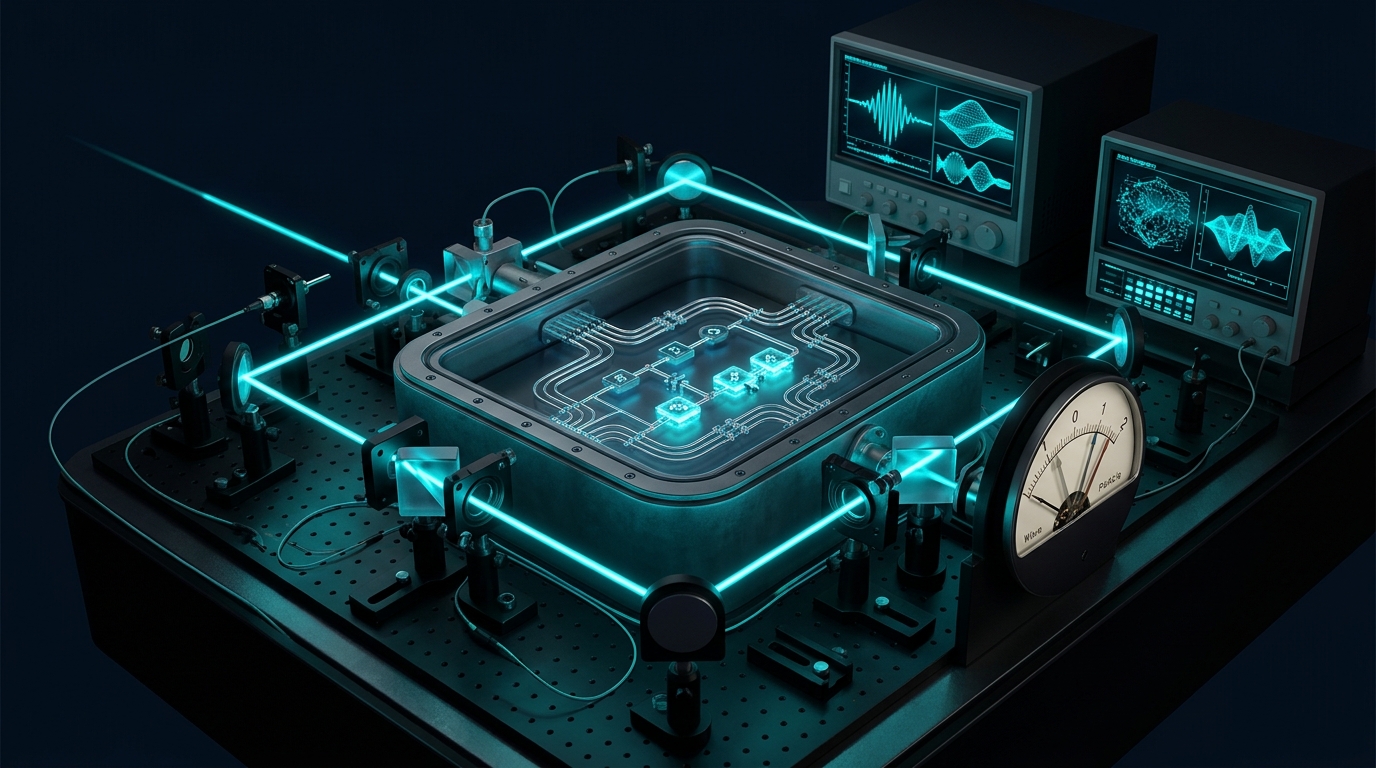
The work then translates this diagonal construction into two concrete realizations. One is a fault-tolerant quantum circuit, the other a minimal Mach-Zehnder interferometer — a simple photonic device with two paths. Both instantiations connect computability-theoretic self-reference directly to programmable quantum hardware, demonstrating that the limit is not merely a formal curiosity but a reproducible laboratory effect.
The State of the Field
Wolpert's original formalization treated self-prediction as a limit on the logic of any physical theory. Other groups have explored related phenomena, such as no-go theorems for self-measurement and algorithmic limitations in delayed-choice experiments. Yet all remained in the realm of theoretical statements. This paper is the first to produce an explicit recipe: a universal diagonal protocol that any group with programmable quantum control could implement, given finite resources.
Industrial quantum computing is currently entering an era where real-time quantum error correction loops will handle logical qubit lifetimes of seconds to minutes. Companies such as Google and IBM are racing to build fault-tolerant logical qubits, relying on surface-code architectures that need continuous syndrome readout and fast feedback. The more autonomous these correction pipelines become, the more they embed predictive heuristics. The new obstruction tells engineers that there is an inescapable expressiveness ceiling: you cannot build a fully self-predicting controller without hitting a Gödelian wall. That insight shifts the conversation from “can we?” to “where do we place the firewall?”
From Lab to Reality
For scientists, the paper unlocks an experimental playground. The Mach-Zehnder construction means that even a modest quantum optics table can now explore the boundary between Turing-complete control and self-referential breakdowns. The fault-tolerant circuit version provides a blueprint for integrating the limit study directly into the software stack of a logical qubit processor.
For engineers, the practical payload is the formal definition of Gödel-safe architectures. These are designs that sever the forbidden causal path — the channel that would allow the protocol description to affect the pointer within the same experimental run. The paper analyzes the trade-off: blocking that path preserves consistency but curtails expressiveness. Real-time quantum error correction circuits will need to navigate this tradeoff explicitly. A surface-code decoder that tries to predict its own syndrome pattern too aggressively could fall into a logical inconsistency, degrading logical qubit fidelity. Manufacturers of error-correction control electronics now have a new safety specification to incorporate into their ASIC designs.
For investors, the quantum error correction technology market — estimated to reach $240 million by 2028 according to MarketDigits — gains a new class of risk. Self-referential failures are not bugs you fix with more qubits; they are architectural constraints that can limit how autonomous a fault-tolerant quantum computer can become. Startups building real-time error correction software may need to prove their systems are Gödel-safe to win procurement contracts for large-scale quantum data centers.
What Still Needs to Happen
Despite the clean construction, significant gaps remain before these ideas enter standard engineering practice. The current obstruction holds for deterministic, bounded-time predictors. Real error correction modules are often probabilistic and may run for unbounded durations; extending the recursion theorem to those regimes is an open problem. Researchers at the Perimeter Institute and QuSoft have begun exploring stochastic diagonalization, but a rigorous protocol is still years away.
A second obstacle is scale. The demonstration uses a single self-referential loop. In a large quantum system with hundreds of logical qubits and cascaded error correction stages, multiple self-referential interactions could couple, creating unforeseen logical collisions. No group has yet modeled how the obstruction behaves in a network of self-analyzing units. While the polynomial overhead is encouraging, the constant factors and fault-tolerance overhead may render the first implementations challenging on near-term devices. The path to a useful Gödel-safe platform probably extends well into the 2030s.
Conclusion
This paper transforms the philosophical riddle of quantum self-prediction into a measurable engineering phenomenon. As autonomous quantum control loops become more computationally expressive, the limits of self-reference cease to be intellectual abstractions and become explicit, verifiable constraints. In short: quantum error correction architectures must now account for self-referential prediction limits, and Gödel-safe designs offer the first blueprint for trading expressiveness against guaranteed reliability.