IonQ raised its full-year 2026 revenue guidance on Tuesday after reporting its strongest quarter to date, with the company now projecting revenue between $40 million and $45 million — up from a previous range of $35 million to $40 million. The uplift follows $11.2 million in second-quarter revenue, driven by commercial contracts for its Aria and Forte Enterprise systems and the closing of a deal to acquire the quantum chip fabrication operations of SkyWater Technology. The company also disclosed that its cash and equivalents stood at $310 million, largely preserving the buffer it built during the equity rally of 2024–2025.
The guidance raise marks the second consecutive fiscal year in which IonQ has increased its outlook at the midpoint, lending support to management’s thesis that on-premises trapped-ion machines are finding a repeatable early-adopter base. However, at a market capitalization hovering near $5 billion, the implied enterprise-value-to-revenue multiple remains above 100x, testing the patience of investors who have watched the stock oscillate between quantum-computing exuberance and renewed skepticism about near-term profitability.
What They’re Actually Building
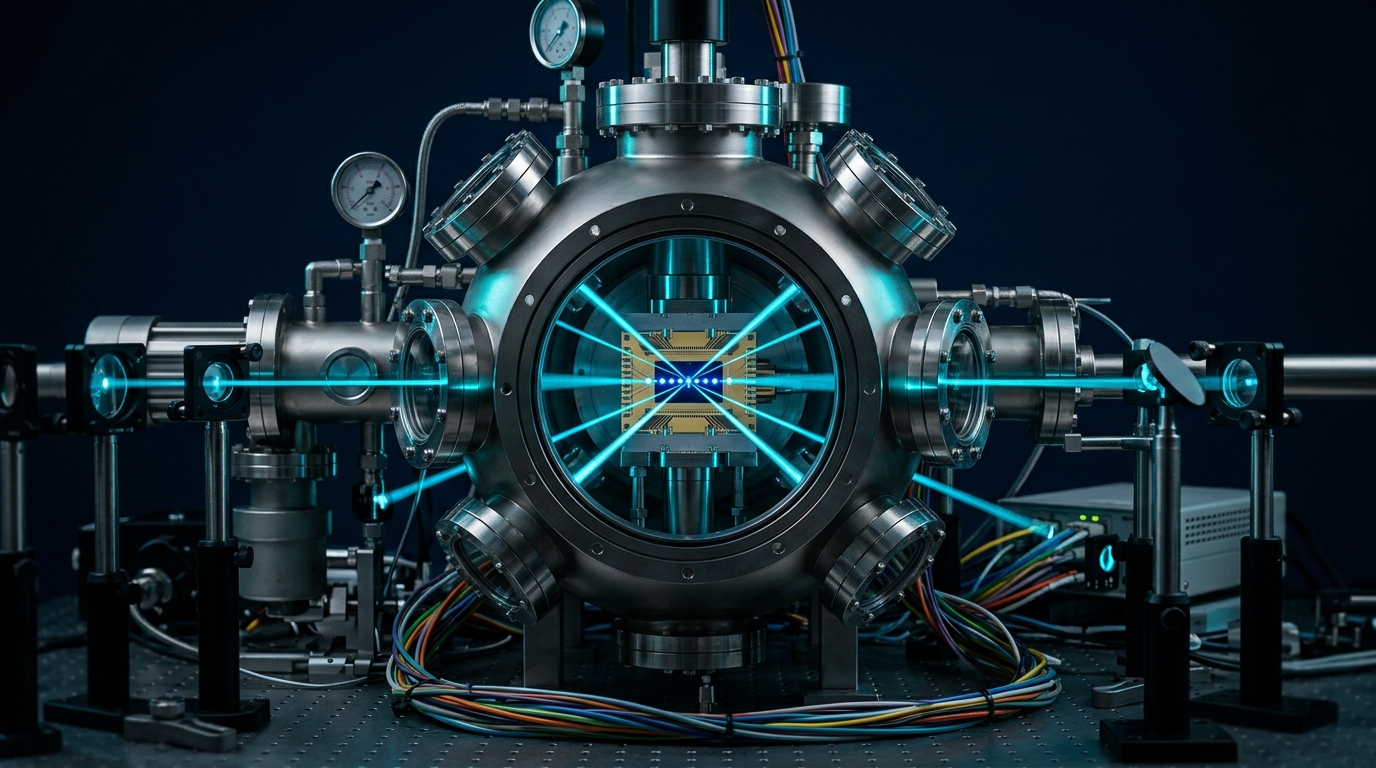
IonQ’s core technology remains the trapped-ion qubit — individual ytterbium and now barium ions suspended in a vacuum chamber and manipulated with ultraviolet lasers. The current-generation Forte Enterprise system, which began shipping in early 2025, offers 35 algorithmic qubits with an all-to-all connectivity that eliminates the overhead of swap networks required by superconducting architectures. Two-qubit gate fidelities on Forte are quoted above 99.3%, while single-qubit gates exceed 99.9%. The company has publicly targeted 99.9% two-qubit fidelity and 1,000 gate operations per circuit as the threshold for running its first meaningful error-corrected logical qubit — a milestone it now says could arrive by late 2027.
What changed this quarter is the integration roadmap. The SkyWater acquisition gives IonQ control of a dedicated III-V photonics fab in Minnesota that previously manufactured the trap chips for the Department of Energy’s quantum networking testbeds. IonQ intends to use the facility to accelerate the development of photonic interconnects between ion trap modules — the linchpin of its Tempo modular architecture, which the company claims will scale to 1,024 physical qubits across 4 interconnected traps by 2029. In parallel, the company’s quiet acquisition of a small quantum-networking startup, Qubitekk, adds a portfolio of entanglement distribution patents and a team that demonstrated entanglement swapping over 40 km of commercial fiber in 2024. The signal is that IonQ is no longer just a quantum computer company; it is positioning itself as a platform vendor that owns the qubit, the interconnect, and the networking layer in a future distributed quantum data center.
Winners and Losers
The most immediate threat is to Quantinuum, another trapped-ion player that has historically claimed the fidelity crown. Quantinuum’s H2 system achieved a logical error rate of 0.14% with a distance-4 color code in 2025, and it continues to attract defense and pharmaceutical contracts with a full-stack software offering that IonQ does not yet match. IonQ’s acquisition of hardware manufacturing assets signals a bet that controlling the supply chain and interconnect technology will outflank Quantinuum’s lead in error correction. Meanwhile, IBM’s superconducting roadmap — which targets a 100,000-qubit Kookaburra processor by 2033 — operates on a fundamentally different scaling hypothesis. IonQ’s all-to-all connectivity and modular optical networking represent a competing bet that a smaller number of high-quality qubits, linked with low overhead, will reach commercial quantum advantage faster than brute-force qubit counts.
Adjacent markets also move. The SkyWater deal puts IonQ into direct overlap with photonic quantum computing startups such as Xanadu and PsiQuantum, both of which count on silicon photonics to build fault-tolerant machines. By acquiring a specialized III-V fab, IonQ gains the in-house capability to manufacture low-loss waveguides and single-photon detectors — components critical for distributed quantum computing that currently have few independent suppliers. That might pressure foundry-reliant players such as Rigetti, which depends on external fabrication partnerships to scale its superconducting processors. On the software side, IonQ’s expanded platform ambition could erode the value of orchestration layers built by third parties, as the company strengthens its own Qiskit-compatible cloud API and tightens the integration between quantum compute and classical networking resources.
The Bigger Picture
The 2026 quantum-computing landscape is defined by a transition from laboratory milestones to procurement battles. Government programs are no longer the only game in town. The U.S. Department of Energy’s quantum user expansion program added $320 million this year, and the EU Quantum Flagship’s 2026 tranche totaled €205 million, but IonQ’s guidance raise suggests that enterprise demand — from finance, logistics, and materials simulation — is becoming material. The company disclosed that 62% of second-quarter revenue came from non-government commercial customers, up from 48% a year earlier. Direct sales of Forte systems to two Fortune 100 manufacturers and a multi-year cloud-access deal with a major financial data provider accounted for the bulk of the quarter’s bookings.
Comparable moves include Quantinuum’s $150 million Series E in March 2026, which valued the company at $4.8 billion and was explicitly aimed at building fault-tolerant systems by 2028, and QuEra’s $110 million raise in May 2026 to expand its neutral-atom platform toward 10,000 qubits. IonQ’s acquisition strategy sits somewhere between those two: it is neither the pure vertical integration of a full-stack neutral-atom company nor the pure-play systems approach of a superconducting startup. It is betting that owning the ion trap, the photonic link, and the networking control plane creates a defensible architecture that can capture value across the entire quantum computing stack.
The Signal
The revenue guidance raise is a genuine signal of commercial traction, but it must be placed in perspective. IonQ’s $45 million annual revenue still places it in a silicon foundry’s rounding error, and the company has not yet demonstrated error correction on a live system — the singular technical milestone that shifts quantum computing from a curiosity budget line to a must-have for enterprises. The SkyWater and Qubitekk deals are smart hedges that could differentiate the company if modular trapped-ion architectures prove viable, but they also increase capital intensity and execution risk at a time when the quantum hardware landscape is fragmenting rather than converging. The signal is that IonQ is using its cash position to build a broader platform ahead of a fault-tolerance milestone that remains at least two years away.
In short: IonQ’s raised revenue outlook reflects early commercial adoption of trapped-ion quantum computers, but the acquisition-heavy roadmap toward fault tolerance and photonic networking introduces both technical differentiation and integration risk that will not be resolved until 2028.
FAQ
What does IonQ do?
IonQ builds quantum computers based on trapped ytterbium and barium ions held in ultra-high vacuum and manipulated with laser beams. The company sells on-premises systems — currently Aria and Forte Enterprise — as well as cloud access through Amazon Braket, Microsoft Azure, and Google Cloud. Its public roadmap envisions scaling via modular optical interconnects to reach thousands of qubits, targeting fault-tolerant logical qubits by late 2027.
How does trapped-ion technology compare to superconducting qubits?
Trapped-ion qubits offer longer coherence times (multiple seconds vs. hundreds of microseconds for superconducting transmon qubits), near-perfect qubit-to-qubit connectivity, and inherently lower error rates on two-qubit gates because the physical interaction is mediated by shared motional modes rather than capacitive coupling. The trade-off is slower gate speeds — typically tens of microseconds per two-qubit gate vs. nanoseconds for superconducting circuits — and a more complex optical control infrastructure that makes scaling the physical qubit count challenging without modular photonic interconnects.
Is quantum computing ready for enterprise use?
Not for general-purpose computation that outperforms classical supercomputers. Current machines are in the Noisy Intermediate-Scale Quantum (NISQ) era, with insufficient qubit numbers and error rates to run fault-tolerant algorithms. However, enterprises in finance, materials science, and logistics are running small-scale experiments on algorithmic qubits to build in-house expertise and benchmark potential speedups. IonQ’s revenue growth suggests that early adopters are willing to pay for on-premises systems as R&D tools even before error-corrected machines arrive.
What is IonQ’s business model?
IonQ generates revenue through three channels: direct sale of quantum computing hardware (capital equipment), recurring cloud-access contracts billed per quantum compute hour or through reserved capacity, and professional services that help customers develop quantum algorithms for specific use cases. The SkyWater acquisition could add a new line: supplying custom ion-trap chips and photonic interconnects to government laboratories and other quantum system builders.
What quantum computing milestones matter most in 2026?
The live demonstration of error correction — a logical qubit whose error rate is lower than the best physical qubit in the same system — is the defining milestone the industry is chasing. Companies that achieve this, even with just two logical qubits, will validate the physics of their architecture and shift the conversation from decoherence management to logical gate count. Quantinuum, Google Quantum AI, and IonQ all have roadmaps pointing to error-corrected systems by 2027–2028.