The first video ever rendered on a quantum computer exists. It is not a wireframe cube or a procedural noise field. It is a recognizable scene with object primitives, transformations, duplications, and topologically non-trivial smears, generated by a method that exploits the very properties that make quantum computing hard: superposition, interference, and the controlled creation of specific quantum states. A preprint uploaded to arXiv on June 26, 2026, describes a general-purpose rendering technique that runs on today's noisy, small-scale devices and lays out a path to a genuine speed-up as hardware matures. [arXiv:2608.04022]
The Connection
This rendering breakthrough and D-Wave Quantum Inc.'s August 2026 demonstration of a 99.9% fidelity two-qubit entangling gate are two halves of the same argument. The rendering paper proves that useful, visually compelling computation can happen now on NISQ hardware if the algorithm is designed to be native to quantum mechanics. D-Wave's gate proves that the hardware required to run such algorithms at scale is arriving faster than the consensus roadmap predicted. This matters because the combination of application-layer creativity and hardware-layer fidelity is what transforms quantum computing from a science experiment into an engineering platform. The timing is not coincidental: both results exploit the same underlying insight that error need not be eliminated before useful work begins.
How It Works
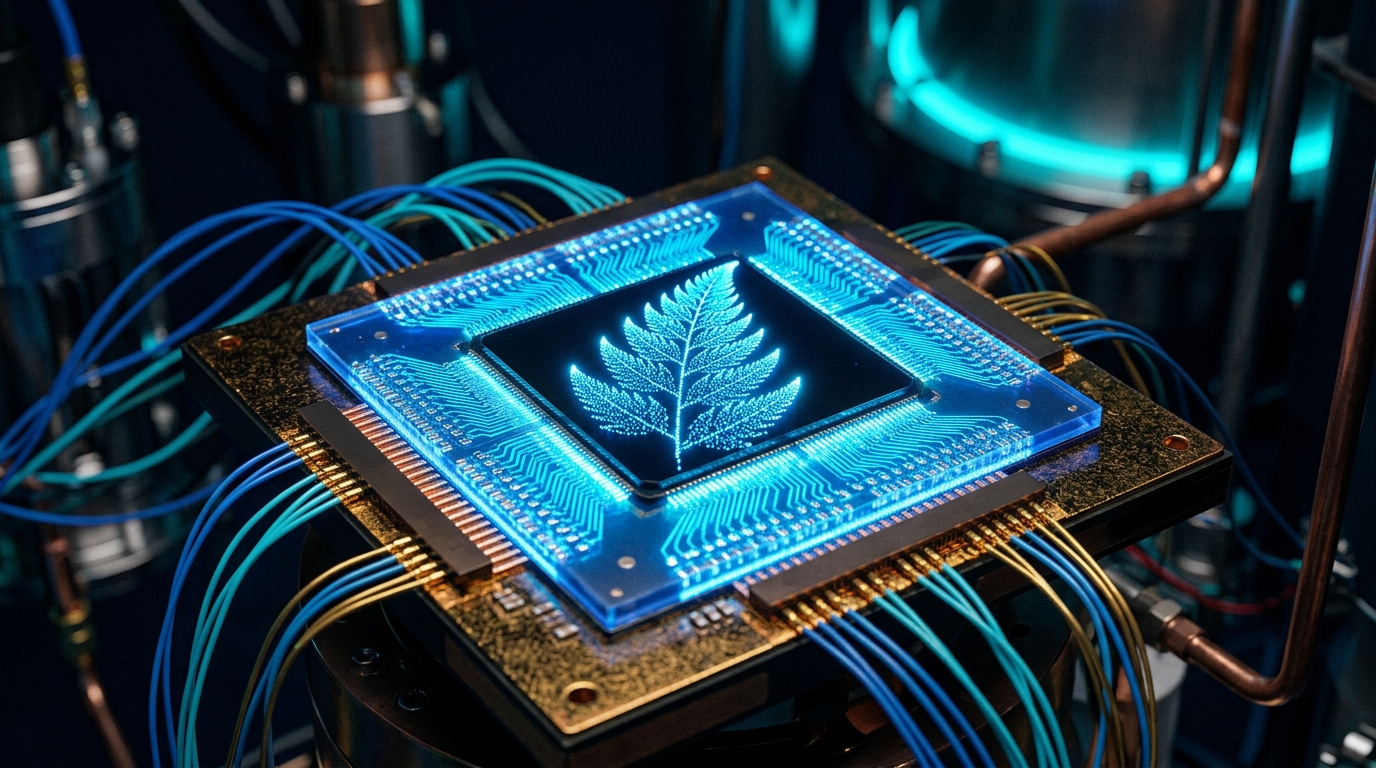
The rendering method extends Composable Function Systems (CFSs) to quantum architectures. Classical CFSs build complex images by iteratively applying a set of simple mathematical transformations—affine maps—to points in a plane. Think of a fern leaf: a few equations, repeated thousands of times, produce an intricate fractal. The quantum adaptation encodes these transformation functions as unitary operators acting on qubit registers. Instead of iterating sequentially, the quantum version prepares a superposition over transformation indices and applies them in parallel, leveraging amplitude amplification to concentrate probability mass on the pixels that form the desired image.
The authors—whose identities are not yet available in the preprint metadata—address a specific limitation of classical CFSs: the computational cost of evaluating many transformations scales linearly with the number of functions. The quantum implementation prepares a superposition across all functions simultaneously. "The controlled creation of specific quantum states is a highly challenging field of research that is also in high demand with applications in various quantum technologies," the abstract states, framing the work as a contribution to state-preparation science as much as to computer graphics. The physical maps necessary for object primitives, duplications, and smears are encoded directly into the structure of the quantum circuit, making the rendering pipeline native to the hardware rather than a classical algorithm awkwardly ported.
The key mechanism is a quantum walk over a function set, where each step applies a transformation conditioned on a qubit register that indexes the function. Measurement collapses the walk onto a specific pixel coordinate. Repeat this process many times—each run is a single sample—and the accumulated measurements reconstruct the image. On classical hardware, rendering a complex scene requires millions of sequential function evaluations. On quantum hardware, the number of circuit executions scales with the desired resolution, not the complexity of the scene. This is where the speed-up lives.
Who's Moving
D-Wave Quantum Inc. (NYSE: QBTS) published the gate-fidelity result in Nature in August 2026, achieving approximately 99.9% fidelity for a two-qubit entangling gate in about 500 nanoseconds on its superconducting dual-rail qubit architecture. The dual-rail design encodes each logical qubit in two physical qubits, creating a built-in error-detection mechanism that preserves an experimentally observed error hierarchy. Simulations reported in the paper suggest an error-reduction factor approaching 10 under favorable assumptions, directly reducing the physical qubit overhead required for full fault tolerance. D-Wave's public roadmap targets a 100-logical-qubit system by 2032.
IBM (NYSE: IBM) remains the other pole of the superconducting qubit race. Its 1,121-qubit Condor processor, unveiled in late 2023, established the scale frontier, and the company's 2025 Heron revision demonstrated gate fidelities crossing the 99.5% threshold on a 133-qubit device. Google Quantum AI, operating under Alphabet (NASDAQ: GOOGL), continues advancing its surface-code architecture on the Sycamore-class processors, with the 2025 Willow chip demonstrating exponential error suppression below the surface-code threshold. IonQ (NYSE: IONQ) and Quantinuum push the trapped-ion approach, with Quantinuum's H2 processor achieving 99.8% two-qubit gate fidelity in 2025. The rendering paper does not disclose its execution hardware, but the method is architecture-agnostic, designed to run on any gate-model quantum device with sufficient qubit count and circuit depth.
Why 2026 Is Different
Three things converge in 2026 that did not exist in 2024. First, gate fidelities on multiple platforms now exceed 99.9%, the threshold where surface-code error correction becomes practical rather than theoretical. Second, the number of available physical qubits on superconducting processors exceeds 1,000, providing the raw material for encoding the first logical qubits with meaningful error suppression. Third, application-layer researchers have stopped waiting for fault tolerance and are designing algorithms that extract useful work from noisy devices today. The rendering paper is exhibit A for this third shift. Within 12 months, expect the first demonstration of a logical qubit with a lifetime exceeding its constituent physical qubits by a factor of 10. Within three years, a 10-logical-qubit system will run a scientifically useful simulation that cannot be replicated on a classical GPU cluster. Within five years, the 100-logical-qubit target enters the engineering phase, not the science phase. The quantum computing market, valued at $1.2 billion in 2025 by McKinsey, tracks toward $8 billion by 2030 on the strength of these hardware milestones.
Conclusion
The rendering paper and the D-Wave gate result tell the same story from opposite ends of the stack. At the bottom, qubit fidelity crosses the threshold where error correction stops being a research problem and starts being an engineering one. At the top, algorithm designers treat today's noisy qubits not as broken classical bits but as a native computational medium with its own expressive vocabulary. The result is a video rendered on a quantum computer—a signal that the NISQ era is not a waiting room but a workshop. In short: quantum error correction at 99.9% gate fidelity transforms noisy physical qubits into reliable logical qubits, and the first quantum-rendered video proves useful computation begins before perfection arrives.
Frequently Asked Questions
What is quantum error correction? Quantum error correction is a set of protocols that protect fragile quantum information from decoherence and operational noise by encoding a single logical qubit across multiple physical qubits. The dominant approach, the surface code, uses a 2D lattice of physical qubits where syndrome measurements detect errors without collapsing the logical state. When physical gate fidelities exceed approximately 99.9%, the surface code suppresses errors exponentially as the code distance increases. D-Wave's dual-rail architecture achieves this threshold in 2026.
How does dual-rail qubit encoding compare to the surface code? Dual-rail encoding maps one logical qubit onto exactly two physical qubits and detects errors by monitoring whether the qubits remain in a defined subspace. It is hardware-efficient but provides only error detection, not full correction. The surface code requires a larger qubit overhead—typically 1,000 to 10,000 physical qubits per logical qubit—but delivers universal fault tolerance. D-Wave's dual-rail approach targets near-term error suppression with low overhead, while Google and IBM pursue surface-code architectures for the long term.
When will quantum rendering be commercially available? Quantum rendering as demonstrated in the 2026 arXiv paper is a research milestone, not a commercial product. The method requires repeated circuit executions to accumulate pixel samples, and current hardware runs each sample in milliseconds to seconds. Commercial availability for rendering applications depends on two advances: faster circuit execution times and higher qubit counts to increase resolution. These align with the broader logical-qubit roadmap, placing practical quantum rendering in the 2028–2030 window, assuming the 100-logical-qubit milestone arrives on schedule.
Which companies are leading in fault-tolerant quantum computing? D-Wave Quantum Inc. (NYSE: QBTS) leads in dual-rail architectures with its 2026 Nature demonstration. IBM (NYSE: IBM) leads in superconducting qubit scale with the 1,121-qubit Condor processor and is advancing its own surface-code implementation. Google Quantum AI (Alphabet, NASDAQ: GOOGL) demonstrated exponential error suppression on the Willow chip in 2025. Quantinuum's trapped-ion H2 processor achieved 99.8% two-qubit gate fidelity. IonQ (NYSE: IONQ) targets photonic interconnects for scaling trapped-ion systems. Each company pursues a distinct path to the same goal: a logical qubit that outlives its physical constituents.
What are the biggest obstacles to quantum computing adoption? The primary obstacle is decoherence: quantum states decay before useful computation completes. Gate fidelity must exceed 99.9% for error correction to function, and even at that threshold, the physical-qubit overhead for a single logical qubit remains in the hundreds to thousands. A secondary obstacle is the talent gap: quantum algorithm design requires fluency in linear algebra, quantum mechanics, and classical optimization that few practitioners possess. The rendering paper addresses this by demonstrating a creative application that does not require a PhD in quantum information theory to understand the output, even if the implementation demands deep expertise.