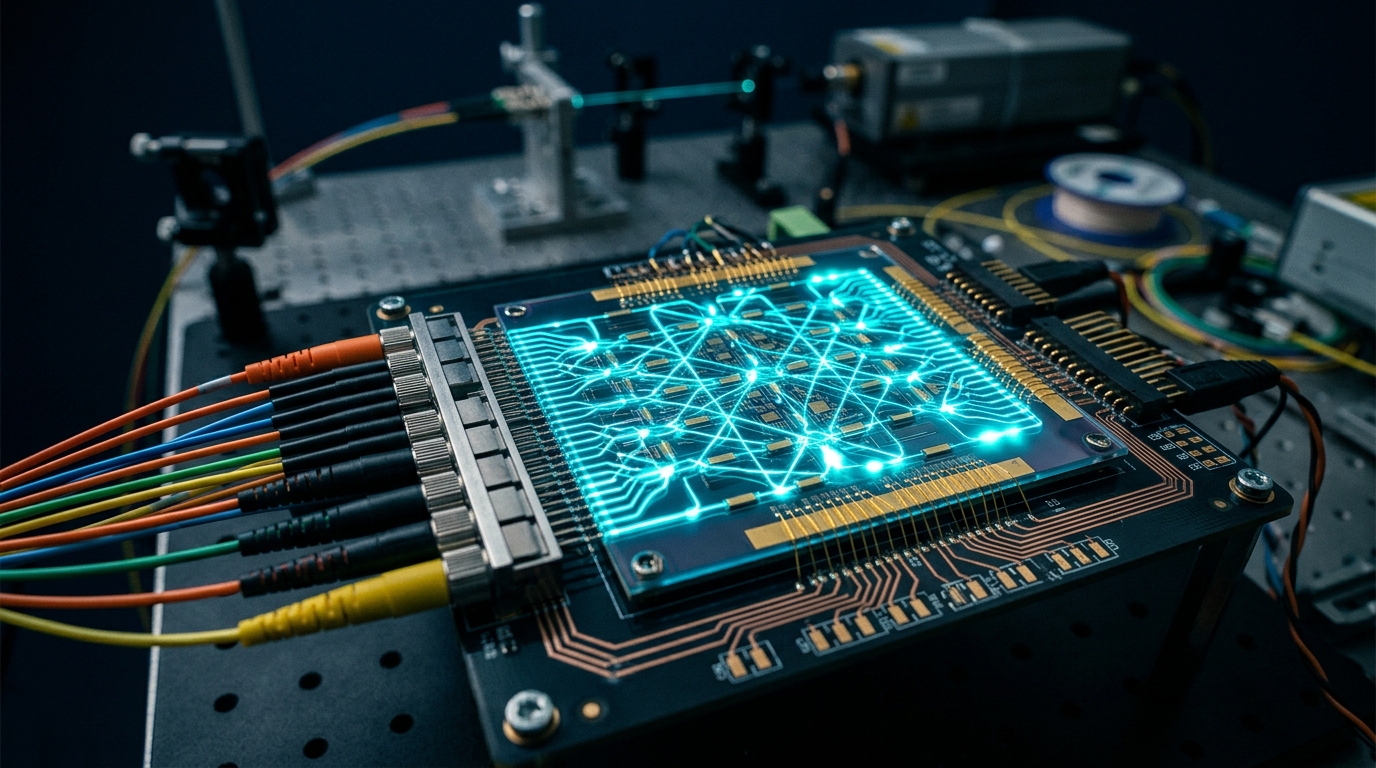
A rack-mountable photonic quantum computing processor with 32 modes is now commercially available, yet the world’s most advanced superconducting quantum computers cannot natively explore six-dimensional quantum states without elaborate embedding tricks. The contrast cuts to the core of a hardware race that quietly intensified in August 2026. While one camp ships programmable integrated photonics for high-dimensional quantum optics, the other builds ever-larger qubit grids that still see the number six as an awkward guest.
The connection is not incidental. On July 12, 2026, an international collaboration posted a preprint on arXiv ([arXiv:2607.10615]) describing a reproducible software workflow to optimize approximate mutually unbiased bases (AMUBs) in dimension six. To run those six-dimensional unitaries on IBM’s 156-qubit Heron processor, the team had to embed them into three-qubit 8×8 unitaries and post-select on a subspace—a workaround that left performance dominated by a hardware and compilation noise floor. Just three weeks later, on August 5, the Dutch startup QuiX Quantum announced commercial availability of its Alquor 2.0 programmable photonic platform, a machine that can implement arbitrary six-dimensional unitaries directly, without any embedding at all. The timing underscores a structural division: photonics handles higher-dimensional Hilbert spaces natively, while qubit machines are forced into expensive encodings.
How It Works
Mutually unbiased bases are a foundational concept in quantum information. Two orthonormal bases in a d-dimensional Hilbert space are mutually unbiased if the squared overlap between any vector from the first basis and any vector from the second is exactly 1/d. Complete sets of MUBs are critical for quantum state tomography, quantum key distribution, and certifying high-dimensional entanglement. In dimension six—the smallest dimension that is not a prime power—it remains an open problem whether a full set of seven MUBs even exists.
The preprint team approached the problem by optimizing approximate MUB configurations using a Lie-algebra unitary parameterization and a Taylor-series matrix exponential layer, which allowed the code to run accelerators including GPUs and Apple’s MPS. They searched for optimal unanchored configurations across 100 random seeds for basis counts of 3, 4, 5, and 6.
“The workflow recovers exact three-basis configurations, identifies a recurrent four-basis partial-exact hub-and-triangle structure.”No near-exact pairs emerged for 5 or 6 bases under the primary tolerance. To physically validate the best 4-basis solution, the team embedded the transition unitaries into a three-qubit circuit and executed it on IBM’s ibm-marrakesh Heron device. The resulting pairwise losses sat at 0.02–0.08, indistinguishable from the hardware noise floor generated by circuits averaging 37 native CZ gates.
A photonic quantum computing approach sidesteps that entire embedding. On a processor like the Alquor 2.0, built from silicon nitride photonic integrated circuits, a programmable mesh of tunable beam splitters and phase shifters implements arbitrary unitary transformations across up to 32 spatial modes. Each mode encodes a qudit level. To implement a dimension-6 unitary, an experimenter simply programs the interferometer to act on 6 of those modes—no post-selection, no wasted Hilbert space. The same interferometer can also generate and measure high-dimensional quantum interference and photon entanglement, placing the complexity where it belongs: in the hardware’s native degrees of freedom.
Who's Moving
QuiX Quantum’s Alquor 2.0 arrives as a rack-mountable 19-inch system in 8-, 20-, and 32-mode configurations, built on the company’s silicon nitride PIC platform. QuiX Quantum, a spinout from the University of Twente, is led by co-founder and principal scientist Alexander Brinkman. The company has not disclosed the pricing of the commercial units, but the launch marks a concrete step from research-grade optics to deployable quantum photonic hardware.
The broader photonic quantum computing landscape is capitalized and crowded. PsiQuantum, co-founded by Imperial College London professor Terry Rudolph, closed a $450 million Series D funding round in 2023 to build a fault-tolerant photonic quantum computer using fusion-based architectures. Xanadu, led by CEO Christian Weedbrook, continues to develop its X-series photonic processors and the open-source Strawberry Fields software platform. ORCA Computing in the UK is deploying quantum memory-enhanced photonic systems. On the competing superconducting side, IBM (NYSE: IBM) has pushed its Heron processor into production, but the MUB preprint shows that even state-of-the-art qubit chips need significant overhead to tackle nontrivial finite-dimensional quantum information problems.
Why 2026 Is Different
The shift is not just about another photonic chip; it is about programmability and commercial availability. In 2026, a research group can order a 32-mode Alquor 2.0, program arbitrary linear optical unitaries, and start probing dimension-6, dimension-8, or dimension-20 MUB landscapes within weeks. Within 12 months, expect the first photonic AMUB experiments that directly compare native high-dimensional loss with the embedded qubit results from the July preprint. Within three years, photonic platforms exceeding 100 modes will enable systematic exploration of open problems in Hilbert space geometry that have frustrated mathematicians for decades. Within five years, these same reconfigurable interferometers will underpin high-dimensional quantum key distribution networks operating in real-world fiber.
The superconducting ecosystem is not standing still. IBM will integrate error mitigation and larger grids, and other modalities like trapped ions offer native qudit access. But the photonic quantum computing advantage for discrete high-dimensional problems is architectural: the number of modes scales with chip real estate, not with the gate overhead of embedding a d-level system into a qubit register. The arrival of a commercial, programmable photonic processor in 2026 turns that advantage from a theoretical argument into an experiment you can schedule on your own hardware.
In short: Photonic quantum computing’s commercial 32-mode processor eliminates the embedding bottleneck that forces superconducting qubits into error-prone post-selection for high-dimensional mutually unbiased bases.