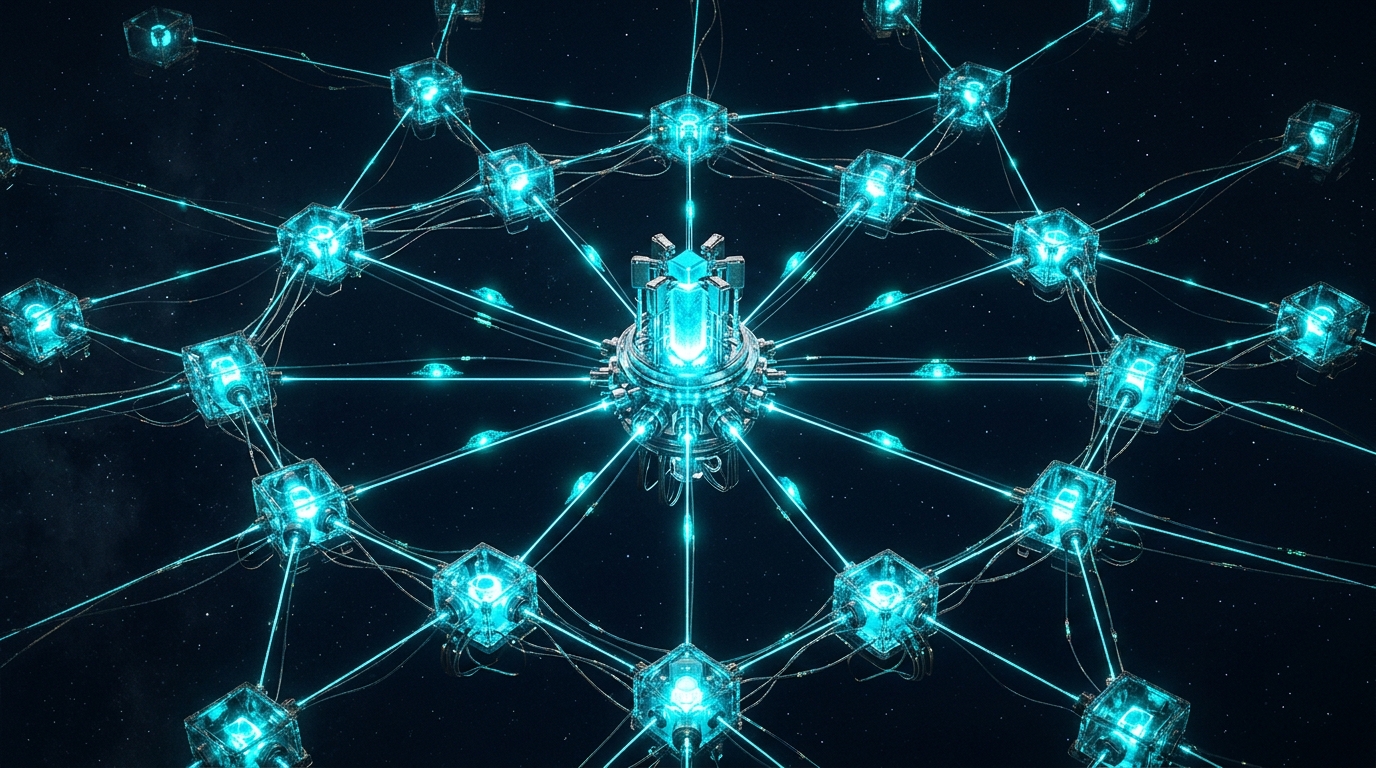
For decades, quantum information scientists have chased a deceptively simple question: how much classical communication do you really need to simulate the correlations that quantum particles produce naturally? In bipartite scenarios, the answer often involves subtle trade-offs. But when the network grows to a star — a central node linked to many senders — the picture has been murky. Until now. [arXiv:2608.03986]
A team of researchers (affiliation listed in the full preprint) has answered that question with a striking lower bound. In a paper posted to arXiv on August 4, 2026, they prove that a specific, perfect-coordination task on a star network forces any classical strategy to transmit an amount of data that grows exponentially with the number of parties and the dimension of the quantum systems. The result doesn't just tighten a theoretical loose end; it supplies a rigorous benchmark for exactly when and why quantum networks can outpace classical ones.
The Core Finding
The authors design an exclusion task. In this distributed game, each of n parties holds a classical input and can send a message to a central node. The central node must then output an outcome that rules out one specific combination of all the inputs, and it must do so perfectly every time. When each party is allowed to send a single quantum system of dimension d — a qudit — the task is provably trivial: a suitable joint measurement on the central node always succeeds.
Classical messages, however, face a steep price. The paper establishes that if each of the n parties sends a classical message, the central node cannot solve the task with certainty unless each message contains at least n(d–1) symbols. For even modest parameters — say, ten parties each holding a four-dimensional quantum system — the classical message size balloons to thousands of symbols per sender, far exceeding the qudit's information capacity.
“The task cannot be solved with certainty if each of the n parties sends a classical message with less than n^{(d-1)} symbols.”
Think of it like a network of flashlights and a central camera. If each flashlight can emit one of d colors, a quantum strategy lets every party send a single photon in a superposition of colors; the camera performs one collective measurement and instantly identifies which color combination was absent. A classical strategy would have to ship color catalogues of exponentially growing size. The separation is not just large — it scales with both the number of parties and the quantum dimension, revealing an advantage that classical simulation cannot erase by adding a few extra bits.
The State of the Field
Quantum communication complexity has a long pedigree. Seminal work by Buhrman, Cleve, and Wigderson in the 1990s showed that quantum messages could slash the communication needed for certain functions. More recently, network nonlocality and the study of star-network correlations have gained traction as building blocks for the quantum internet. Yet previous results often focused on probabilistic success, specific functions, or didn't provide a clean, dimension-dependent lower bound for perfect success. The new paper fills that gap by delivering a crisp, unconditional lower bound on classical message size in a task that quantum systems solve with certainty.
What makes this approach different is the construction of the exclusion task itself. It leverages the structure of joint measurements that are possible on quantum systems but have no analogue in classical probability — a phenomenon rooted in the incompatibility of quantum observables. By tying the lower bound to the number of systems measured simultaneously and their Hilbert-space dimension, the proof sidesteps the need for large-scale entanglement distillation or error correction that plagues other advantage demonstrations. This simplicity is its strength.
The broader quantum landscape in 2026 is hungry for such clean separations. As experimentalists string together small quantum processors into metropolitan-scale networks, theory must provide testable, no-go theorems that certify genuine quantum behaviour. This paper delivers exactly that: a target protocol that can be attempted in the lab and, if successful, would stand as a cryptographic-grade proof that the network has operated beyond classical limits.
From Lab to Reality
For researchers, the result unlocks a new class of benchmarks for quantum network testbeds. The exclusion task requires a central node capable of performing a specific joint measurement — a feat already within reach for small n and low d using trapped ions or photonic chips. Experimental groups can now say, “If we build a star network of five qudits and succeed at this task, we have demonstrated a provable quantum advantage in communication complexity.”
For engineers working on secure delegation of computation, the protocol suggests a primitive for classical-verifier quantum-advantage models. A bank, for instance, could outsource a computation to a quantum server while being mathematically certain that no classical cloud could have forged the result — all without needing a full-blown quantum computer at every branch. The quantum communication market, projected by some analysts to reach $5.5 billion by 2030, would absorb such primitives as it shifts from point-to-point quantum key distribution to multi-node trusted networks.
Investors looking at quantum infrastructure should note that the paper doesn't rely on large-scale fault-tolerant quantum computers. It points toward early-revenue devices: small, special-purpose quantum transmitters and receivers that implement precise joint measurements. Startups like Qunnect and Aliro are already commercializing components for entanglement distribution; the exclusion task gives them a clear performance target that is both scientifically rigorous and easy to explain to customers.
What Still Needs to Happen
The most obvious obstacle is noise. The theoretical bound assumes perfect quantum state preparation, transmission, and measurement. In any real fibre or free-space link, photon loss, decoherence, and detector imperfections will erode the success probability. Extending the lower bound to the realistic, high-fidelity-but-not-perfect regime is an open problem. A group led by Stefano Pirandola at the University of York has been developing composable security frameworks for quantum networks; their tools might quantify how much noise can be tolerated before the classical simulation cost collapses.
A second challenge is scaling the central measurement. The joint measurement that reads out the excluded combination becomes increasingly complex as n grows, requiring multi-qudit interactions that are hard to implement without introducing errors. Quantum network researchers at QuTech in Delft, including Stephanie Wehner and colleagues, are prototyping nodes that can perform three- and four-party measurements. But a general-purpose, low-error joint measurement for arbitrary n is still a hardware dream. Without it, the protocol remains a proof of principle rather than a deployable service.
Conclusion
In short: a star-network quantum exclusion task forces classical simulation to require a message size that scales as n(d–1), proving an exponential communication advantage for even modest quantum systems.
Frequently Asked Questions
What is an exclusion task?
An exclusion task is a distributed game in which multiple senders each hold a piece of classical information and send messages to a central receiver. The receiver must output an outcome that rules out one specific combination of all the senders' inputs. In the quantum version, senders transmit quantum states and the receiver performs a joint measurement.
How does the quantum protocol work?
Each party encodes its classical input into one of d orthogonal states of a qudit and sends that qudit to the central node. The central node performs a carefully designed joint measurement on all n qudits. This measurement acts on the whole collection at once and produces a result that perfectly identifies the excluded combination, owing to the incompatibility of observables that has no classical counterpart.
How does this compare to previous quantum communication advantages?
Earlier results typically required many rounds of interactive communication or gave an advantage only in terms of bounded-error probability. By demanding perfect success, the new lower bound is unconditional and directly ties the classical simulation cost to the Hilbert-space dimension. It also applies to a star network, which models the client-server architecture of future quantum internet nodes more closely than pairwise links.
When could this be commercially relevant?
The first commercial relevance could appear within five to ten years, as metropolitan quantum networks mature and offer secure-delegation services. The protocol's hardware requirements — small qudits and a central measurement station — align with devices already being tested by telecom operators and defence contractors for quantum-secured communications.
Which industries would benefit most?
Cybersecurity would benefit first, through provably classically unspoofable verification of remote quantum computations. Finance and critical infrastructure could use it to outsource sensitive calculations to quantum nodes without trusting the node's internal workings. Longer term, distributed sensing networks could exploit the same star-topology correlations to enhance measurement precision beyond classical limits.
What are the current limitations of this research?
The main limitation is the assumption of perfect noiseless devices. Real-world optical losses and detector imperfections will reduce the success probability below unity, and the paper does not provide a threshold at which the classical simulation cost evaporates. Scaling the central joint measurement to many parties also remains an experimental hurdle that will require advances in multi-qudit gates.