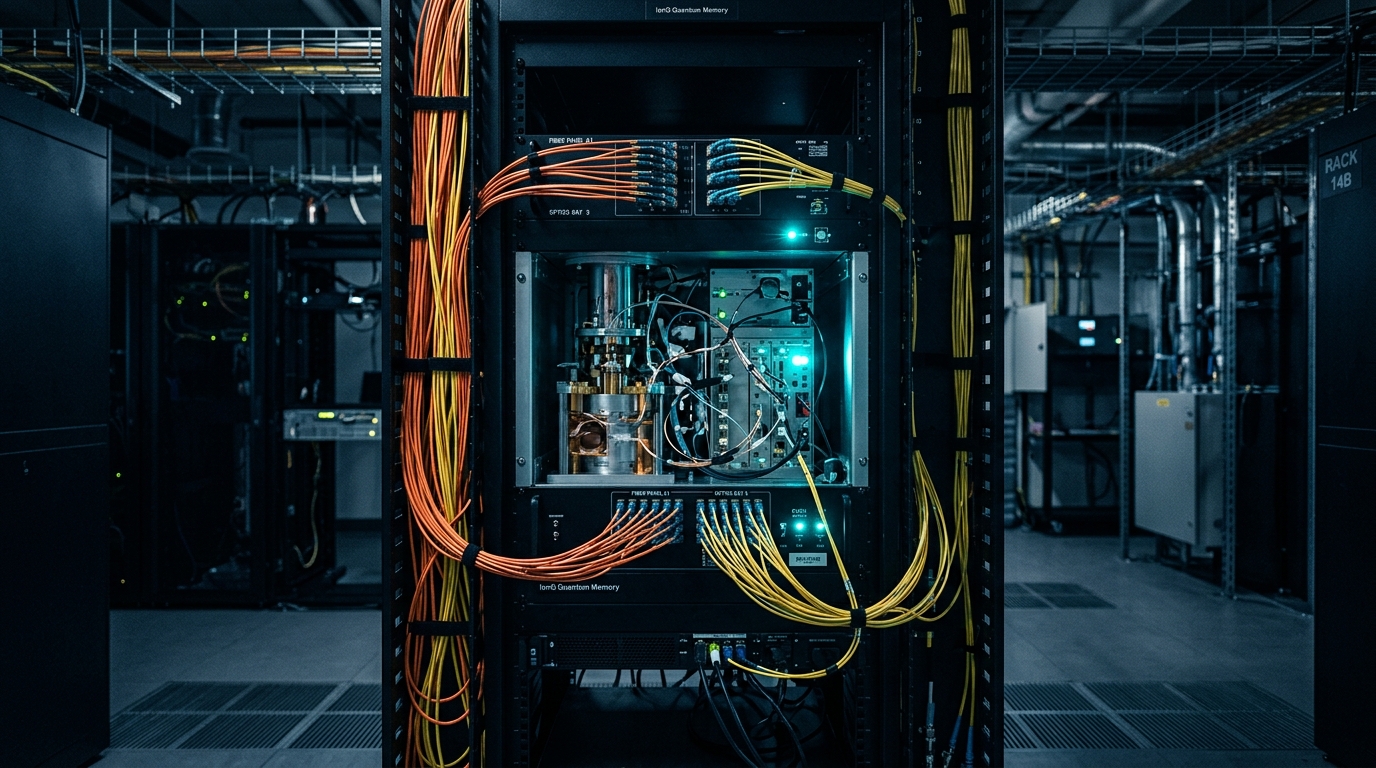
On August 4, 2026, IonQ announced two initiatives: a memorandum of understanding with Sandia National Laboratories to accelerate quantum co-design for national security, and the launch of the Tennessee Quantum Communications Research Center with Chattanooga utility EPB. The center is backed by a five-year, $15 million commitment from EPB and will house what IonQ describes as the first commercial quantum memory operating on a live fiber network.
The moves deepen IonQ’s footprint in New Mexico—where it already collaborates with Sandia on ion-trap fabrication—and in Chattanooga, home to the EPB Quantum Center established in 2024. No new equity funding was disclosed; the $15 million is a project commitment from EPB, not an investment in IonQ.
What They're Actually Building
IonQ’s core technology remains trapped-ion quantum computing. Its most advanced system, IonQ Tempo, launched in late 2025 with 64 algorithmic qubits and a roadmap targeting 1,024 qubits by 2028. The company uses ytterbium ions held in electromagnetic traps, manipulated with lasers to perform gates with single-qubit fidelities above 99.99% and two-qubit fidelities around 99.9%. These numbers place IonQ among the fidelity leaders, though qubit count lags behind superconducting competitors: IBM’s 1,121-qubit Condor debuted in 2023, and Google’s 105-qubit Willow chip in 2024 demonstrated exponential error suppression with logical qubits.
The quantum memory device at the heart of the Tennessee center is a different beast. Quantum memory stores a quantum state—typically a photonic qubit—in a material or atomic system for later retrieval, a critical component for quantum repeaters that extend entanglement distribution beyond direct fiber loss limits. IonQ has not disclosed the memory’s physical implementation, storage time, fidelity, or wavelength compatibility. The company says it is “commercial” because it will be deployed on EPB’s existing fiber network, but no customers or service-level agreements have been announced.
Trapped ions themselves can serve as excellent quantum memories. Their hyperfine ground states have coherence times measured in minutes, far longer than photonic or solid-state alternatives. IonQ may be adapting its ion-trap technology to store photonic qubits by mapping the photon’s state onto an ion and later retrieving it. This would require frequency conversion between telecom wavelengths (1550 nm) and the ion’s optical transition (typically 369 nm for ytterbium), a non-trivial engineering challenge. If successful, the memory could become a building block for a trapped-ion quantum repeater.
By comparison, academic groups have demonstrated quantum memories with storage times from microseconds to milliseconds using warm atomic vapors, rare-earth-doped crystals, and diamond color centers. Startups such as Qunnect and MemQ have tested memories on deployed fiber in the New York and Chicago areas. IonQ’s claim of “first commercial” likely refers to a permanent installation integrated into a utility’s operational network, rather than a temporary field trial. Without published metrics, the device’s performance cannot be assessed.
Winners and Losers
The Sandia MOU positions IonQ to compete more directly for Department of Energy and Department of Defense quantum computing contracts. Quantinuum, which already works with Sandia and Los Alamos, is the incumbent in trapped-ion national security work. IBM and Rigetti also hold significant federal quantum contracts. The co-design angle—jointly developing algorithms and hardware for specific national security problems—mirrors how classical supercomputing vendors partner with labs. If the MOU leads to a funded program, IonQ could gain a foothold in the classified quantum computing market.
The EPB center puts IonQ into the quantum networking arena, where it has not previously been a player. This threatens photonic quantum computing companies like Xanadu and PsiQuantum, which view networking as a natural extension of their optical platforms. It also pressures quantum memory startups that aim to sell components to network operators. For EPB, the center reinforces its brand as a municipal utility investing in advanced technology; the city of Chattanooga has marketed itself as a “quantum city” since 2024. EPB’s existing quantum center already hosts a quantum key distribution (QKD) link and a node on the DOE's quantum network testbed.
From an investment perspective, IonQ’s diversification into networking could open a new addressable market beyond cloud-accessible quantum processing units (QPUs). However, the $15 million commitment is modest—roughly the cost of a single high-end dilution refrigerator for superconducting qubits—and signals early-stage research rather than near-term revenue. IonQ’s stock (NYSE: IONQ) has been volatile, and investors will look for technical milestones, not press releases, to justify the company’s $3 billion market capitalization.
The Bigger Picture
In 2026, the quantum computing industry remains split between NISQ-era applications and the march toward fault tolerance. IonQ, Quantinuum, and IBM have all demonstrated logical qubits with error rates below physical qubit thresholds, but no system has yet run a commercially relevant algorithm that outperforms classical computers. Quantum networking is even earlier: the U.S. Department of Energy’s quantum internet blueprint envisions a prototype network by 2030, and testbeds like the Chicago Quantum Exchange and the EPB Quantum Center are laying fiber and installing nodes. The global quantum networking market is projected to reach $5 billion by 2030, according to industry analysts, but that number assumes the availability of practical quantum repeaters—a technology that does not yet exist.
The $15 million EPB commitment is small compared to the $1.2 billion National Quantum Initiative and the EU’s €1 billion Quantum Flagship, but it reflects a pattern of regional quantum hubs funded by local utilities and state governments. In 2025, the state of Maryland allocated $10 million for a quantum network testbed with IonQ and the University of Maryland. These hubs aim to attract talent and startups, much like early internet testbeds did in the 1990s.
IonQ’s Sandia MOU is one of dozens of national lab partnerships announced in 2025–2026. Its significance depends on whether it leads to a funded program of record. Sandia’s Quantum Demonstration Facility, where the co-design work will occur, is a newly established space for evaluating quantum systems against national security requirements. The MOU does not guarantee funding; it is a framework for future collaboration.
The Signal
The Sandia MOU is a business-development checkbox, not a technical milestone. The quantum memory claim is more interesting but unverifiable without published performance metrics. The signal here is that IonQ is hedging its trapped-ion computing bet with a networking play that could, over the next decade, enable distributed quantum computing—linking multiple QPUs via entangled photons. That vision is shared by most quantum hardware companies, but IonQ is now putting hardware on a live fiber network, not just publishing a roadmap slide. The milestone that would validate this announcement is a demonstration of entanglement distribution between two quantum memories over a distance of at least 10 kilometers with fidelity above the classical bound. Until then, treat “first commercial quantum memory” as a marketing label for a research prototype.
“IonQ's deployment of a quantum memory on EPB's live fiber network is a real-world test of quantum networking hardware, but without published fidelity or storage time, its commercial readiness remains unproven.”
In short: IonQ quantum memory + EPB fiber network = early-stage quantum networking testbed, not a product.