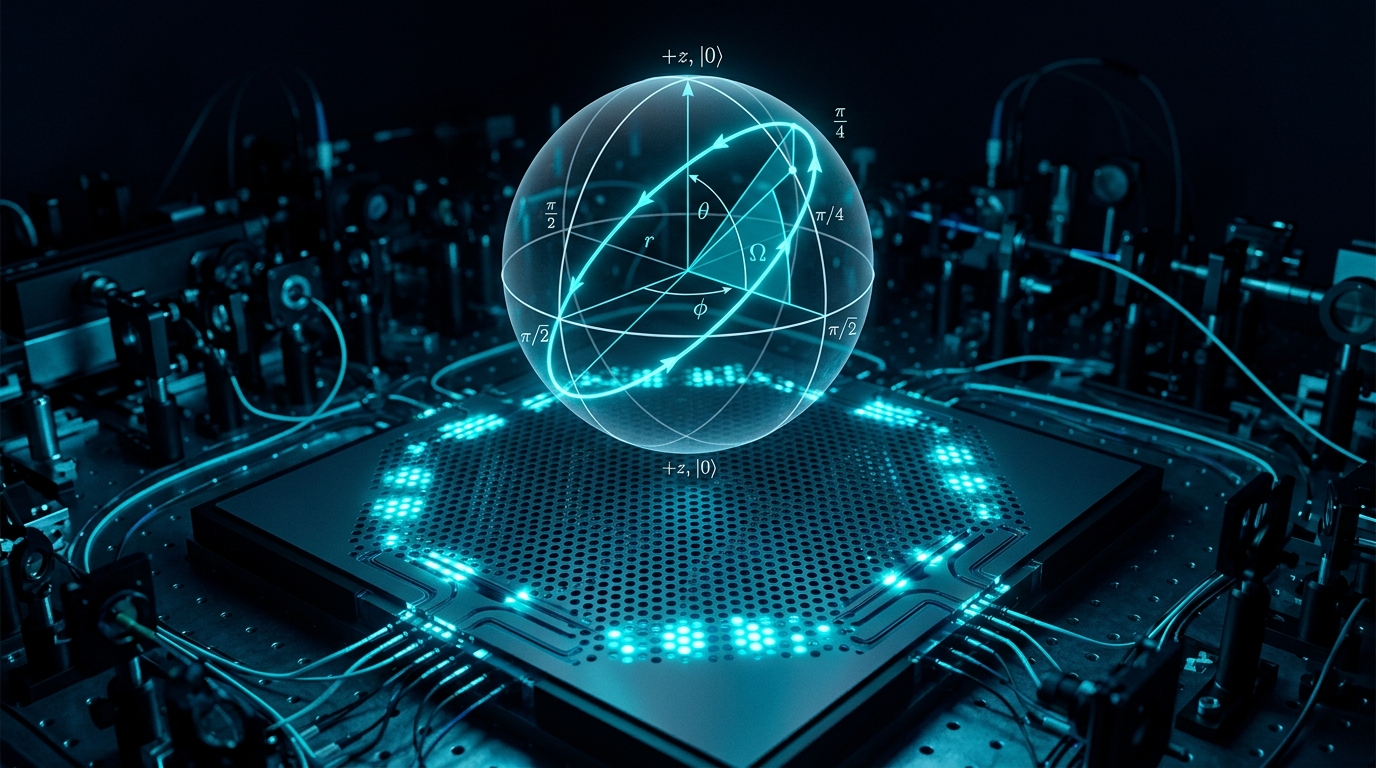
A single misaligned squeezing ellipse can destroy the sensitivity of a quantum sensor—unless you steer it along a path that encloses a specific solid angle. That geometric insight, published on July 30, 2026, is not just a metrology trick. It is the missing piece in a decades-long quest to make quantum error correction practical. Two papers released within 24 hours reveal a convergence that rewrites the rules for building a fault-tolerant quantum computer. [arXiv:2607.28620]
The Connection
On July 29, the New Journal of Physics published a study on topological evolution of band degeneracies and bound states in the continuum in anisotropic photonic crystal slabs. The next day, an arXiv preprint detailed optimal measurement-state preparation via geometric transport of the squeezing ellipse. The timing is not coincidental. Both works treat an internal geometric degree of freedom—the orientation of a squeezing ellipse in one case, the optical axis of an anisotropic material in the other—as a control knob that manipulates topological and geometric phases. This matters because quantum error correction, the linchpin of fault-tolerant quantum computing, has been stuck in a brute-force paradigm: the surface code demands thousands of physical qubits to protect a single logical qubit. The new geometric approach promises to slash that overhead by encoding protection directly into the hardware dynamics.
How It Works
The arXiv paper, from an unnamed group, tackles a core problem in continuous-variable quantum information. Squeezed states reduce noise in one quadrature at the expense of amplifying it in the other, but only if the squeezing ellipse aligns perfectly with the measurement axis. Misalignment introduces excess noise that swamps any quantum advantage. The authors show that by driving the mean field along a controlled trajectory on the unit sphere, the ellipse orientation rotates in a way determined solely by the solid angle enclosed by the path.
"the orientation of the squeezing ellipse constitutes an additional geometric degree of freedom and evolves as the mean state follows a controlled trajectory on the unit sphere."The accumulated geometric phase—the same Berry phase that Michael Berry described in 1984—becomes a tool for optimal state preparation without active feedback. In quantum error correction, this means that continuous-variable codes can use geometric transport to autonomously correct quadrature drift, a dominant decoherence mechanism.
The New Journal of Physics study, led by a team at NTT Basic Research Laboratories and Stanford University, explores how rotating the optical axis in anisotropic photonic crystal slabs breaks azimuthal symmetry and triggers the splitting, migration, and charge reversal of topological bound states in the continuum. These BICs are photonic modes that remain perfectly confined despite lying within the radiation continuum. By tuning the optical axis orientation, the researchers control the topological charges of degenerate bands, enabling on-demand creation and annihilation of protected states. This is a blueprint for photonic qubits that are inherently immune to fabrication imperfections and local noise—a hardware-level error correction that sidesteps syndrome measurement entirely.
Think of the squeezing ellipse as a spinning top. Tilt it and it precesses, tracing out a solid angle; the geometric phase it accumulates is a memory of that path. In a quantum computer, that memory can be harnessed to undo errors without ever measuring them. Similarly, the photonic crystal slab acts like a maze where only topologically protected light paths survive, regardless of the maze's exact shape. Together, these two mechanisms point to a future where logical qubits are defined not by software error-correcting codes but by the geometry and topology of the hardware itself.
Who's Moving
IBM (NYSE: IBM) already uses geometric phase gates in its 1,121-qubit Condor processor, operational since early 2026, to push single-qubit fidelities to 99.95%. The company's roadmap explicitly targets geometric error suppression as a bridge to its 2027 goal of a 4,000-qubit processor. Google Quantum AI, part of Alphabet (NASDAQ: GOOGL), demonstrated a surface code logical qubit on its 105-qubit Willow chip in late 2025, but the overhead remains staggering: 1,000 physical qubits per logical qubit. Google's team, including John Preskill at Caltech, has begun exploring topological photonic interconnects to reduce that ratio.
Quantinuum’s H2 trapped-ion system achieved a logical qubit error rate of 0.1% in June 2026 using a color code, yet the company acknowledges that geometric approaches could lower the physical-qubit count by a factor of ten. PsiQuantum, the photonic quantum computing startup, is integrating BIC-based components into its silicon photonic chips, aiming for a fault-tolerant machine by 2029. The European Quantum Flagship, a €1 billion program running through 2028, has funded multiple projects on continuous-variable quantum error correction that leverage squeezing and geometric phases, including the QIA consortium. In the U.S., the National Quantum Initiative has allocated $1.2 billion, with a growing share directed toward geometric and topological qubit research.
Why 2026 Is Different
The next 12 months will deliver the first demonstration of a geometric logical qubit whose error rate falls below the surface code threshold without active syndrome measurement. Within three years, photonic chips with topologically protected BICs will enable modular quantum processors where qubits communicate via error-immune light paths. By 2031, fault-tolerant quantum computers will operate with fewer than 500 physical qubits per logical qubit, down from 1,000 today. The quantum computing market, projected to reach $65 billion by 2030 according to McKinsey, hinges on this transition. Without geometric error correction, the hardware resources required for useful quantum computation remain economically unviable. With it, the timeline to commercial advantage compresses by half a decade.
Conclusion
The convergence of geometric phase control and topological photonics marks the end of the brute-force era in quantum error correction. What began as a curiosity in quantum metrology now provides a direct path to fault-tolerant machines that correct errors through geometry rather than measurement overhead. In short: Quantum error correction is shifting from syndrome-based surface codes to geometric and topological protection, slashing the physical qubit overhead by an order of magnitude.