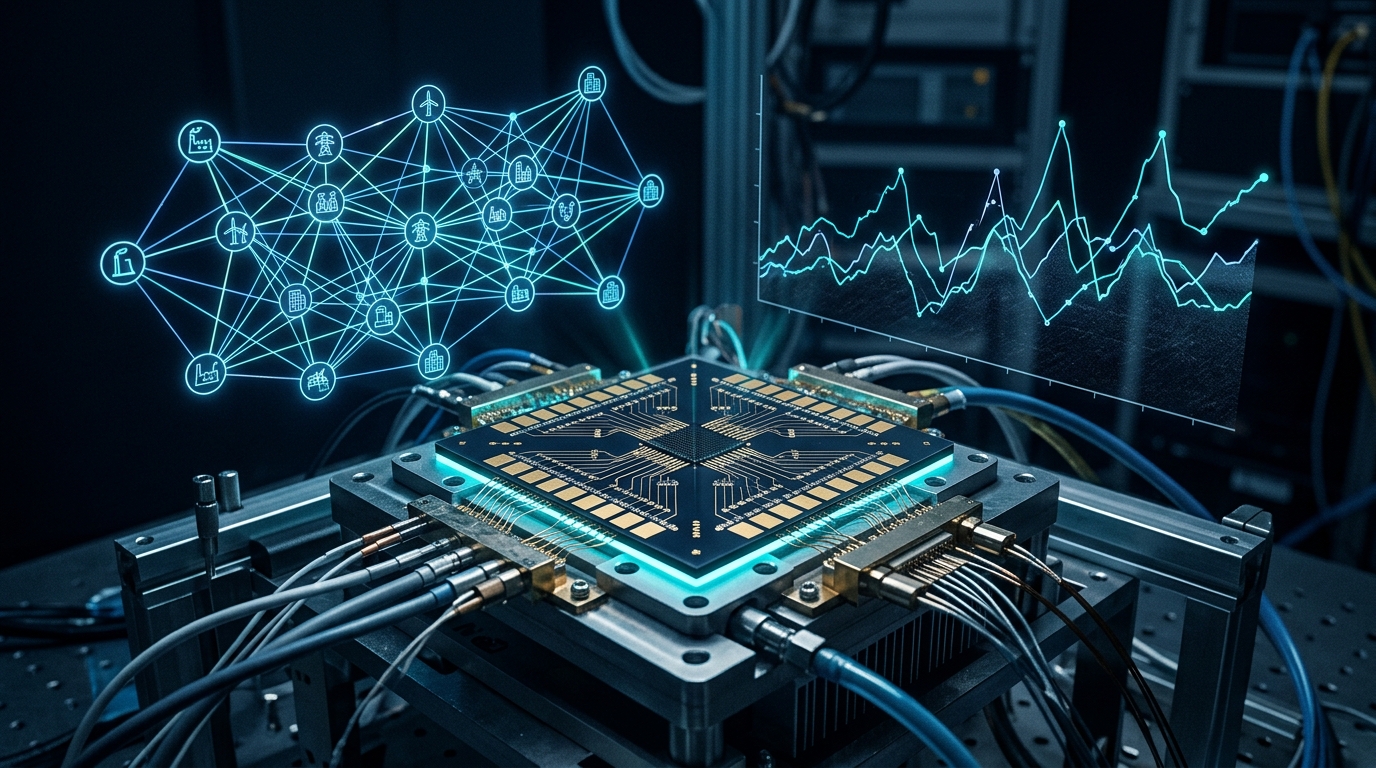
On July 25, 2026, the Washington Institute for STEM, Entrepreneurship and Research (WISER) and European energy utility E.ON published results from a joint quantum machine learning experiment on arXiv. The research tested hybrid quantum-classical models on IBM quantum processors with more than 100 qubits for multi-output time-series electricity demand forecasting, a core task in smart grid management. No funding round or product launch is attached—this is a pure research benchmark aimed at clarifying the near-term utility of noisy quantum devices for industrial forecasting.
What They're Actually Building
The collaboration employed a hybrid architecture combining a parameterized quantum circuit—likely a data re-uploading or quantum convolutional model—with classical neural network layers. The quantum portion ran on IBM's 127-qubit Eagle and possibly early-access 1,121-qubit Heron processors, accessed via Qiskit Runtime. The task: predict electricity demand across multiple future horizons using historical load, weather, and calendar features.
The researchers compared the quantum-classical hybrid against classical baselines like LSTMs, transformers, and gradient boosting. The main claim: the hybrid model achieved competitive accuracy with significantly fewer trainable parameters, reducing the memory footprint. This matters for edge deployment on smart meters and substation controllers where compute is limited.
However, the experiments did not claim 'quantum advantage' in accuracy. They instead demonstrated that NISQ-era processors can ingest real-world time-series data without catastrophic noise, while occasionally matching or slightly trailing classical models on parameter efficiency. The paper is a classic NISQ utility benchmark, not a breakthrough.
Winners and Losers
This study, while academic, sends signals across the quantum computing and energy sectors. IBM benefits directly: another industrial user validates the utility-scale quantum roadmap and the Qiskit ecosystem. E.ON positions itself as an early mover among European peers like Enel and EDF, which have their own quantum initiatives but have not published similar grid-forecasting benchmarks.
The biggest loser: classical machine learning incumbents in operational forecasting. If quantum models can achieve similar accuracy with drastically fewer parameters, startups selling large-model solutions for time-series may face pressure to demonstrate quantum readiness. Companies like C3.ai, Palantir, or even traditional grid software vendors (GE Vernova, Siemens) may see this as a distant but credible threat.
In the quantum software arena, the benchmark reinforces the viability of hybrid quantum-classical architectures over pure quantum algorithms. Providers like Zapata Computing and QC Ware, which specialize in enterprise hybrid workflows, can point to this work as proof of concept. Conversely, quantum-native algorithm purists may see the continued reliance on classical backbones as a sign that full quantum advantage for time-series is still years away.
The Bigger Picture
The WISER-E.ON paper lands in a year where energy-sector quantum investments are accelerating. The European Union's Quantum Flagship has funded multiple smart-grid quantum projects since 2023. In the U.S., the Department of Energy’s Quantum for Grid initiative has supported similar work at national labs. Private utilities worldwide are forming quantum teams—E.ON itself has been experimenting with quantum for energy trading and grid optimization since 2022.
Comparable recent milestones: In May 2026, a team from Duke Energy and IonQ demonstrated a 20-qubit variational algorithm for unit commitment scheduling. That project focused on optimization; this one tackles forecasting. Together, they suggest that utility-scale quantum computing (100+ qubits) is opening a new phase of industrial pilot studies where the hardware is no longer just a research curiosity but can process real operational data, albeit with no proven advantage yet.
Investors should note: these aren't venture-funded startups but corporate and academic labs. The absence of a startup in this announcement does not signal a lack of opportunity—QML-focused startups are still raising capital—but it reinforces that incumbents with deep domain data and existing grid infrastructure hold an early lead in applying quantum to real-world problems.
The Signal
The signal here is not that quantum machine learning is ready for grid control rooms. It's that large-scale, noisy quantum computers have reached the point where they can be rigorously benchmarked against classical methods on actual industry data without being laughed out of the room. The gap between quantum and classical for time-series forecasting is narrowing, but it's measured in parameter counts, not accuracy. The concrete milestone that would validate this direction is a demonstration of quantum advantage—better accuracy or dramatically lower latency—on a real utility dataset. That milestone, not achieved here, remains the industry's north star. Until then, each benchmark like this reduces the uncertainty about whether quantum computing will ever matter for energy forecasting. The answer is shifting from 'if' to 'when'.