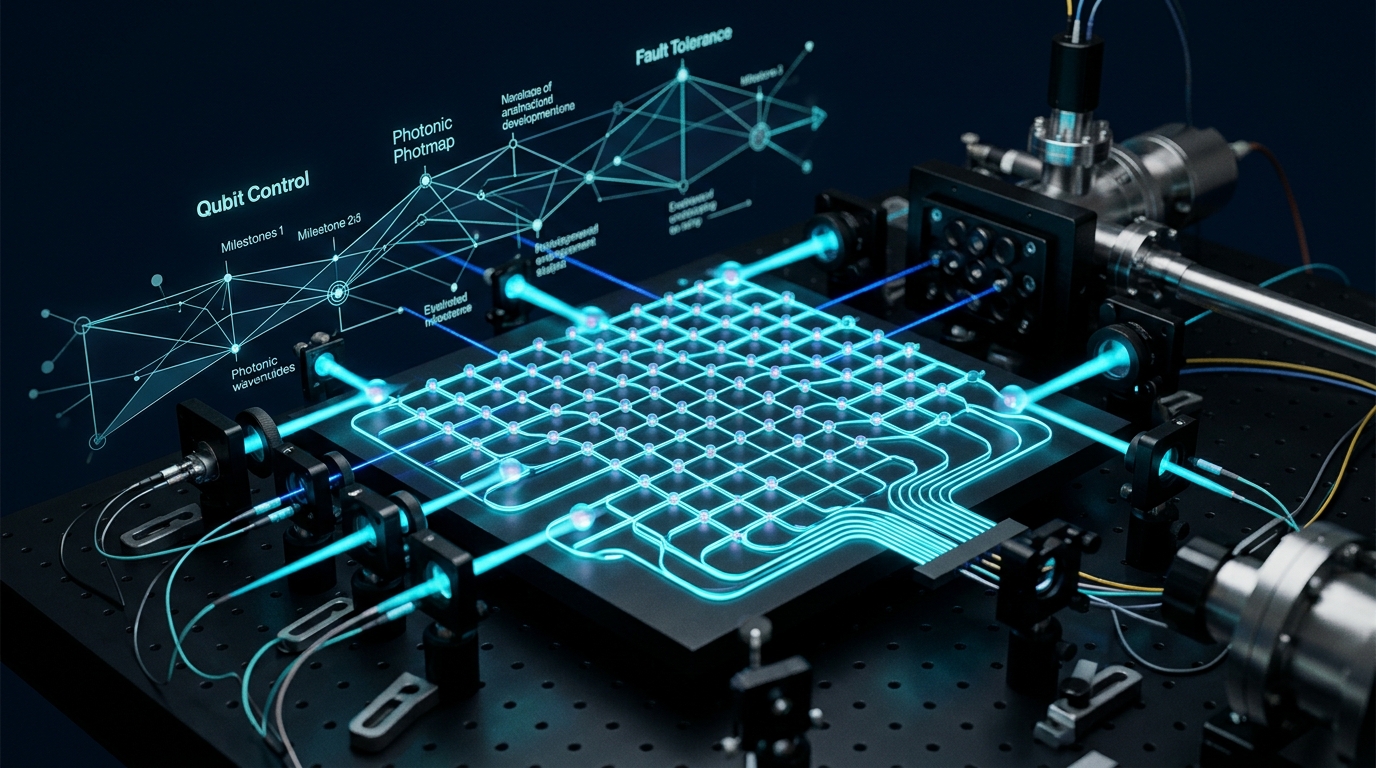
Every quantum computing platform promises a path to advantage, but neutral atoms faced a fragmentation problem no other architecture had yet solved. The hardware was racing ahead—two-qubit gate fidelities above 99.5%, arrays of hundreds of trapped atoms, even early logical qubits—yet there was no unified blueprint that stitched together the algorithms, error correction, verification protocols, and networking required to turn a lab demonstration into a machine that solves real-world problems faster than any classical computer. In a new preprint posted to arXiv on July 23, 2026, a team of researchers lays out precisely that missing blueprint. [arXiv:2607.21554]
The Core Finding
The paper delivers a strategic plan for neutral atom quantum computation that, for the first time, weaves hardware development, quantum algorithm design, error correction, compilation, and distributed computing into a single coherent roadmap. It does not report a single experimental milestone. Instead, it defines "practical quantum advantage"—how to know when a quantum computer has truly outperformed classical counterparts on a useful task—and specifies verification methods that would prevent false claims. The plan then describes future hardware directions: scaling system size into the thousands of qubits, exploring new qubit encodings and atomic species, pushing logical-qubit performance further below the fault-tolerance threshold, enabling continuous reloading of atoms lost during computation, and building fast readout systems. On the software side, it proposes advances in quantum error correction codes and new compilation strategies for quantum circuits, including variational circuits used in hybrid classical-quantum algorithms. Finally, it examines networking multiple neutral atom processors with photonic interconnects to enable distributed quantum computing.
"bringing together hardware development and theory advancements to achieve the goal of practical quantum advantage."
Think of it like an architectural blueprint for a skyscraper that specifies every structural beam, electrical pathway, and safety regulation before a single brick is laid. By making the interdependencies explicit, the plan aims to guide the entire neutral atom ecosystem—from academic groups to hardware startups—toward machines that can deliver verifiable quantum advantage on industrially relevant problems.
The State of the Field
Before this plan, neutral atom quantum computing had demonstrated impressive physics but lacked a comprehensive integration strategy. In 2024, the group led by Dolev Bluvstein and Mikhail Lukin at Harvard reported a logical quantum processor based on reconfigurable atom arrays, proving that error-corrected qubits could be realized with neutral atoms. Companies such as QuEra and Pasqal have meanwhile built early-generation analog and digital processors that exploit Rydberg-mediated interactions. Yet each effort largely addressed hardware scaling or a single algorithmic demonstration. No prior document defined what constitutes practical quantum advantage in a machine-verifiable way, nor did it connect the required breakthroughs in compilation, error correction, and continual qubit reloading into a single timeline. The broader quantum computing landscape remains a multi-platform race. Superconducting qubits from IBM and Google push gate counts and speed, while trapped-ion systems from Quantinuum and IonQ set fidelity records. Neutral atoms offer unique strengths—arbitrarily reconfigurable connectivity, identical qubits without manufacturing variation, and straightforward scaling to large arrays. This strategic plan differentiates itself by showing that hardware alone will not deliver advantage; instead, co-designed advances in quantum software, verification theory, and photonic networking are equally essential.
From Lab to Reality
For scientists, the plan provides a clear prioritization map. Research groups can focus on the specific error-correction codes most compatible with neutral atom noise profiles, or build integrated photonic control circuits that maintain qubit coherence while shrinking the control footprint by orders of magnitude. For engineers, the vision of continuous atom reloading and fast readout moves the technology toward rack-mounted systems that do not need to be entirely recalibrated after a fraction of atoms are lost—a practical requirement for any machine that must run deep circuits for hours. The proposal for networking processors via optical links opens the door to modular, fault-tolerant clusters that can grow beyond the physical limits of a single vacuum chamber. For investors, the neutral atom segment now has a definable technical roadmap, which matters in a quantum computing market that analysts project will reach $10 billion by 2030. Companies that align their development with this integrated plan can more credibly articulate milestones to customers in pharmaceuticals, materials design, and logistics, where quantum algorithms for molecular simulation or combinatorial optimization could unlock value long before general-purpose machines arrive.
What Still Needs to Happen
Despite the clarity of the roadmap, formidable technical obstacles remain. First, the logical-qubit error rates needed to run deep algorithms—roughly 10−10 per gate operation—require physical gate fidelities far above 99.9% across thousands of qubits, coupled with fast, high-fidelity measurement that does not disturb neighboring atoms. Groups at Harvard, the Institut d’Optique in Paris, and the University of Wisconsin–Madison are actively improving two-qubit gate fidelities using Rydberg dressing and robust pulse sequences, but reaching the necessary thresholds at scale remains unproven. Second, continuous atom reloading must operate with minimal overhead and without degrading qubit coherence, a challenge that pushes the limits of optical tweezer technology and real-time control electronics. Integrated photonic control—replacing bulky free-space optics with chip-scale beam delivery—is another hurdle that several academic labs and startups are tackling, but no system has yet demonstrated high-fidelity single-qubit addressing on a chip while preserving millisecond coherence times. The networking of processors, while promising, adds latency and photon-loss bottlenecks that will demand new error mitigation schemes. Realistically, the first practical quantum advantage demonstrations with neutral atoms could be five to seven years away for specialized problems, with commercially robust platforms likely a decade out.
In Short
This strategic plan for neutral atom quantum computation delivers the first integrated roadmap to practical quantum advantage, uniting quantum algorithm design, hardware scaling, and distributed computing. It transforms the neutral atom conversation from impressive physics demonstrations into a coordinated engineering campaign with measurable milestones.