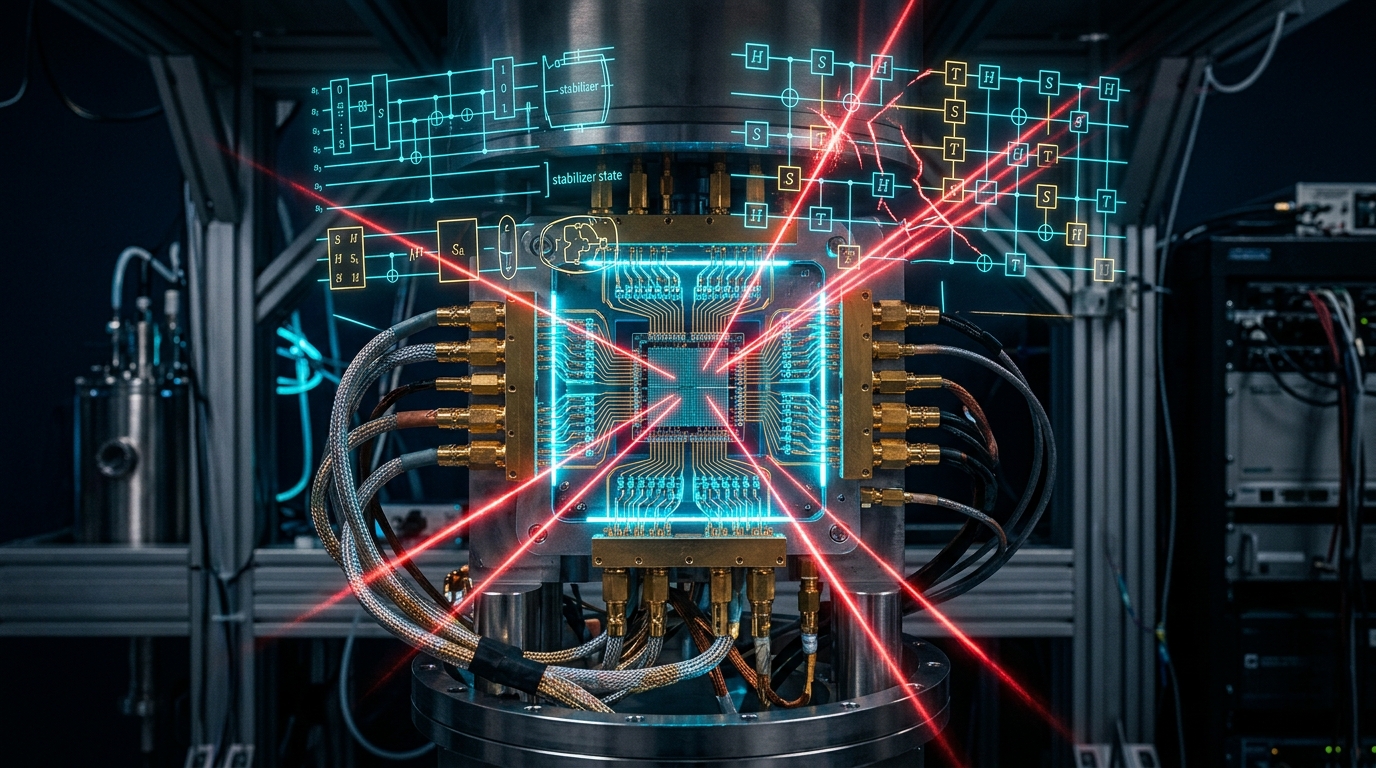
The most dangerous attack on a quantum algorithm doesn't touch the qubits—it poisons the mathematical tools that clean up their noise. A new red-teaming benchmark reveals that adversaries can amplify errors in the Variational Quantum Eigensolver (VQE) by nearly nine times without ever altering a single quantum gate. The weapon of choice: the very error mitigation pipeline that makes near-term quantum computers useful. [arXiv:2607.19318]
This matters because the same Clifford group that underpins today's leading error mitigation techniques is now fully characterized by a new mathematical theory, just as adversaries are learning to exploit it. The timing is not coincidental. As VQE workloads move to cloud-based "VQE-as-a-service" pipelines, the attack surface expands exactly when the fundamental theory to secure it arrives. On July 21, 2026, a multi-institutional team posted VQE-AdvBench, the first unified red-teaming benchmark for VQE, to arXiv. The next day, Quantum journal published a complete theory of the Clifford commutant—the set of operators that commute with tensor powers of Clifford unitaries. Together, they draw a bullseye on the soft underbelly of hybrid quantum-classical computing.
How It Works
VQE is the workhorse quantum algorithm for estimating molecular ground-state energies on noisy intermediate-scale quantum (NISQ) hardware. It splits the computation: a parameterized quantum circuit prepares trial wavefunctions on a quantum processor, while a classical optimizer iteratively tweaks parameters to minimize the energy. The result is a hybrid quantum-classical loop that chemists use to model reactions, catalysts, and drug candidates. But NISQ devices are noisy, so practitioners rely on error mitigation techniques like Zero-Noise Extrapolation (ZNE), which runs the same circuit at multiple noise levels and extrapolates to the zero-noise limit. ZNE is built on the Clifford group—the set of gates that can be efficiently simulated classically and that form the backbone of error characterization.
The VQE-AdvBench benchmark systematically evaluates seven attack scenarios across a black-, gray-, and white-box taxonomy. It tests circuit-level backdoors like QTrojan, parameter-level backdoors like QDoor, gradient-based parameter attacks (FGSM, PGD), and three noise-induced variants that manipulate the ZNE pipeline. The benchmark runs on H2 and H3+ molecules across five noise-calibrated IBM backends. The result is a clear severity ordering. As the paper states,
"noise-induced attacks that manipulate the Zero-Noise Extrapolation (ZNE) pipeline are the most damaging (up to 8.84× error amplification)."The QTrojan circuit backdoor follows at 7.52× amplification, while the QDoor parameter backdoor barely registers at 1.37×. The attacks don't need access to the quantum processor; they can be injected anywhere in the cloud transpilation stack—by a compromised service component, a malicious co-tenant, or an insider.
Enter the Clifford commutant. The Clifford group is central to quantum error correction, randomized benchmarking, and ZNE. It matches the first three moments of the Haar measure, making it a pseudorandom workhorse. The commutant—the set of operators that commute with k-fold tensor powers of Clifford unitaries—dictates what information can be extracted from Clifford circuits. Until now, understanding was limited to small k and n. The new theory provides an explicit orthogonal basis for the commutant for any number of qubits and any tensor power. This complete characterization is the mathematical key to verifying the integrity of ZNE pipelines. If you know exactly which operators commute with the Clifford group, you can design provable checks that detect when an adversary has tampered with noise extrapolation. The same theory could also harden the randomized compiling protocols that underpin error mitigation on IBM's 1,121-qubit Condor processor.
Who's Moving
IBM (NYSE: IBM) is the gravitational center of this story. Its Condor processor, with 1,121 superconducting qubits, is the largest gate-based quantum computer available via the cloud. IBM's Qiskit Runtime already offers VQE as a service, complete with ZNE error mitigation. The ZNE technique itself was pioneered by IBM researchers Kristan Temme, Sergey Bravyi, and Jay Gambetta, who demonstrated its power for extending the reach of NISQ devices. Now, the VQE-AdvBench benchmark shows that the very pipeline they built is the prime target. IBM is not alone. Amazon Braket (Amazon, NASDAQ: AMZN) and Microsoft Azure Quantum (NASDAQ: MSFT) also host VQE workloads, each with their own transpilation and error mitigation stacks. The attack surface spans all three clouds.
The Clifford commutant breakthrough comes from a separate group of quantum information theorists, whose paper in Quantum provides the orthogonal basis that could underpin next-generation error mitigation verification. While the authors of VQE-AdvBench remain anonymous in the preprint, the connection to IBM's hardware and the ZNE pipeline is unmistakable. John Preskill of Caltech, who coined the term NISQ, has long warned that the classical-quantum interface is a security blind spot. These two papers turn that warning into a quantifiable risk and a mathematical countermeasure.
Why 2026 Is Different
In 2026, VQE-as-a-service is no longer a lab curiosity. Pharmaceutical companies and materials startups are running production-grade molecular simulations on cloud quantum processors. The global quantum computing market is projected to reach $65 billion by 2030, with chemistry and materials science as the leading application verticals. Within 12 months, expect cloud providers to begin integrating Clifford-based integrity checks into their error mitigation pipelines. Within 3 years, VQE on 1,000+ qubit processors with hardware-hardened ZNE will tackle molecules that strain classical methods like coupled-cluster with single and double excitations (CCSD). Within 5 years, the lessons from VQE-AdvBench will inform the security architecture of early fault-tolerant quantum computers, where error correction, not just mitigation, will need adversarial robustness.
The convergence is stark: the same month that the most damaging attack on a variational circuit is quantified, the mathematical tool to neutralize it is handed to the community. The Clifford commutant theory doesn't just close a chapter in quantum information science; it opens a new one in quantum algorithm security.
In short: Noise-induced attacks on the variational quantum eigensolver amplify errors 8.84x, but a complete Clifford commutant theory can harden error mitigation.