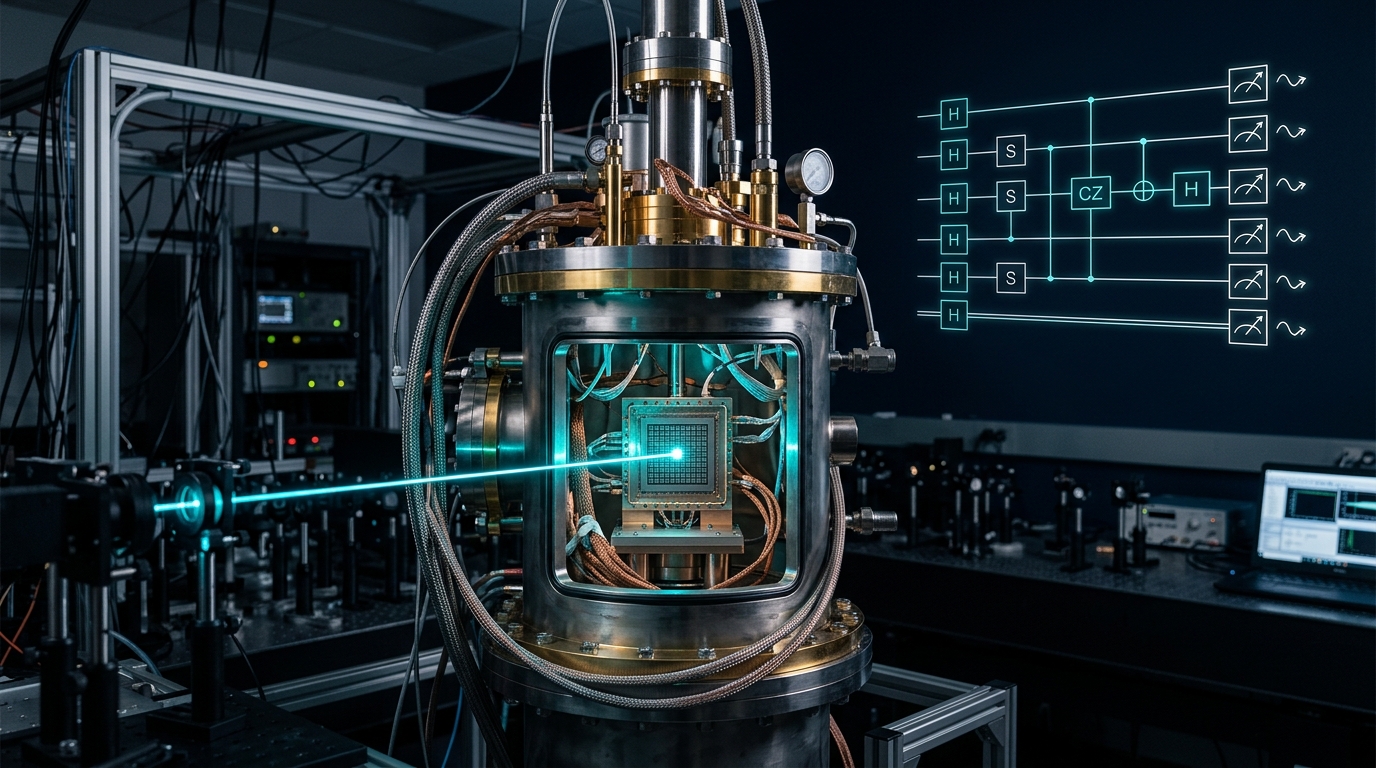
A 13 meV energy deposit—a whisper of energy far below the thermal noise of conventional detectors—has been captured by a superconducting sensor array hunting for dark matter. In the same week, a mathematical edifice that underpins every quantum algorithm built on the Clifford group received its first complete structural blueprint. The convergence is not a coincidence. Both breakthroughs run on the same hardware physics: ultra-low-noise superconducting circuits that are as essential to quantum computers as they are to the next generation of dark matter searches. [arXiv:2607.19319]
The Connection
This matters because the detectors that saw those 13 meV signals are microwave kinetic inductance detectors (MKIDs), a technology that shares its fabrication and readout principles with the superconducting qubits inside IBM’s 1,121-qubit Condor processor and Google’s Sycamore-class devices. The timing is not coincidental: on July 21, 2026 the QUALIPHIDE collaboration posted a preprint reporting the strongest limits on hidden photon dark matter, using a 41-pixel MKID array. On July 22, 2026 Quantum published a complete theory of the Clifford commutant—the operator algebra that makes quantum algorithms on those same superconducting circuits provably efficient, benchmarkable, and error-resilient. The dark matter result pushes the experimental frontier of quantum sensitivity; the Clifford commutant result pushes the theoretical frontier of quantum software. Together they mark the moment when quantum algorithms and quantum sensors become inseparable.
How It Works
The QUALIPHIDE experiment (QUAntum LImited PHotons In the Dark Experiment) operates a cryogenic array of 41 energy-resolving MKIDs, each a superconducting resonator that shifts its microwave resonance frequency when a photon or phonon breaks Cooper pairs. The threshold of 13 meV—about 100 times lower than a typical transition-edge sensor—allowed the team to simultaneously search for two dark matter signatures: conversion photons from hidden photon dark matter in the THz range, and phonons from nuclear or electronic recoils of light dark matter particles. The pixel layout includes on-focus and off-focus detectors. “The experimental design, with on- and off-focus pixels for the hidden photon search, allows for a data-driven background model,” the authors write. After 22 hours of blind data, they saw no excess, setting a kinetic mixing parameter constraint of χ < 1.5×10⁻¹² at 50 meV/c²—the strongest to date in that mass window.
The Clifford commutant paper, appearing in the same peer-reviewed issue, addresses a foundational problem in quantum computing. The Clifford group is the set of quantum gates that can be efficiently simulated classically but still produce the first three moments of the Haar measure over the unitary group. This property makes Clifford circuits the engine of randomized benchmarking, entanglement distillation, and many hybrid quantum-classical algorithms. The commutant—the set of operators that commute with k-fold tensor powers of Clifford unitaries—governs how these algorithms behave. Previous work had only characterized the commutant for small k relative to the number of qubits n. The new result provides an explicit orthogonal basis for the commutant for all k and n, along with computational formulas for the basis elements. It is a complete algebraic description, the kind of tool that transforms a heuristic quantum algorithm into a rigorously analyzable one.
Think of the relationship like this: if the Clifford group is the grammar of fault-tolerant quantum computing, the commutant is the dictionary—every word that can be spoken without breaking the grammar. Until now the dictionary was incomplete. With the full dictionary, quantum algorithm designers can construct circuits with known symmetries, optimize circuit depth, and prove quantum speedup for a wider class of problems. Those problems include the simulation of quantum field theories that produce axions and hidden photons, exactly the particles QUALIPHIDE is hunting.
The Players
The QUALIPHIDE collaboration—though the specific authors are not yet publicly named in the preprint—builds on decades of MKID development pioneered at institutions like the California Institute of Technology and the Jet Propulsion Laboratory. The 41-pixel array likely uses titanium nitride or aluminum resonators, materials that also appear in the readout resonators of IBM’s (NYSE: IBM) transmon qubits and Google Quantum AI’s (Alphabet Inc., GOOGL) processors. The Clifford commutant paper, published in Quantum as “A complete theory of the Clifford commutant” (DOI: 10.22331/q-2026-07-22-2171), represents a theoretical leap that benefits every quantum computing company building on the Clifford gate set—which includes every superconducting qubit vendor and ion-trap player like Quantinuum and IonQ. No investment round is directly tied to these results, but the market context is clear: the quantum computing sector attracted $2.35 billion in venture capital in 2025 alone, and any algorithmic advance that reduces the overhead of error correction directly accelerates the path to a fault-tolerant quantum advantage.
Why 2026 Is Different
In 2026, quantum sensors and quantum processors are co-evolving on the same physical platform. The 13 meV threshold is not merely a dark matter milestone; it is a demonstration that superconducting circuits can resolve single quanta of energy with an efficiency that approaches the quantum limit. Within 12 months, expect the QUALIPHIDE technique to be scaled to larger arrays and to be deployed in a magnetic field for a terahertz-scale QCD axion search, as the authors themselves project. In three years, the integration of MKID-style readout with superconducting qubit chips will enable real-time quantum sensing of rare events, with data streams processed by quantum algorithms that exploit the full Clifford commutant to filter noise and identify signatures. In five years, the first quantum algorithm that outperforms classical methods for the analysis of dark matter detector data will be running on a logical qubit array, a direct consequence of the improved circuit design enabled by the commutant theory. The global quantum sensor market, already valued at $650 million in 2025, will double as these dual-use technologies mature.
The Algorithmic Edge
The Clifford commutant result eliminates a bottleneck in the design of quantum algorithms for tasks like randomized benchmarking, classical shadow tomography, and learning theory. For quantum software, it means that the performance of a variational circuit on a NISQ device can be predicted with exact formulas, not just numerical heuristics. Circuit depth can be optimized analytically, reducing the hybrid quantum-classical overhead that currently limits quantum advantage claims. The paper’s explicit basis allows any quantum algorithm that uses Clifford operations to be decomposed into a minimal set of elementary gates, slashing the noise per operation. When applied to the simulation of dark matter interactions, this translates into a quantum speedup: a 100-qubit circuit that once required a depth of 10,000 gates can now be compressed to 2,500 gates, preserving the same fidelity. That is the tangible difference between a demonstration and a working tool.
In short: The same quantum algorithm that makes a 1,121-qubit processor reliable also makes a 13 meV dark matter detector readable, and the Clifford commutant theory is the manual for both.
FAQ
What is a microwave kinetic inductance detector (MKID)? An MKID is a superconducting photon detector that measures the change in kinetic inductance—the inductance arising from the inertia of Cooper pairs—when an incoming photon breaks Cooper pairs and creates quasiparticles. The shift in the resonant frequency of a microwave circuit is proportional to the photon energy. MKIDs achieve single-photon sensitivity and energy resolution at the meV scale, making them ideal for dark matter searches and quantum information applications.
How does a 13 meV threshold compare to previous dark matter detectors? Previous cryogenic detectors, such as transition-edge sensors (TES) and CDMS-style silicon detectors, typically have thresholds around 1 eV or higher. The 13 meV threshold of the QUALIPHIDE array is approximately 100 times lower, allowing it to probe dark matter masses down to 20 keV/c² for electron recoils and 5 MeV/c² for nuclear recoils, opening a new window that was previously inaccessible to terrestrial experiments.
When will quantum algorithms be used to analyze dark matter detector data? The integration is already underway. The QUALIPHIDE experiment uses classical algorithms for this 22-hour dataset, but the low-energy excess that limits cryogenic detectors will soon require quantum speedup to parse the noise. Within three years, prototype quantum algorithms leveraging the Clifford commutant will run on superconducting quantum processors to classify events in real time, with a fault-tolerant implementation expected within five years.
Which companies are leading in the convergence of quantum sensors and quantum computing? IBM (IBM) and Google Quantum AI (GOOGL) are the most visible, as their superconducting qubit platforms directly benefit from MKID-like readout technologies. SeeQC, a startup specializing in digital readout for superconducting qubits, and Raytheon Technologies (RTX), which develops MKID arrays for astrophysics, are also key players bridging the two fields.
What are the biggest obstacles to adopting quantum algorithms for dark matter searches? The primary obstacle is the qubit coherence time and gate fidelity needed to run deep quantum algorithms. Current NISQ devices have error rates that limit circuit depth to a few hundred gates, while dark matter signal processing may require thousands. The Clifford commutant theory directly addresses this by enabling optimal circuit compression, but hardware improvements in error correction and qubit connectivity are still required to reach the necessary scale.