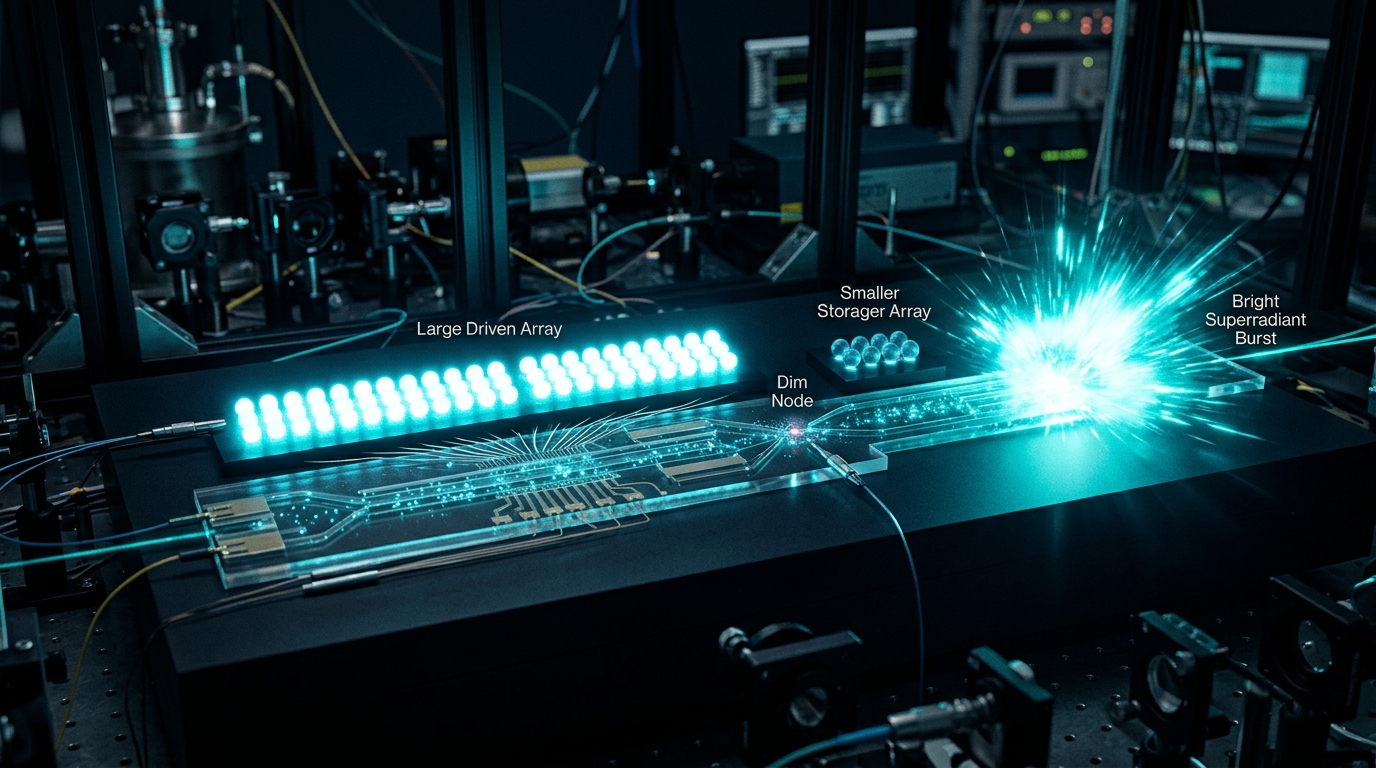
Storing a flash of light as a quantum excitation and retrieving it exactly when needed is a foundational challenge for quantum technologies. The vision of a quantum battery—charged rapidly and discharged with perfect control—has tantalized physicists for years. But in many-body systems of quantum emitters, the dance of coherent driving, dissipation, and correlations turns what should be a clean transfer into a murky mess. Now, a team of physicists has uncovered a scaling law that simplifies the chaos, revealing how to charge up a quantum memory to near perfection. The work, posted on the arXiv preprint server in July 2026, cuts through the tangle by showing that when one emitter ensemble is made much larger than the storage target, the complex quantum correlations fade, and the transfer becomes almost classical in its predictability. [arXiv:2607.17320]
The Core Finding
The researchers model two ensembles of quantum emitters coupled to a semi-infinite waveguide. One ensemble is driven coherently and acts as an excitation reservoir; the other sits close to a dissipative node—a point where radiative decay is suppressed—and functions as a subradiant storage medium. By systematically varying the sizes of the ensembles, they find a clean scaling law: as the driven ensemble grows much larger than the storage ensemble, the dynamics enters a nearly correlation-free regime.
“The transfer dynamics enters a nearly correlation-free regime, allowing the driven ensemble to behave effectively as a classical excitation source.”In that limit, the storage ensemble can reach near-complete population inversion, meaning virtually every emitter in it becomes excited at once. Think of it like charging a small battery from a vast reservoir. If the reservoir is huge, its level barely drops while filling the battery, so the process follows a simple, predictable law. Here, the large driven ensemble plays the part of the reservoir, washing out the messy mutual interactions that usually spoil quantum charging. The paper also lays out a three-stage storage‑and‑release protocol: a coherent drive fills the storage unit, the excitation is held at the subradiant node, and a controlled trigger releases it as a burst of superradiant light.
The State of the Field
Waveguide QED has already delivered superb control over light–matter interactions, enabling collective phenomena like superradiance and subradiance. Early proposals for quantum batteries often relied on idealized, fully coherent protocols or struggled with the interplay of drive and dissipation. Recent work by Asenjo-Garcia, Chang, and others explored how subradiant states in atomic arrays can protect quantum information, but nobody had mapped out a scaling principle for transient excitation transfer between two separate ensembles. The new insight is that by making the source ensemble large enough, the drive-induced correlations that complicate the storage process are effectively averaged out, allowing the driven ensemble to mimic a classical energy source. This dovetails with a broader push in quantum technologies: as hardware improves, the community is hunting for simple, robust design rules to build quantum memories and fast photon emitters without being forced to simulate full many-body dynamics.
From Lab to Reality
For scientists, the scaling law offers a clear blueprint for on‑chip quantum memories and programmable light sources that can store energy and release it on demand with a short, intense pulse. For engineers, it could directly inform the design of quantum batteries that charge faster and suffer fewer efficiency losses, potentially integrating with superconducting qubit circuits or solid-state atom arrays. The work also suggests that quantum storage protocols can be understood with classical intuition once the reservoir is large, reducing the need for expensive many-body simulations. On the investment horizon, the quantum technology market is projected to surpass $100 billion by 2040, and energy storage and memory components will be essential for quantum networks and modular processors. Even if quantum batteries remain a niche, the storage-and-release logic underlying this research is likely to find its way into photonic interconnects and sensor platforms much sooner.
What Still Needs to Happen
Translating the scaling law to the laboratory will be tough. First, placing an ensemble of emitters at a precise dissipative node with subwavelength accuracy demands near‑flawless nanofabrication; even slight misalignment kills the storage protection. Second, the scheme assumes long coherence times and identical emitters, whereas real atoms, molecules, or artificial atoms suffer from disorder and decoherence. Groups at ETH Zurich and Caltech are pushing waveguide QED experiments with superconducting qubits and atoms near photonic‑crystal structures, but scaling to dozens of well‑controlled emitters while maintaining alignment is still years away. A practical, fully programmable quantum battery based on this idea is likely at least a decade away, but the intellectual framework can already guide near‑term experiments that demonstrate few‑emitter proof‑of‑concept storage and release.
Conclusion
This paper turns the messy transient dynamics of driven‑dissipative emitters into a clean, scalable rule. By revealing that a large driven ensemble behaves like a classical battery, it gives experimenters an unexpectedly simple recipe for reaching near‑complete excitation storage. In short: Waveguide QED systems obey a scaling law that enables near‑perfect excitation storage by making one ensemble much larger than the other, transforming quantum chaos into a plug‑and‑charge blueprint.