The Problem That Stalled Optical Stargazing
For decades, astronomers have dreamed of linking optical telescopes across continents to form a virtual mirror the size of Earth — long-baseline interferometry. The payoff would be images of exoplanet surfaces, the silhouettes of black holes, and the weather on distant worlds, all at resolutions impossible for any single observatory. But a stubborn obstacle stands in the way: light. Unlike radio waves, optical photons are fragile. They get lost in fiber optics, scattered by the atmosphere, and absorbed by imperfect detectors. Even a small amount of photon loss can erase the delicate quantum coherence that carries the interference signal, rendering the measurement useless. Existing loss-tolerant schemes for quantum-assisted interferometry ultimately store only an ancillary entangled photon as a reference, not the astronomical light itself, leaving the core problem unsolved. In a preprint posted to arXiv on July 19, 2026, a team of quantum optics researchers reports a protocol that flips this logic entirely, turning photon loss from a deal-breaker into a correctable error. [arXiv:2607.17321]
The Core Finding
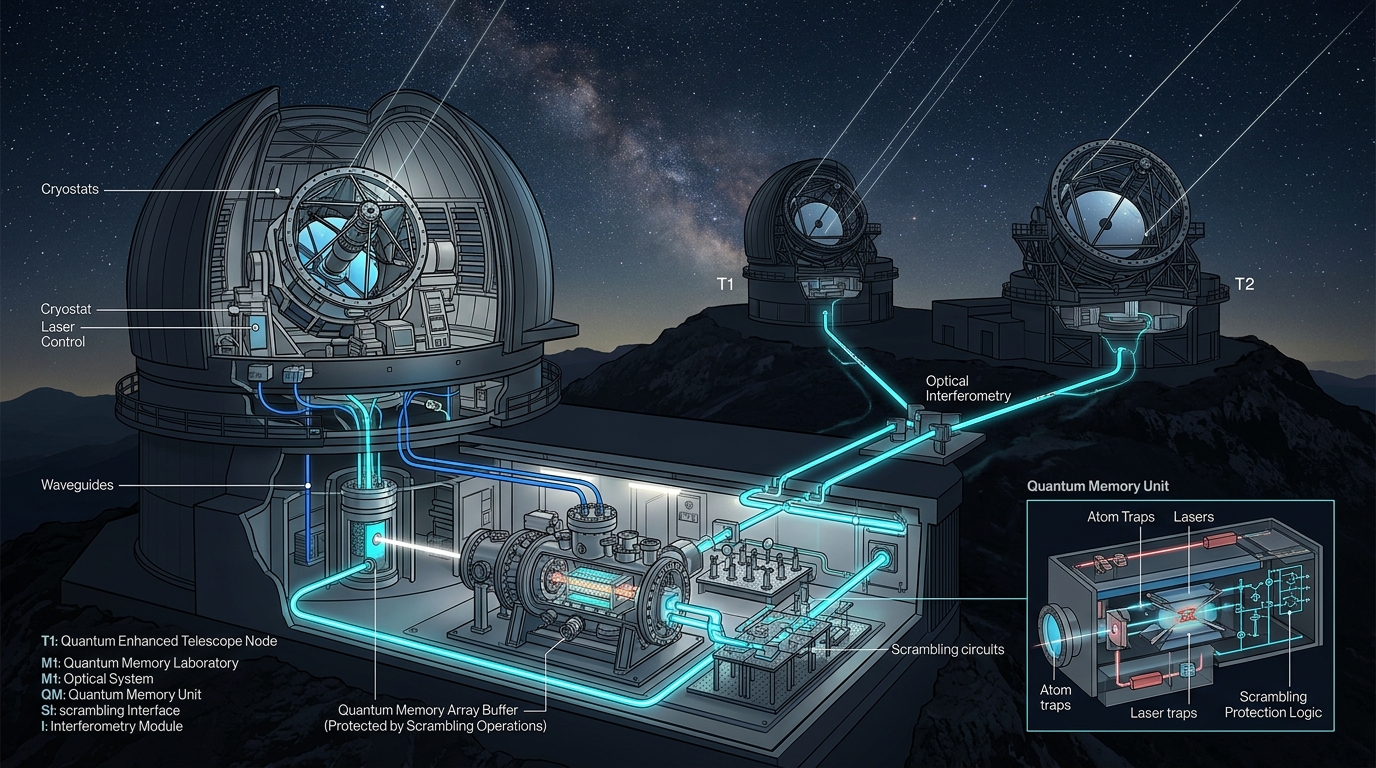
The researchers propose a loss-tolerant extension of entanglement-assisted optical interferometry in which the actual astronomical optical coherence is first mapped coherently to distributed quantum memories at each telescope. Then, local scrambling encoders — sequences of random quantum operations — protect this stored light against erasure errors. When a photon is lost, the event is flagged, and exact local correction can restore the complete complex visibility, the two-parameter quantum Fisher information matrix, and the associated classical Fisher information. The protocol tolerates the erasure of fewer than one half of the physical memories per node, a sharp threshold derived in the paper. As the authors write,
exact local correction of flagged erasures restores the complete complex visibility, its QFI matrix, and the operational GJC CFI.Think of it like a distributed backup system for quantum light. Each memory holds a scrambled fragment of the whole stellar signal. Even if you lose a few fragments, the original interference pattern can be mathematically reconstructed without any loss of sensitivity.
The State of the Field
Prior efforts to make long-baseline optical interferometry loss-tolerant relied on the Gottesman–Jennewein–Croke (GJC) interferometer, proposed in 2012. In that scheme, quantum memories store an ancillary single-photon-entangled reference beam, while the astronomical light remains unprotected. The new work departs radically by mapping the astronomical state itself into the memories and then applying local scrambling encoders — a form of quantum error correction explicitly designed for flagged erasures. This shift matters because the protection criterion is reference–environment decoupling, not merely generating volume-law entanglement as previous approaches assumed. In the broader quantum computing landscape, fault-tolerant architectures based on surface codes and bosonic codes have been proving that logical qubits can survive error rates that would destroy bare physical qubits. This paper extends that philosophy to distributed quantum sensing, showing that quantum error correction principles can safeguard classical parameters estimated from fragile photons.
From Lab to Reality
For scientists, this work unlocks a new route to ultra-long-baseline interferometry with optical photons. By tolerating substantial loss, it could make feasible continent-spanning arrays that image exoplanet atmospheres, resolve stellar surfaces, and perform precision astrometry well beyond current limits. For engineers, the path requires integrating these protocols with emerging quantum memory technologies — trapped ions, neutral atoms, or rare-earth-doped solids — that can store optical coherence with high fidelity. The quantum error correction market, projected to reach $2.6 billion by 2027, stands to gain a new sensing vertical that demands the same fault-tolerance hardware being developed for computing. For investors, the most direct impact is an expansion of the addressable market for quantum memories and error correction technologies beyond pure computation into astronomy, remote sensing, and secure communications.
What Still Needs to Happen
Two technical hurdles dominate. First, building quantum memories that can store optical states with sufficient fidelity to stay below the erasure threshold remains an open challenge. The protocol’s promise hinges on memories with low enough baseline loss, and today’s best optical quantum memories still operate near the edge of the required regime. Groups at Harvard University, the University of Innsbruck, and the Max Planck Institute of Quantum Optics are actively pushing coherence times and efficiencies. Second, the local scrambling encoders themselves are currently conjectured to achieve the necessary decoupling bounds. The authors state, as conjectures, quantitative bounds for local random encoders and finite-depth scramblers, but rigorous proofs are absent. Without them, an experimentalist cannot be certain that a given scrambling circuit achieves the theoretical threshold. Additionally, the protocol imposes phase-covariance and superselection-rule constraints that must be satisfied in any physically meaningful distributed implementation. If these interconnected challenges are not resolved, a working prototype remains at least a decade away.
Conclusion
In short: Quantum error correction via locally scrambled quantum memories can make loss-tolerant long-baseline optical interferometry feasible, restoring full visibility even with up to 50% erased memories.