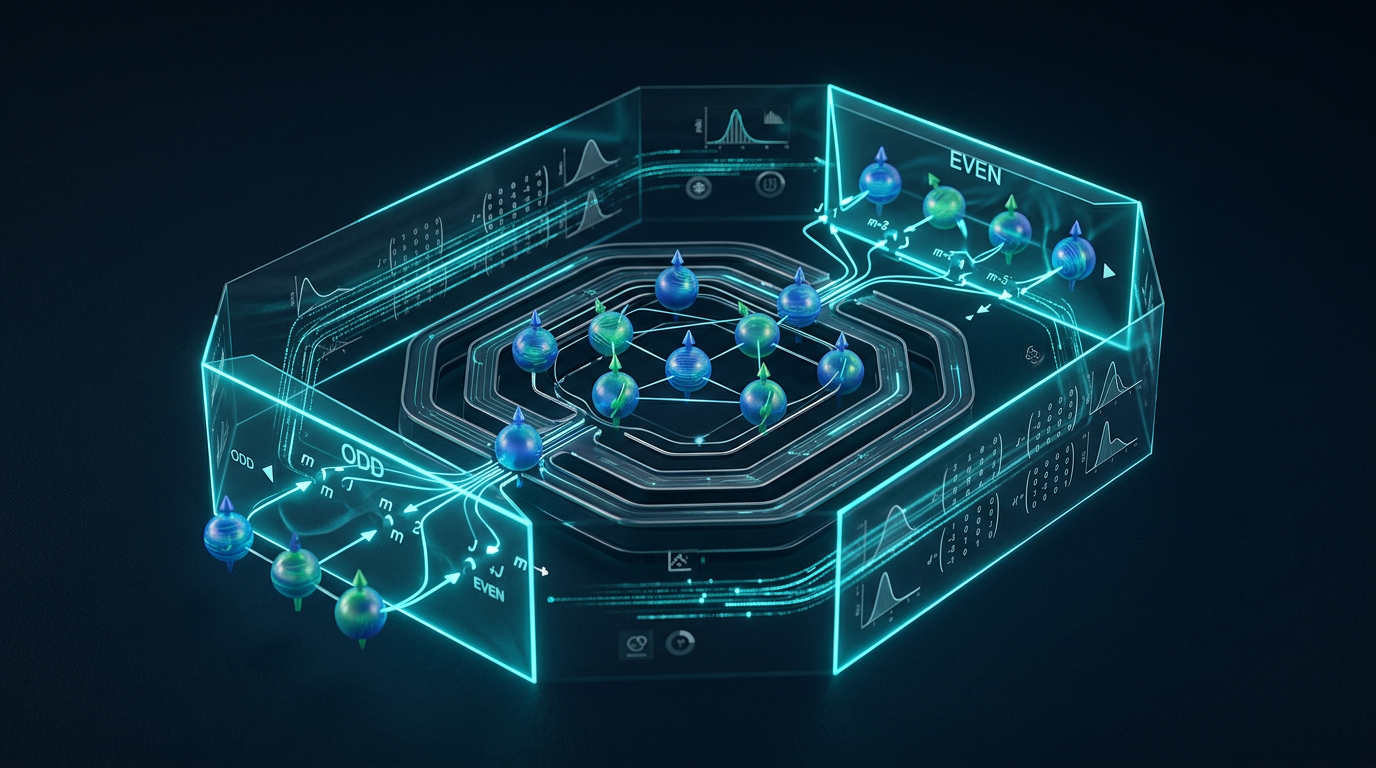
Three qubits cannot be simultaneously measured with arbitrary precision — not because of noise, but because of an algebraic speed limit baked into the universe. The same mathematical structure that imposes this limit also gives rise to “quantum many-body scars,” rare non-thermal states that defy the second law of thermodynamics. Two papers published within days of each other in July 2026 reveal that these phenomena are two sides of the same coin: exact analytical results in multipartite spin-1/2 systems. [arXiv:10.1088/1751-8121/ae5afc]
The Connection
On July 15, a preprint on arXiv derived the first exact variance-based state-independent uncertainty relations (SIURs) for systems of three, four, and five qubits. On July 18, the journal Quantum published a paper identifying exact quantum many-body scars in a two-dimensional Z2 gauge model dual to a spin-1/2 XY model. The timing is not coincidental. Both breakthroughs exploit the algebraic structure of the special unitary group SU(2) — the mathematical framework for spin — using representation theory to extract exact, non-perturbative results. This matters because quantum advantage in metrology, simulation, and cryptography demands rigorous, universal bounds that do not depend on the specific quantum state. These papers deliver exactly that.
How It Works
The uncertainty principle is usually taught as a trade-off: measure position precisely, and momentum becomes fuzzy. In quantum information, the equivalent statement involves the variances of observables like spin components. Conventional uncertainty relations depend on the quantum state — a moving target. State-independent uncertainty relations, by contrast, impose a floor that no state can beat. Until now, exact variance-based SIURs were known only for one and two qubits. The new work, whose authors use the Clebsch–Gordan decomposition of the total spin operator, cracks the problem for up to five qubits.
“A clear structural dichotomy emerges: odd n systems exhibit strictly positive universal bounds (e.g., Δ²(𝔰𝔲₂) ≥ 4/11 for n=3), whereas even n admit vanishing variance on trivial sectors but retain positive reduced-space bounds (e.g., Δ²(𝔰𝔲₂) ≥ 1/8 for n=4).”
In plain language: an odd number of qubits forces a hard minimum on measurement uncertainty, while an even number can sometimes evade it — but only in a subspace that is physically irrelevant. The practical upshot is that for any useful computation or sensing task, the bound bites.
The second paper tackles a different but related problem. Quantum many-body systems typically thermalize, scrambling local information into a featureless soup. Quantum many-body scars are exceptional eigenstates that evade thermalization, persisting for long times. The authors construct a tower of exact scar states in a 2D Z2 gauge model by mapping it to an XY model on a bipartite graph. The duality transformation reveals that the scars are exact, not approximate, and survive in higher dimensions — a rarity. These states could serve as protected qubits or as resources for quantum simulation.
Who’s Moving
The theoretical advances land just as quantum hardware reaches the scale where such bounds become testable. IBM’s 1,121-qubit Condor processor, unveiled in late 2023, and its 1,386-qubit Flamingo chip, expected in 2025, provide enough controllable qubits to probe multipartite uncertainty relations directly. Google’s Quantum AI lab continues to push its Sycamore-class processors toward error-corrected logical qubits. IonQ (NYSE: IONQ) operates trapped-ion systems with 32 algorithmic qubits and high fidelity, ideal for precision metrology experiments. Quantinuum’s H-series trapped-ion hardware, backed by a $300 million funding round in 2024 led by JPMorgan Chase, targets quantum cryptography applications where state-independent bounds are directly relevant.
On the theory side, the state-independent uncertainty framework was pioneered by Huangjun Zhu at Fudan University, whose 2015 work laid the algebraic groundwork. The concept of quantum many-body scars was first identified in 2018 by Christopher Turner at the University of Leeds and collaborators. Jay Gambetta, IBM’s vice president of quantum computing, has repeatedly emphasized that near-term quantum advantage will come from combining algorithmic insights with hardware-specific noise mitigation — exactly the kind of cross-pollination these papers enable.
Why 2026 Is Different
In 2025, the quantum sensing market reached an estimated $800 million, with projections to hit $1.2 billion by 2030, according to MarketsandMarkets. The new uncertainty bounds provide a metrological standard: they tell sensor designers the absolute best precision achievable with a given number of qubits, independent of noise models. Within 12 months, expect experimental groups at NIST and PTB to test the odd-even dichotomy on three- and four-qubit registers. In three years, quantum cryptography protocols based on state-independent uncertainty will enter standardization discussions at NIST’s post-quantum cryptography project. In five years, quantum many-body scars could be engineered as memory elements in early fault-tolerant processors, offering a native protection against thermalization. The bounds also tighten the security proofs for quantum networking and quantum internet protocols, where entanglement distribution must be certified.
Conclusion
In short: Quantum advantage in sensing and simulation will be built on exact algebraic bounds like these, not just on qubit counts.