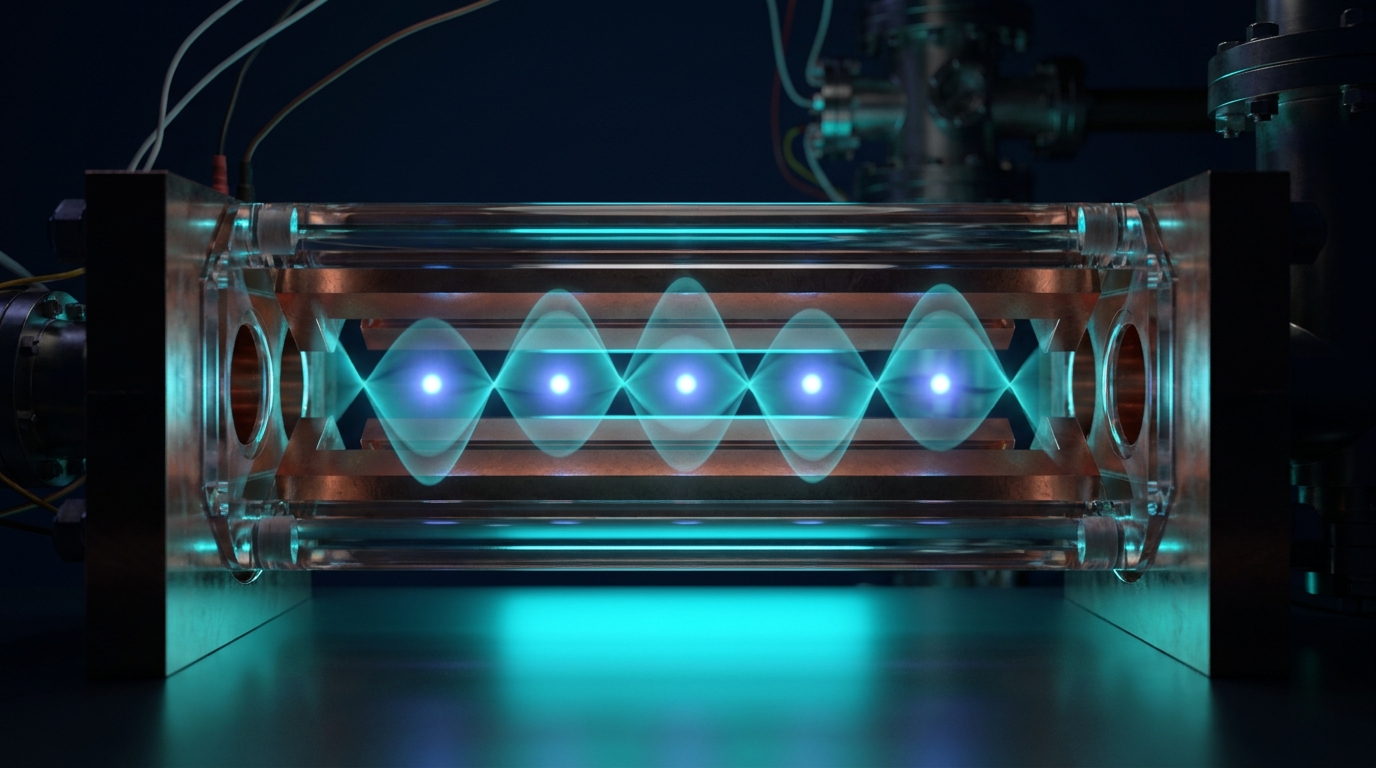
Simulating quantum systems that aren't well-behaved has been a stubborn bottleneck for quantum processors. Many of physics' most important problems — from the behavior of fundamental particles to how exotic materials conduct electricity — involve periodic, wavelike, or angular variables that oscillate the way a cosine does. A superconducting quantum chip or a trapped-ion chain can already simulate some of these systems, but most existing quantum logic gates are built around Gaussian or polynomial transformations that cannot naturally express periodic functions. That limitation is now being challenged. Researchers operating the QSCOUT trapped-ion quantum platform have reported the first experimental demonstration of one- and two-qumode cosine gates — the trigonometric continuous-variable operations that theorists have flagged as missing building blocks for years. [arXiv:2607.14085]
The demonstration, published on 2026-07-15, focuses on "qumodes," the bosonic oscillator degrees of freedom that live inside a hybrid quantum processor alongside conventional qubits. Qubits, which hold binary 0s and 1s, drive the system and read out results; qumodes store continuous quantum information in the shared motion of the ion chain. A cosine gate applied to a qumode transforms its quantum state by the cosine of a specific oscillator variable, generating an intrinsically non-Gaussian, non-polynomial operation that hybrid quantum simulators have historically lacked.
The Core Finding
The team, working with chains of three and four 171Yb+ ions, used the collective motion of those ions as qumodes and implemented cosine gates by stitching together hybrid qubit-qumode logic with conditional phase-space displacements. They then approximated the smooth cosine operation with a finite number of "Trotter steps," a standard trick in which a continuous mathematical function is broken into a rapid sequence of smaller, repeatable operations. The number of steps is a tunable knob: more steps produce a more accurate cosine but take longer and accumulate more noise. They benchmarked each gate by measuring Fock-space transition probabilities — the chances that the gate shifts the oscillator from one discrete energy level to another — and compared those measurements against simulations that included the paper's two dominant noise mechanisms: thermal initialization and motional dephasing.
Think of it like approximating the smooth path of a rolling ball by a series of small stair-steps. Each step is a well-behaved displacement that any quantum processor can perform; many steps stacked together reproduce a transformation no single standard gate can natively produce.
These results establish trigonometric CV gates as reusable building blocks for bosonic Hamiltonian simulations and hybrid quantum algorithms requiring intrinsically non-polynomial operations.
That language, drawn directly from the paper, signals a deliberate shift. Previous demonstrations of continuous-variable gates on trapped-ion platforms have focused on Gaussian operations — displacements, rotations, and squeezers that preserve the simple parabolic shape of quantum states. Cosine gates break that mold, generating non-Gaussian features that are essential for simulating lattices, rotors, and gauge theories. The QSCOUT team measured how transition probabilities shift as gate parameters and Trotter step number change, and derived ideal matrix elements and phase-space diagnostics to connect those measurements to the non-Gaussian structure being produced.
The State of the Field
Trigonometric CV gate sets have been theoretically proposed in recent years, with multiple groups arguing that any compact variable, rotor model, lattice gauge theory, or anharmonic simulation can be expressed more compactly using cosines and sines as primitives. Until now, those proposals remained on paper. Discrete-variable hardware has been maturing in parallel: IBM announced a 1,121-qubit superconducting quantum chip called Condor in December 2023, and Google's Willow chip demonstrated below-threshold error correction in late 2024. Yet most of those advances focus on qubit count and discrete-variable logic, not the hybrid qubit-qumode architectures that trigonometric gates require. What changed: the QSCOUT platform has matured into a programmable test bed for hybrid continuous-discrete experiments. The 171Yb+ ion chain offers both well-controlled internal qubit states (the two hyperfine clock transitions) and shared motional modes that double as qumodes, making it a natural proving ground for gates that don't fit the discrete-variable mold. The 2026-07-15 paper benchmarks these primitives directly, rather than compiling them into a higher-level algorithm as earlier works did.
From Lab to Reality
For physicists, the immediate unlock is digital quantum simulation of systems that were previously out of reach. Lattice gauge theories — the frameworks underlying our best models of quarks, gluons, and fundamental forces — are particularly hungry for periodic operations, because the compact direction that defines a gauge field is angular. Rotor models, which describe arrays of spinning quantum objects, also map cleanly onto cosine gates. The team frames trigonometric CV gates as primitives for "compact variables," making them attractive for simulating condensed-matter systems where angular momentum is quantized, including exotic phases such as quantum spin liquids.
For engineers, the takeaway is architectural rather than commercial. A working cosine gate is not yet a deployable subroutine, but it does expand the toolbox that hybrid algorithms can call on. Quantum processor designers at IBM, IonQ, Quantinuum, and QuEra now have a concrete recipe — Trotter-stepped trigonometric sequences with phase-space displacements — that they could in principle port to other hardware. Whether they choose to do so depends on whether demand for non-Gaussian, non-polynomial operations grows large enough to justify a hybrid architecture.
For investors, the relevant market is quantum simulation, which Boston Consulting Group sized at roughly $1 billion in annual revenue by 2030 in a 2023 industry outlook. Cosine gates are not a standalone product but an enabling technology inside larger simulation stacks that pharmaceutical, materials, and high-energy-physics customers may eventually pay for. Expect no immediate revenue; expect cautious experimentation through 2028.
What Still Needs to Happen
The paper itself names two dominant noise sources — thermal initialization and motional dephasing — that still degrade the gates. Both must be substantially suppressed for cosine operations to reach the fidelities needed for fault-tolerant hybrid algorithms. Ion-trap research groups at the University of Maryland, MIT, and the University of Innsbruck are pursuing sympathetic cooling and decoherence-free subspaces to address exactly these limitations. A more demanding challenge lies ahead: building the two-qumode cosine gate from the current "mode-resolved marginal benchmark" up to a full joint characterization. Marginals tell you what each mode does on its own; a full benchmark also tracks how the two modes become entangled, the property that makes two-qumode gates useful for lattice gauge theories.
It is worth being honest about the timeline. Trapped-ion systems are scientifically mature but commercially small, with perhaps a dozen groups worldwide operating programmable chains in the four- to thirty-two-ion range. Translating a gate-level benchmark into a usable simulation subroutine typically takes three to five years of engineering. Realistic expectation: hybrid trigonometric simulation runs at scale around 2031, with commercial applications probably arriving in the mid-2030s.
In short: a quantum processor built on three- and four-ion ytterbium chains has experimentally realized the cosine gate, putting trigonometric primitives on the menu of hybrid continuous-discrete quantum algorithms for the first time.
Frequently Asked Questions
Q1: What is a qumode?
A qumode is the continuous-variable analog of a qubit. Instead of storing a quantum 0 or 1, it stores information in an oscillator mode — for example, the shared motion of a chain of trapped ions — that can take a continuous range of values. Qumodes and qubits together form a hybrid system: qubits for control and readout, qumodes for naturally continuous physics. The cosine gate presented in this paper is the first non-polynomial, non-Gaussian primitive specifically designed to act on these continuous degrees of freedom.
Q2: How does a cosine gate work on a trapped-ion quantum processor?
The team at the QSCOUT platform encoded each qumode in the collective motion of three or four 171Yb+ ions. They implemented the cosine by approximating it with a short sequence of basic operations: hybrid qubit-qumode logic plus conditional phase-space displacements of the oscillator. This is the Trotter approximation, in which a smooth function is broken into many small steps. The number of steps is a tunable knob: more steps yield a more accurate cosine but take longer and accumulate more noise.
Q3: How does a cosine gate differ from a normal quantum logic gate?
Standard quantum logic gates, including those on superconducting qubit chips, are typically built from Gaussian or polynomial building blocks. A cosine gate is neither: it produces a non-Gaussian transformation that creates states a Gaussian-only circuit cannot reach. This matters physically because cosines are periodic, so they are the natural language for any system with a circular or angular structure, such as a gauge field or a rotor.
Q4: When could trigonometric CV gates become relevant for commercial quantum processors?
The gate has been realized at laboratory scale on a single ion chain in 2026. Porting the recipe to commercial trapped-ion systems from IonQ or Quantinuum probably requires three to five years of engineering work, putting practical applications in the early 2030s. Industry-scale deployment of the underlying hybrid simulations is more likely in the mid-2030s.
Q5: Which industries could benefit most?
Materials science and high-energy physics are the most direct beneficiaries, because they routinely need to simulate systems with periodic or angular variables. Pharmaceuticals and chemistry may benefit indirectly if cosine-gate-enabled hybrid algorithms eventually help model molecular vibrations or enzyme dynamics. Logistics and finance, the most public quantum marketing targets, gain nothing specific from this result.
Q6: What limitations remain for the cosine gate?
Two noise sources dominate: thermal initialization — the fact that the oscillator starts in a slightly warm state rather than its true ground state — and motional dephasing, in which the oscillator gradually loses its quantum coherence. Both effects were included in the paper's numerical simulations. A full two-qumode cosine gate has not yet been benchmarked, only its marginal behaviors. Scaling to longer ion chains with lower heating rates remains an open experimental challenge.