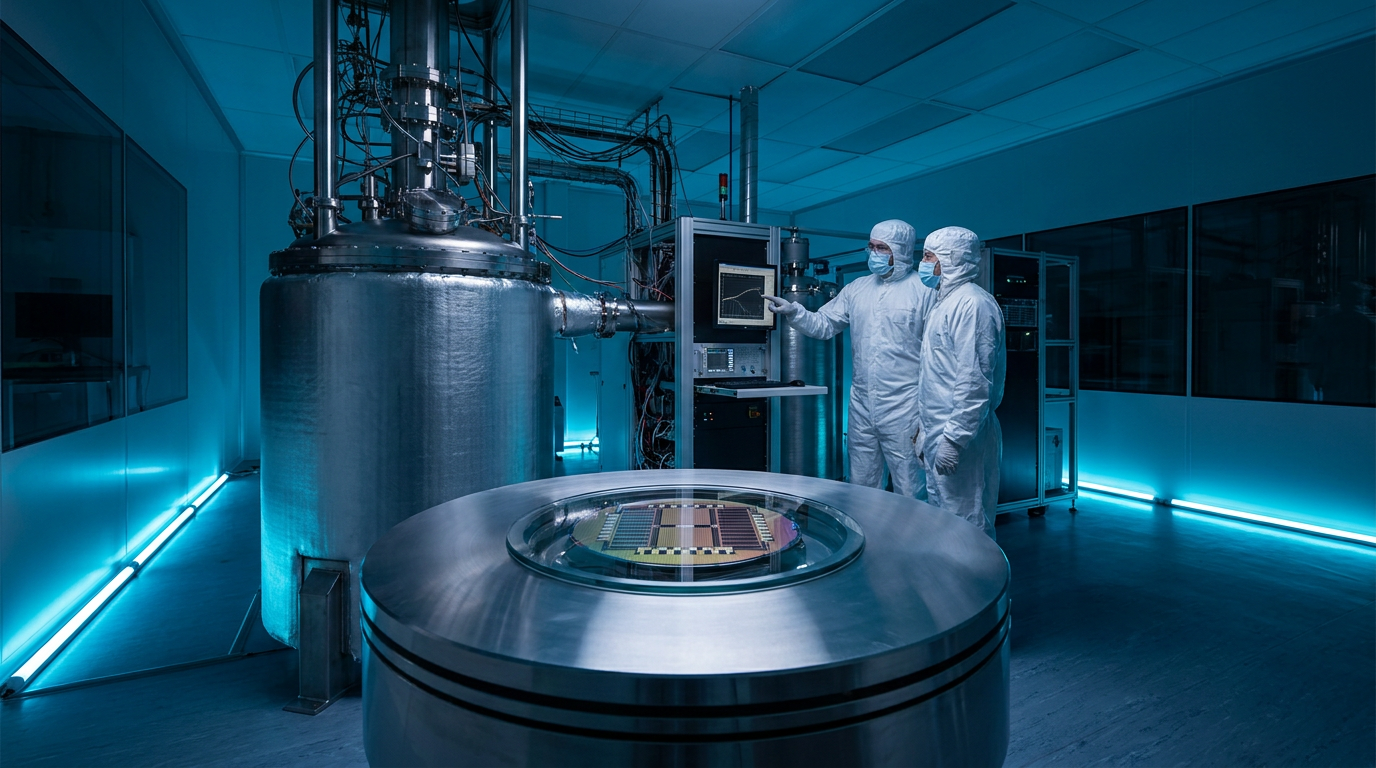
The U.S. National Science Foundation on July 16, 2026 named Connecticut one of 12 regional winners in the second cohort of its Regional Innovation Engines program, awarding a public-private coalition led by Yale University and the University of Connecticut an initial $15 million over two years to operationalize the NSF Quantum Technologies Engine, branded QuantumCT.
The award marks the second federal investment vehicle Connecticut has secured for quantum in 2026, following the Department of Defense's February designation of a $20 million Defense Industrial Base quantum prototyping hub in the state. NSF's two-year, $15M commitment is renewable to roughly $160 million over ten years if the engine meets milestones.
What QuantumCT Is Actually Building
The engine is not a quantum computer. It is an ecosystem orchestration body. The stated mission is to translate quantum hardware research from Yale, UConn, and MIT-affiliated supply-chain partners into domestic manufacturing capacity, workforce pipelines, and prototype foundry services.
The coalition's technical scope spans three modalities: superconducting qubits (Yale's bulk acoustic wave resonator program), trapped-ion systems, and quantum networking hardware. Yale's Robert Schoelkopf group, which pioneered the transmon architecture now used by IBM and Google, will provide the core superconducting IP. UConn brings cryogenic packaging and rare-earth materials processing capacity. Private partners include quantumfoundry, QCi, and several undisclosed defense primes.
Compared to standalone quantum hardware companies, the engine's deliverables are different: 200 trained quantum technicians by 2028, three operational prototyping lines, and at least one U.S.-sourced superconducting qubit foundry. There are no qubit-count milestones. There is no announced logical qubit target.
Winners and Losers
Direct beneficiaries: Yale and UConn retain the largest share of research funding flow. Applied materials suppliers in Connecticut's existing aerospace corridor, including Precision Castparts and a network of Tier 2 CNC shops, gain a federally backed pivot option into quantum cryostat and vacuum component manufacturing. Quantumfoundry, a Yale spinout building superconducting foundry tooling, becomes a default procurement path for any U.S. lab needing domestic qubit fabrication.
Threatened: Quantum foundries outside Connecticut lose a defensible geography. The DoD's February 2026 hub designation plus this NSF award effectively close the Northeast corridor to competing state bids for the next 24-36 months. Colorado, which has been lobbying for a similar dual designation through CU Boulder's quantum initiative, now faces a harder case to make.
For the major quantum hardware vendors, the implications are mixed. IBM, Google, and Rigetti already operate outside the engine's scope, but their supply chains will eventually interact with Connecticut-built components. IonQ and Quantinuum, both pursuing trapped-ion architectures, gain a domestic hardware corridor but not a procurement commitment.
The investment angle is straightforward: the engine formalizes a U.S. quantum supply chain thesis that public-market investors have been pricing into names like IonQ (IONQ), Rigetti (RGTI), and Quantum Computing Inc. (QUBT) since early 2025. Whether that thesis survives technical milestones is a separate question.
The Bigger Picture
QuantumCT lands in the middle of a busy year for U.S. quantum policy. The National Quantum Initiative Reauthorization Act, signed in March 2026, allocated $2.8 billion across NSF, DOE, and NIST through 2030. Of that, NSF's Engines program is the agency-flagship vehicle, having awarded 12 regions in Cohort 1 (2024) and now 12 more in Cohort 2.
Comparable deals for calibration: Colorado's Elevate Quantum consortium won a $41 million NSF Engine award in Cohort 1 (2024), with expansion potential to $160 million. Illinois' Bloch Quantum Tech Hub secured $50 million from DOE in January 2026. New York's Microsystems Engineering & Quantum Foundry received $25 million from DARPA in 2025.
What makes Connecticut's case unusual is the dual federal designation. DoD + NSF in the same state, same year, for the same technology vertical, is uncommon. It reflects the Biden-to-Trump administration's bipartisan continuity on quantum industrial policy.
The Signal
The signal here is not a technical breakthrough. It is a procurement commitment. QuantumCT does not advance the qubit roadmap by a single unit; it advances the U.S. industrial base by formalizing a domestic pathway from Yale's research output to foundry-grade manufacturing. The specific milestone that would validate this claim is operation of a pilot superconducting qubit fabrication line in Connecticut producing transmon devices with coherence times above 100 microseconds at a yield exceeding 30 percent, by Q4 2027.
If QuantumCT hits that, the engine's ten-year renewal to $160 million is effectively pre-approved, and the Northeast corridor becomes the default geography for U.S. quantum hardware manufacturing. If it misses, the dual federal designation will be re-litigated, and the next cohort of state bids will pivot to Illinois or Colorado.
In Short
In short: QuantumCT converts $15M of NSF funding into a federally backed U.S. quantum manufacturing corridor anchored by Yale, positioning Connecticut over Colorado for the next phase of national quantum industrial policy.
FAQ
Q: What does the NSF Quantum Technologies Engine actually do?
The QuantumCT engine does not build a quantum computer. It funds workforce training, prototyping facilities, and domestic supply chain development for superconducting, trapped-ion, and quantum networking hardware across Connecticut, with Yale and UConn as the primary research nodes.
Q: How does Connecticut's quantum ecosystem compare to other U.S. states?
Connecticut is now the only U.S. state with both an NSF Regional Innovation Engine and a DoD quantum prototyping hub designated in 2026. Colorado holds an NSF Engine from Cohort 1 but no DoD hub. Illinois holds a DOE quantum tech hub but no NSF Engine. Connecticut's combined federal footprint is unmatched.
Q: Is quantum computing ready for enterprise use in 2026?
No. As of mid-2026, no commercial quantum computer demonstrates fault-tolerant operation at scale. IBM's Condor (1,121 qubits) and Google's Sycamore-class systems remain noisy intermediate-scale devices. Enterprise quantum advantage claims in 2026 are still benchmark-conditional, not production-ready.
Q: What is QuantumCT's business model?
The engine operates as a federally funded nonprofit consortium. Revenue is grant-based. Sustainability depends on the ten-year renewal track, which is milestone-driven, and on private-sector procurement contracts that emerge from prototype lines.
Q: What quantum computing milestones matter most in 2026?
Four milestones define the 2026 competition: first logical qubit demonstrated below the surface code threshold (IBM and Quantinuum are closest), first commercial photonic quantum networking link, first U.S.-sourced superconducting qubit foundry at foundry yield above 30 percent, and first quantum-AI hybrid workload showing measurable speedup on a non-synthetic benchmark.