The Deutsch-Jozsa problem is one of quantum computing's most celebrated thought experiments — a clean demonstration that a quantum machine can outperform any classical counterpart on a specific task. In January 2026, a paper in Physical Review A made a striking claim: a single thermal query, essentially letting a quantum probe exchange heat with a reservoir, could solve the problem, with the remaining work done by classical statistics on roughly 116 probe samples. A Comment published on July 3, 2026 and archived at arXiv as [arXiv:2607.11911] now shows that the resource accounting behind that claim does not hold up. The correction matters because the field is racing toward fault tolerant quantum computing, where every qubit operation, every thermal interaction, and every measurement must be carefully accounted for.
The Core Finding
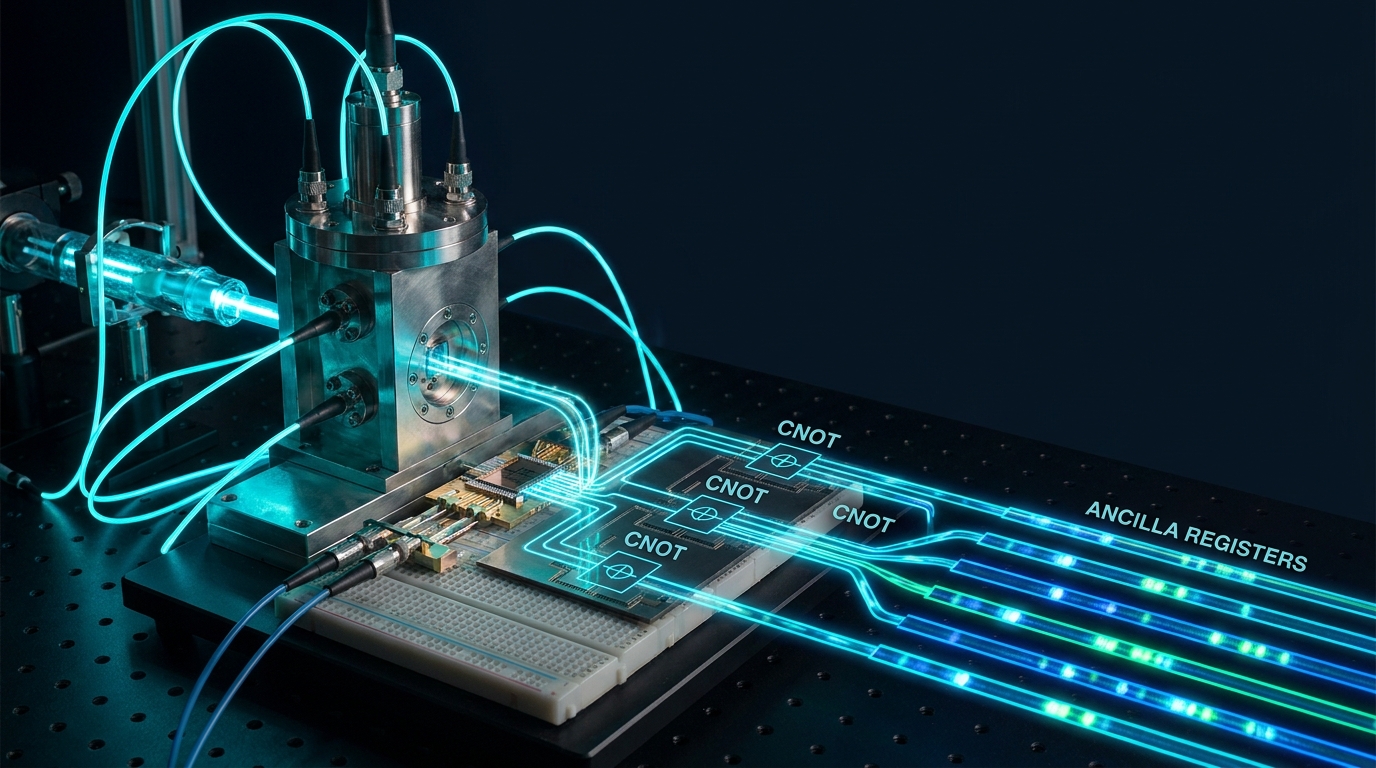
The Comment's central finding is technical but consequential. The original protocol used a CNOT fanout — a cascade of controlled-NOT gates — to copy information from a single post-query probe into multiple ancilla registers. The Comment shows this fanout does not produce independent copies. Instead, it broadcasts the one-qubit marginal while leaving the registers perfectly correlated. Think of it like photocopying the same page of a book over and over: you get many sheets, but they all carry identical information, not independent samples.
A CNOT fanout of a diagonal post-query probe broadcasts its one-qubit marginal but produces perfectly correlated registers rather than independent copies.
Consequently, neither the trace distance nor the relative entropy between the balanced and constant hypotheses increases, and repeated measurements of the ancillas yield only one Bernoulli observation, not 116. The Comment puts it bluntly: independent samples instead require repeated preparation and heat exchange, which are repeated queries under the definition adopted in the original paper.
The State of the Field
The original paper appeared as Phys. Rev. A 113, 012420 (2026), exploring thermodynamic query complexity — a young subfield asking how heat exchange can substitute for quantum gate operations. The Comment, posted to arXiv on July 3, 2026, responds to specific claims about resource counting. This debate matters because the broader quantum computing landscape in 2026 is racing toward fault tolerant quantum computing. Surface code architectures and logical qubit designs depend on precise resource budgets; sloppy accounting anywhere in the stack undermines confidence in the whole. Major hardware efforts at IBM, Google, and IonQ are now publishing logical qubit demonstrations, and any foundational claim about resource savings gets scrutinized closely.
From Lab to Reality
For theorists, the Comment sharpens the definition of what counts as a "query" in thermodynamic settings. Under the original paper's own definition, independent samples require repeated preparation and heat exchange — which is to say, repeated queries. For experimentalists building quantum hardware, the takeaway is that thermal kicks may still encode the decision in the probe temperature, but extracting that information faithfully demands more than a single round of CNOT fanout. For the quantum error correction market — projected by multiple industry analysts to exceed $1 billion annually by 2030 as fault tolerant quantum computing efforts scale — this kind of foundational clarity matters because investors and engineers need reliable resource estimates before committing capital to specific architectures. Companies building surface code implementations, in particular, depend on accurate qubit-overhead projections to plan fabrication roadmaps.
What Still Needs to Happen
The Comment identifies two specific technical issues that remain unresolved. First, the sample lower bound of approximately 116 stated in the original paper does not follow from Pinsker's inequality as invoked; the inequality actually gives the opposite ordering for the reciprocal relative entropy. Second, the thermal-kickback mechanism itself is not dismissed — the Comment explicitly notes it "may still encode the decision in the probe temperature." What needs correction is the readout claim and the necessity of approximately 116 samples. Researchers working on thermodynamic resource theories, including groups active in quantum thermodynamics at institutions like ETH Zurich, the University of Tokyo, and various U.S. national laboratories, will need to revisit these accounting questions. Realistically, integrating thermodynamic primitives into fault tolerant quantum computing pipelines remains at least a decade away from commercial relevance, and the field still lacks a consensus framework for counting thermal resources alongside gate-based resources.
In short: the original claim that one thermal query solves Deutsch-Jozsa with approximately 116 independent samples is incorrect, because CNOT fanout produces correlated rather than independent registers, and the sample lower bound does not follow from Pinsker's inequality as stated.
Frequently Asked Questions
What is the Deutsch-Jozsa problem? The Deutsch-Jozsa problem is a foundational quantum computing task: given a black-box function that is either constant (always outputs the same value) or balanced (outputs 0 half the time and 1 half the time), determine which type it is. A quantum algorithm can solve it with a single query, while any classical deterministic algorithm needs exponentially many queries in the worst case. It is a textbook example of quantum advantage and a standard benchmark in introductory quantum computing courses.
What is thermodynamic query complexity? Thermodynamic query complexity is a research framework that asks how heat exchange with a reservoir can substitute for or augment traditional quantum gate operations when solving computational problems. It sits at the intersection of quantum computing, quantum thermodynamics, and resource theory. The goal is to understand which computational problems can be solved efficiently using thermal resources alone, or with a hybrid mix of thermal and gate-based operations.
How does CNOT fanout work? A CNOT (controlled-NOT) gate uses one qubit as a control and another as a target, flipping the target if the control is in state |1⟩. A CNOT fanout chains these gates so that one input qubit controls many target qubits. In the original protocol, this was meant to copy probe information into many ancillas, but the Comment shows the copies are perfectly correlated rather than independent. This is a subtle but important distinction: classical copying produces independent samples, while quantum fanout of a diagonal state produces correlated ones.
When could this matter for practical quantum computing? The immediate impact is theoretical: it corrects a specific resource-counting claim in a 2026 paper. Practical implications for fault tolerant quantum computing architectures will emerge as thermodynamic primitives are integrated into larger quantum algorithms, which most analysts place beyond 2030. Near-term quantum hardware, including current NISQ devices and early logical qubit prototypes, does not yet operate in regimes where thermodynamic query complexity is the binding constraint.
Which industries would benefit most from this kind of analysis? Industries that depend on rigorous quantum resource accounting — including quantum hardware vendors, quantum software companies building compilers for surface code and other error-corrected architectures, and government agencies funding quantum error correction research — benefit when foundational claims are scrutinized and corrected. Pharmaceutical companies exploring quantum simulation and financial firms evaluating quantum optimization also rely on accurate resource projections to plan their research investments.
What are the current limitations of this research? The Comment addresses one specific protocol in one paper. It does not rule out other thermodynamic approaches to Deutsch-Jozsa or related problems. The thermal-kickback mechanism itself remains a live research question, and the broader field of thermodynamic query complexity is still young, with most results confined to idealized theoretical models rather than noisy intermediate-scale quantum hardware. Bridging the gap between these idealized models and real quantum devices remains an open challenge.