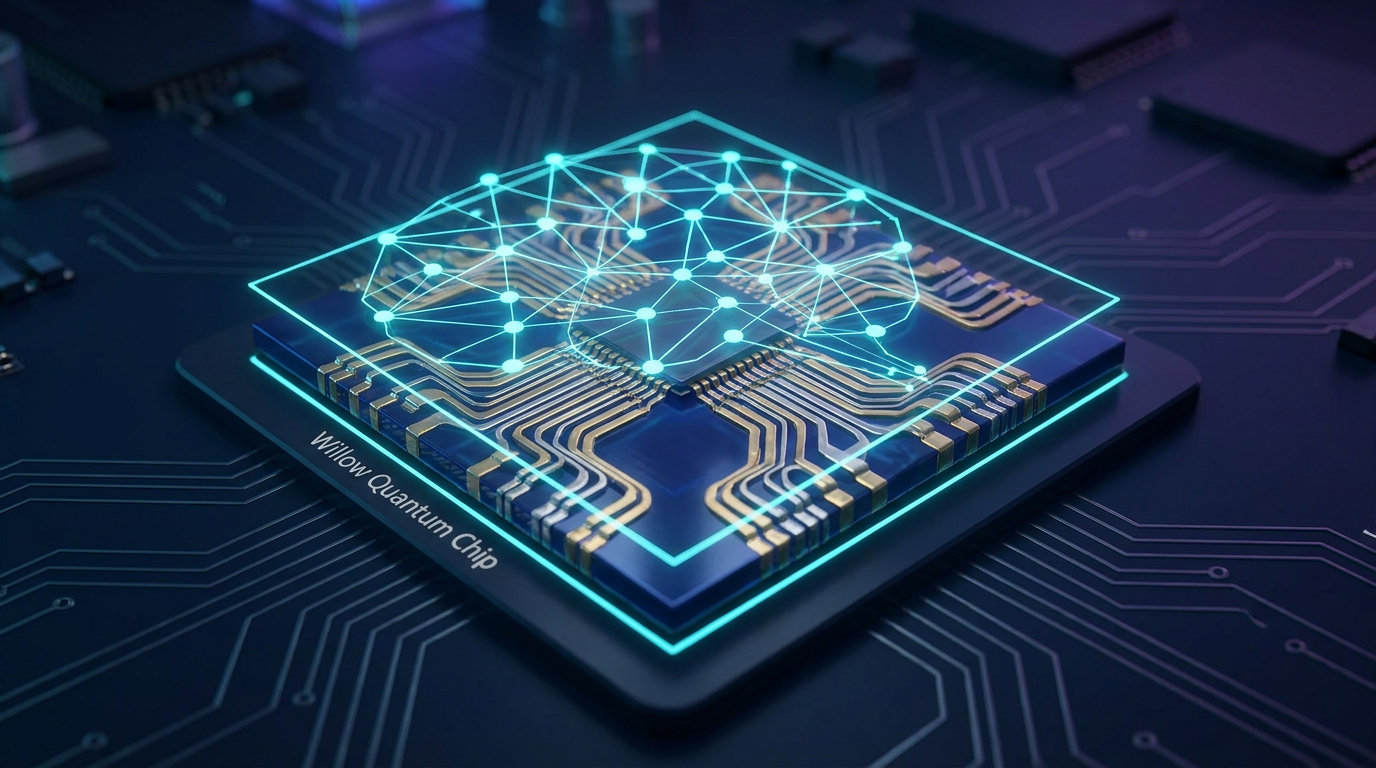
Google Quantum AI published a Nature paper on July 11, 2026 describing a reinforcement learning (RL) control framework that stabilizes logical qubits on its Willow superconducting processor during uninterrupted execution. The framework unifies real-time calibration with active quantum error correction (QEC), addressing what Google frames as the primary bottleneck for fault-tolerant quantum computing. The work is engineering, not physics: it operates entirely at the control plane and does not change the underlying qubit hardware.
What Google Is Actually Building
Willow is a 105-qubit superconducting chip that Google introduced in December 2024. That announcement established that Willow operates below the surface code threshold, meaning adding more physical qubits reduces the logical error rate rather than amplifying it. The current paper extends that result by automating the calibration loop with an RL agent that adjusts control parameters during execution, without operator intervention.
Numbers matter here. Google has not yet published the logical error rate, the duration of uninterrupted operation, or the number of logical qubits under RL control in the press materials. The headline claim of "uninterrupted execution" is the substantive technical promise, and the Nature publication implies it has cleared initial peer review.
The competitive picture in mid-2026 is dense. IBM's Heron processor, a 156-qubit superconducting chip deployed in late 2024, remains the largest superconducting system in commercial service, with IBM publicly targeting 100,000-qubit fault-tolerant systems by 2033. Quantinuum's H2 trapped-ion system reported 99.7% two-qubit gate fidelity in early 2026, the highest publicly cited figure for any qubit modality. Atom Computing announced a 1,180-qubit neutral-atom array in late 2024 and is pursuing a parallel fault-tolerance roadmap. Google's RL layer changes none of these qubit counts. It changes the operating envelope: how long logical qubits survive without human recalibration, and how stable that operation is during a commercial cloud session.
Winners and Losers
The most direct losers are vendors of classical quantum control stacks. Quantum Machines, Zurich Instruments, and Keysight Technologies (KEYS) sell control hardware and calibration software built around human-supervised or scripted pipelines. An RL-based autonomous layer embedded at the firmware level threatens to commoditize parts of that stack. Smaller middleware plays, including Q-CTRL and QunaSys, face a similar squeeze if RL becomes the default control paradigm.
Winners include cloud quantum providers, who can promise longer continuous operation per session: AWS Braket, Microsoft (MSFT) Azure Quantum, and Google Cloud. They also include RL-for-quantum startups such as Phasecraft, where a published RL result from a frontier lab validates the approach. The investment angle: control-plane software is becoming a defensible moat for vertically integrated players like Google and IBM, and a fragile one for control hardware vendors selling into the same labs.
Adjacent markets also move. Quantum software stack providers, including Classiq and QC Ware, benefit from more stable logical qubits, which expands the addressable workload set. Quantum networking companies such as Aliro Quantum and Quantum Bridge are unaffected at this stage, since Willow is a single-chip experiment and the RL layer does not change inter-chip communication.
The Bigger Picture
Mid-2026 is the year of the logical qubit. Quantinuum published 12 logical qubits via qLDPC encoding in February 2026. Atom Computing demonstrated a 256-atom logical array in March 2026. QuEra reported 30 logical qubits in late 2025. Google's December 2024 Willow paper was the entry point to this era, and the current RL control work is the second wave: stabilizing those logical qubits in operation, not just demonstrating their existence.
Government capital is flowing in the same direction. The U.S. National Quantum Initiative Reauthorization Act of 2024 allocated $2.7 billion through 2028. DARPA's Quantum Benchmarking Initiative, launched in 2024, funds utility-scale comparisons. The EU Quantum Pact replaced the Quantum Flagship in 2024 with a €1 billion annual budget. India's National Quantum Mission, launched in 2023, allocated ₹6,003 crore (roughly $720 million) over eight years. All of this is flowing toward QEC and fault tolerance, which is precisely where Google's RL control framework is positioned.
A comparable engineering milestone: in May 2026, IBM published a paper in Physical Review X showing a real-time decoder for surface codes running on a classical FPGA co-processor attached to its Heron processor. The two papers converge on the same target, automated logical-qubit maintenance, from opposite ends of the stack. Google adds an RL agent to the control plane. IBM hard-codes a decoder in silicon. Both reduce the human-in-the-loop latency that has defined QEC since Peter Shor's 1995 result.
The Signal
The signal is that the QEC bottleneck has moved from physics to engineering. Whether the specific "uninterrupted execution" claim survives quantitative scrutiny is a separate question. The Nature publication indicates the work has cleared initial review, but the logical error rate per cycle, the number of logical qubits under sustained RL control, and the duration in physical time are not yet in the public record. The technical milestone that would validate this claim is a published logical error rate below 10⁻⁶ per cycle on at least 10 logical qubits, with reproducible runs across multiple days. If Google publishes that number, this is a fault-tolerance milestone. If the number remains inside the press release, it is a calibration upgrade.
In short: Google's reinforcement learning control layer stabilizes Willow's logical qubits during uninterrupted execution, but the published logical error rate will determine whether this is a fault-tolerance breakthrough or a control-plane optimization.