The Problem Nobody Solved (Until Now)
For more than a century, engineers have guided waves the same way: by surrounding them with continuous walls. Fiber optic cables sheath light in unbroken glass. Microwave guides channel radio signals through seamless metal tubes. Acoustic ducts carry sound within rigid, uninterrupted surfaces. The assumption has always been that to confine a wave, you need an unbroken barrier — a continuous boundary that reflects the wave back into the guided region.
But a paper published in Physical Review Letters on May 10, 2021 turns that assumption on its head. Researchers have demonstrated that you can guide waves using nothing more than a periodic array of slits — essentially, by repeatedly cutting the wave's edges rather than sealing them. The work, identified by DOI 10.1103/PhysRevLett.127.014303, shows that this counterintuitive approach works for at least two very different kinds of waves, suggesting it may be a universal phenomenon applicable across wave physics.
The result matters because waveguides underpin technologies from telecommunications to medical imaging. Any new guiding mechanism potentially expands the design space for these systems, and the simplicity of the new approach — periodic truncation rather than continuous confinement — could lower fabrication costs in applications where it proves practical.
The Core Finding
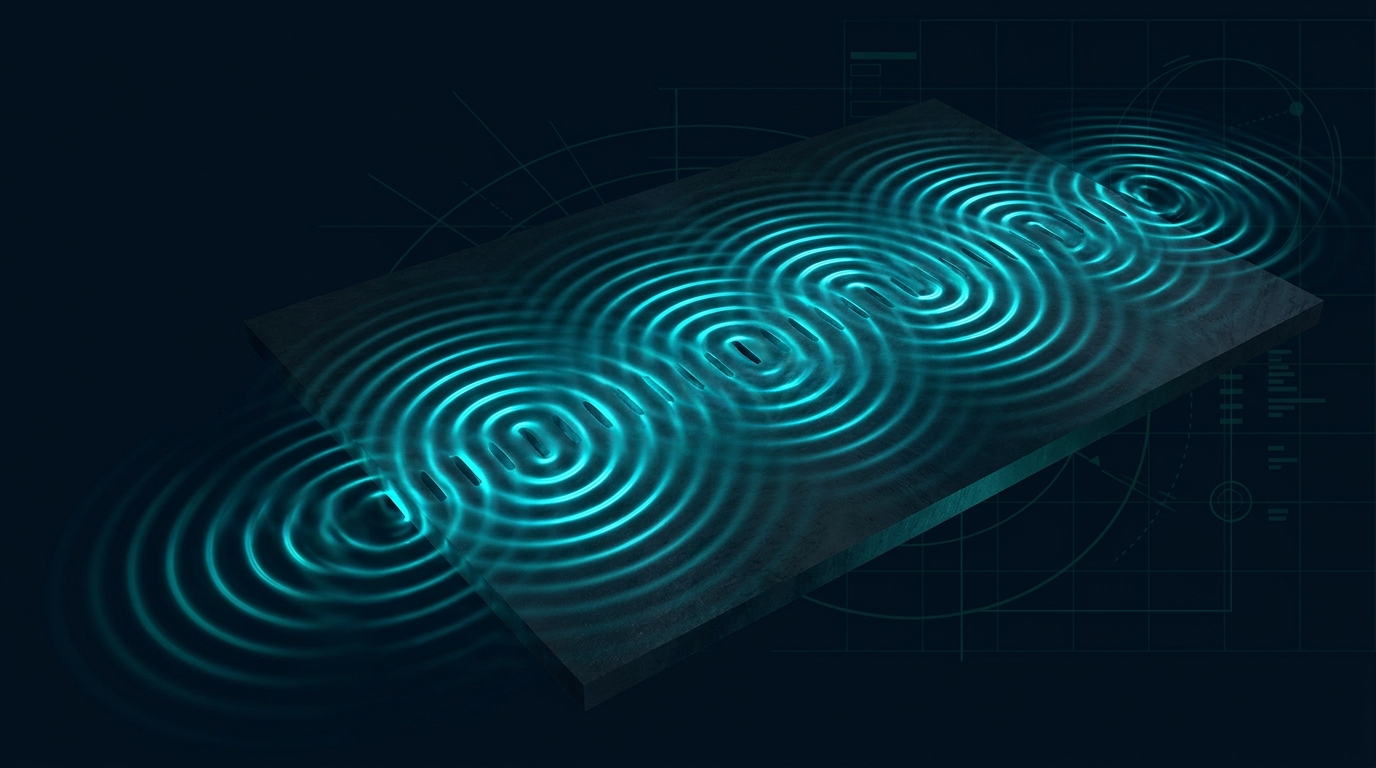
The team's central claim is stark: "in order to guide waves, it is sufficient to periodically truncate their edges." That is, you don't need a continuous wall — you just need a repeating pattern of barriers with gaps between them.
Think of it like a picket fence guiding a stream of water. Instead of building a solid dam, you place evenly spaced posts across the flow. Counterintuitively, the water still follows a predictable path, with the wave pattern repeating itself as it moves between the posts. The gaps do not destroy the guidance; they enable it.
The researchers demonstrated this in two settings. First, they worked with plasmonic waves — oscillations of electrons at a metal-air interface — periodically blocked by nanometric metallic walls. Second, they used surface gravity water waves in a laboratory tank, where they truncated the wave packet, let it propagate, regenerated it, and showed that the pattern repeated. In both cases, the modes propagated freely between the slits while maintaining their overall structure.
The key metric here is conceptual rather than quantitative: the demonstration shows that a fundamentally different guiding mechanism — periodic truncation rather than continuous confinement — can produce stable, repeating wave modes. This is a shift in design principle, not just an incremental improvement in waveguide performance.
The State of the Field
Traditional waveguide design relies on total internal reflection or continuous metallic boundaries. Optical fibers, for instance, guide light by exploiting the refractive index difference between a glass core and a surrounding cladding. Microwave guides use hollow metal tubes. Acoustic waveguides employ rigid walls. In each case, the boundary is continuous and unbroken, and the physics of guidance is well understood.
Periodic structures have been studied extensively before. Photonic crystals and phononic crystals use repeating patterns to control wave propagation, and these have been a major area of research since the 1980s. But those structures typically involve continuous periodic variations in material properties — alternating layers of different refractive index, for instance — not discrete truncations of the wave itself. What this new work introduces is the idea that simply cutting the wave's edges periodically is enough to create guided modes, without requiring a continuous periodic medium.
The advance was made possible by two capabilities. Precise nanofabrication techniques enabled the plasmonic demonstration, with metallic walls only nanometers thick. High-speed imaging allowed the water wave experiments to capture the propagation pattern in detail. Neither capability existed in its current form a generation ago, which explains why this simple idea took so long to verify experimentally.
From Lab to Reality
For scientists, this result opens a new design principle for waveguides. Instead of engineering continuous boundaries, researchers can now think about periodic truncation as a guiding mechanism. This could simplify fabrication in some cases — building a series of posts may be easier than constructing a seamless tube, particularly at small scales where continuous coatings are difficult to apply uniformly.
For engineers, the immediate applications lie in plasmonic circuits and integrated photonics. Plasmonic waveguides are being developed for chip-scale optical interconnects, where they could carry signals faster than electronic circuits while remaining compatible with existing semiconductor manufacturing. A simpler guiding mechanism could reduce fabrication complexity and cost in these systems.
The water wave demonstration also has implications beyond physics. Ocean engineers study surface gravity waves for coastal protection, wave energy harvesting, and ship design. Understanding how periodic structures guide these waves could inform new kinds of breakwaters or energy converters that exploit rather than block wave motion.
The paper notes that the concept is "applicable for a wide variety of waves," which suggests electromagnetic waves more broadly, acoustic waves, and even elastic waves in solids could be guided this way under the right conditions. The two demonstrations — plasmonic and water — span very different physics, supporting the universality claim. If the principle holds for other wave types, the design space for waveguide engineering expands substantially.
What Still Needs to Happen
Several challenges remain before this approach can be widely adopted. First, the plasmonic demonstration showed guiding, but plasmonic systems are inherently lossy — the waves dissipate as heat in the metal. Researchers will need to quantify how periodic truncation affects loss compared to continuous-boundary waveguides, and whether the loss is acceptable for practical applications.
Second, the work demonstrated the principle for two specific wave types. A broader survey across electromagnetic, acoustic, and elastic waves would establish the universality of the effect and identify any regimes where it fails. The authors suggest the concept is general, but only two examples have been verified.
Third, practical device integration requires connecting these periodically truncated waveguides to other components — sources, detectors, modulators. That integration work has not yet been done, and it is not clear how periodic truncation interfaces with conventional waveguide technology.
Groups working on plasmonic waveguide design, including teams at various photonics research centers, will likely pursue these questions. The water wave aspect may attract attention from coastal engineering and fluid dynamics communities. Realistically, translating this laboratory demonstration into commercial technology will take at least five to ten years, and possibly longer if fundamental loss or integration challenges prove difficult to overcome.
Conclusion
In short: periodic edge truncation can guide waves as effectively as continuous boundaries, demonstrated for both plasmonic and surface gravity water wave systems in a 2021 Physical Review Letters paper.