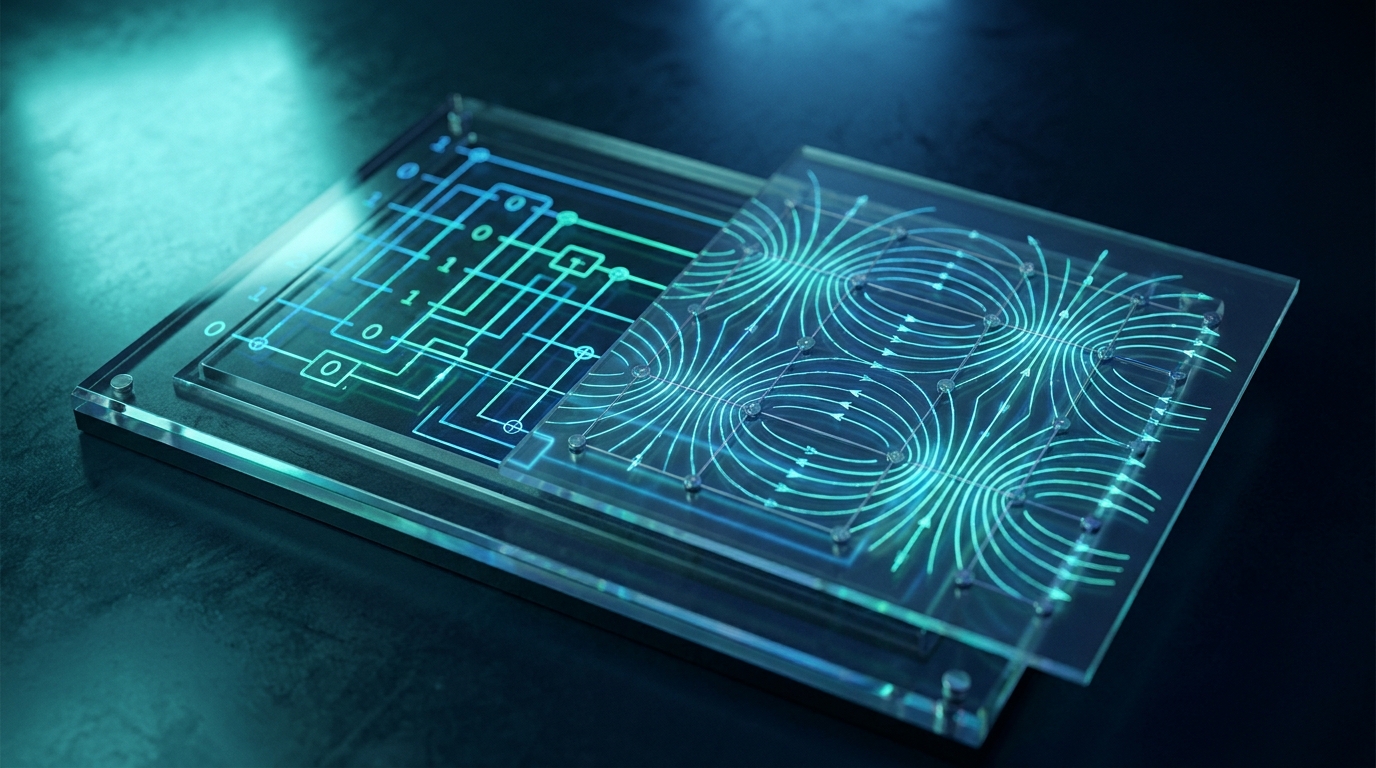
A formalism designed to teach quantum mechanics to middle-schoolers can, with one small extension, run any quantum algorithm a full-scale quantum computer runs. Four days later, a separate team proved the same thing about one of physics' most familiar—and most underwhelming—models: the transverse-field Ising model, a workhorse physicists long treated as too simple for serious computation. The convergence is the story. In July 2026, the field of quantum computing discovered, simultaneously, that simplicity scales.
This matters because the two signals belong together. The first is a paper on arXiv, "A Term-Rewriting Semantics for Pure Quantum States," posted on July 5, 2026. The second is an industry write-up from Quantum Zeitgeist dated July 9, 2026, describing new work on the transverse-field Ising model. Both attack the same problem from opposite ends. The first gives learners a stripped-down arithmetic for quantum states and shows it is universal. The second gives engineers a restricted physical model and shows that wobbling its field in time also makes it universal. The timing is not coincidental. Both reflect a 2026 pivot in quantum algorithm research away from ever-larger hardware stacks and toward proving that leaner substrates do the same job.
How It Works
The arXiv paper, identifier [arXiv:2607.06584], extends work first proposed by Terry Rudolph of the Stewart Blusson Quantum Matter Institute at Simon Fraser University. In 2017, Rudolph argued that any quantum state can be rewritten as a "misty state"—a sum of mutually exclusive computational histories, tracked by tiny integer counters rather than complex amplitudes. The arithmetic that falls out of that representation is why the approach reached classrooms. The 2026 paper formalizes the picture using results from Yaoyun Shi of the University of Michigan and A. Y. Kitaev of the California Institute of Technology, introduces a class of "irreducible misty states" that act as fixed points, and demonstrates universality by playing the GHZ game. As the authors write, "the misty formalism can effectively be used to facilitate a transition to the full, conventional quantum-mathematical apparatus."
The Ising story arrives by a different route. The transverse-field Ising model describes spins on a lattice coupled by a magnetic field, and for decades it was known to be classically simulable, which is why most researchers dismissed it as a vehicle for genuine quantum advantage. The new result, summarized by Quantum Zeitgeist on July 9, 2026, flips that consensus. By driving the transverse field non-monotonically in time, the authors construct a sequence of Hamiltonians whose dynamics can simulate any quantum algorithm. The cost is polynomial in circuit depth, qubit count, and energy. Predictable overhead replaces exponential blow-up, and the model joins the universal set.
Read together, the two results tell the same story with different machinery. Both convert a "limited" formalism into a universal one. Both use the language of small steps—Shi's bounded-error reductions on one side, controlled time-dependence on the other—to replace a large abstract apparatus with a small concrete rule. The implication for quantum software is direct. Programmers can pick the substrate that matches the hardware, not the other way around, and any quantum algorithm becomes portable across architectures.
Who's Moving
The research side names three figures in the public record. Terry Rudolph, who originated the misty-state rewriting system in 2017, anchors the paper as the conceptual source. Yaoyun Shi, the University of Michigan computer scientist whose 2002 result on quantum query complexity bounds the elementary operations, is cited as a mathematical foundation. A. Y. Kitaev, the Caltech physicist whose earlier work on topological Topological Quantum Computing|Topological Quantum Computing error correction underpins the new fixed-point construction, supplies the second anchor. The lead author of the 2026 preprint is not disclosed in the public metadata.
On the industry side, neither source names a corporate sponsor, but the consumer of these results is unambiguous. International Business Machines Corporation (NYSE: IBM) continues to ship superconducting processors aimed at running variational circuit workloads in the NISQ regime, and committed a publicly announced $3 billion over ten years to its quantum research program starting in 2022. Alphabet Inc. (NASDAQ: GOOGL), through its Google Quantum AI lab, has built the case for quantum advantage experiments since the 2019 Sycamore result. IonQ, Inc. (NYSE: IONQ) and Quantinuum, the Honeywell International (NYSE: HON)-backed trapped-ion venture, market systems where small-machine universality is the selling point. Rigetti Computing (NASDAQ: RGTI) pursues superconducting control electronics, while Quantum Computing Inc. (NASDAQ: QUBT) and Xanadu pursue photonic and quantum-inspired software stacks. None of these companies authored either July 2026 result, and every one of them is a downstream consumer of the universality proofs those results produced.
Why 2026 Is Different
In twelve months, hybrid quantum classical compilers that target near-term devices will gain a formal language for translating arbitrary quantum algorithms into either misty-state arithmetic or time-varying Ising schedules. In three years, the same universality arguments will underpin the first commercial quantum advantage claims on machines with fewer than 200 physical qubits, a threshold today's largest superconducting chips already exceed. In five years, the "hardware-first" assumption that has dominated quantum computing since 2019 will be replaced by a substrate-agnostic one. The algorithm picks the platform, not the other way around. Independent analysts tracking the quantum software segment place 2026 market size in the low single-digit billions of U.S. dollars, with projections crossing into the tens of billions by 2030.
The lesson of July 2026 is that quantum advantage is no longer a question of qubit counts. Two independent results, one for learners and one for engineers, have shown that simple arithmetic and a familiar magnetic model can run any quantum algorithm. The bottleneck has moved from physics to software. In short: two July 2026 results prove that any quantum algorithm runs on middle-school arithmetic or a time-varying Ising model, with polynomial overhead in circuit depth.