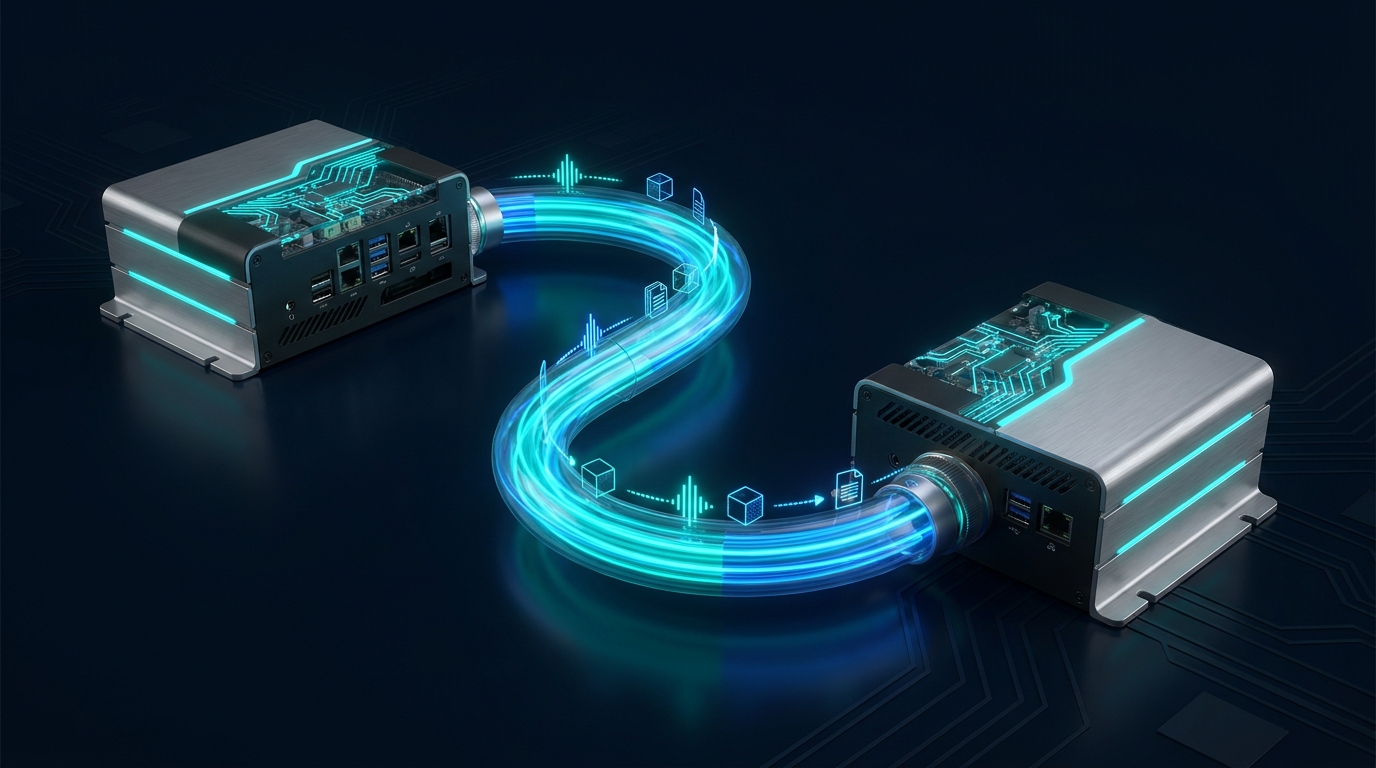
Quantum key distribution has promised unbreakable encryption for decades, but connecting QKD systems to everyday applications has remained stubbornly difficult. Banks, governments, and telecoms want quantum-safe communications, yet most demonstrations still live in laboratory settings, transmitting test patterns rather than actual phone calls or video conferences. The challenge is the so-called last mile — bridging the gap between a quantum physics experiment and a working network application. Researchers working with Spanish quantum cryptography company LuxQuanta set out to solve exactly this integration problem, and the result is a prototype that ran for eight continuous hours without interruption. [arXiv:2607.06602]
The Core Finding
The team built a prototype VPN that pulls encryption keys directly from a QKD system rather than generating them with classical algorithms. The VPN uses AES-256-GCM encryption — the same standard protecting most modern web traffic — but feeds it keys derived from quantum key distribution. Think of it like swapping the lock on your front door while keeping the same key shape: the underlying security mechanism changes, but everything that uses the lock keeps working without modification.
The system transports ETSI key identifiers in-band alongside regular IP traffic, then retrieves matching keys from local Key Management Entities, or KMEs. After validating the design with a controlled KME simulator, the researchers deployed it on two Jetson Xavier NX edge-computing devices connected to a LuxQuanta NOVA QKD platform. The result, in the authors' own words, was that "the experiment successfully transmitted bidirectional real-time audio and video traffic through the VPN for eight continuous hours," demonstrating that classical VPN applications can integrate with QKD infrastructure through a standardized key-delivery interface.
The State of the Field
QKD has been demonstrated in laboratories since the 1980s, with companies including ID Quantique, Toshiba, and LuxQuanta now building commercial systems. The ETSI GS QKD 014 standard, which defines how QKD keys should be delivered to applications, has existed for several years. What was missing was proof that real applications — not just test data — could run continuously over these standardized interfaces.
Previous demonstrations typically showed point-to-point file transfers or short test sessions. This work extends that to sustained multimedia traffic, which is far more demanding because audio and video streams cannot tolerate the latency spikes or key-rotation hiccups that a file transfer might survive. The broader quantum computing landscape in 2026 has intensified interest in QKD: as fault-tolerant quantum computers edge closer to reality, the cryptographic algorithms protecting today's internet face eventual obsolescence, making quantum-safe communications infrastructure a pressing concern for any organization with data that needs to remain secret for more than a decade.
From Lab to Reality
For scientists, this work provides a reference implementation that other groups can build on. The use of standardized ETSI interfaces means researchers can swap in different QKD hardware without rewriting their applications, accelerating experimental comparisons and reproducibility across labs.
For engineers, the immediate beneficiaries are telecoms and financial institutions. Telecom carriers have been piloting QKD links between data centers for years; integrating those links with VPN infrastructure is the next logical step. Government networks handling classified information represent another near-term market, as do financial backbones where regulatory pressure to adopt post-quantum cryptography is mounting.
For investors, the quantum-safe communications market — distinct from but adjacent to the quantum error correction market — is drawing serious capital as post-quantum cryptography standards finalize. LuxQuanta's NOVA platform is one of several commercial QKD systems now being deployed in European quantum communication networks, and the company raised a Series A round in 2024 to scale production.
What Still Needs to Happen
Two technical challenges stand between this prototype and widespread deployment. First, QKD systems currently require dedicated fiber optic links, and the achievable key rate drops sharply with distance — typically limiting practical deployments to around 100 kilometers without trusted nodes. Researchers at institutions including the University of Geneva and China's Hefei National Laboratory are working on quantum repeaters to extend this range, but functional repeaters remain years from production.
Second, the cost of QKD hardware remains high compared to classical encryption. A single LuxQuanta NOVA system represents a significant capital investment, and integrating it with existing network infrastructure requires specialized expertise. Companies including QuantumCTek and ID Quantique are pursuing chip-scale integration to reduce costs, but economies of scale have not yet arrived.
Realistically, quantum-secured VPNs will appear first in niche applications — government, defense, financial backbones — before becoming mainstream. Mass-market adoption probably remains a decade away, contingent on advances in both QKD hardware and quantum repeater technology. No false optimism is warranted: this is a meaningful step, but it is one step on a long road.
In Summary
In short: This prototype demonstrates that quantum key distribution can sustain real-time encrypted communications for eight continuous hours using standardized ETSI interfaces, bringing QKD one step closer to practical network integration.
Frequently Asked Questions
What is quantum key distribution?
Quantum key distribution is a method for two parties to share a random encryption key by exchanging photons whose quantum states cannot be measured without disturbance. Any eavesdropper attempting to intercept the key leaves detectable traces, making the resulting key information-theoretically secure. QKD is used for secure communications, not for quantum computing.
How does a QKD-secured VPN work?
The VPN encrypts traffic with a standard algorithm such as AES-256-GCM, but instead of generating keys locally, it requests them from a QKD system through a standardized API. Key identifiers travel alongside the encrypted data, and a local Key Management Entity matches each identifier to the correct quantum-derived key. The classical encryption does the heavy lifting; QKD supplies keys that are provably unbreakable by future quantum computers.
How does this compare to post-quantum cryptography?
Post-quantum cryptography replaces today's algorithms with new classical algorithms believed to resist quantum attacks. QKD takes a different approach, using physics rather than mathematics to secure keys. The two are complementary: post-quantum cryptography runs on existing internet infrastructure, while QKD requires dedicated hardware but offers stronger security guarantees.
When could quantum-secured VPNs be commercially relevant?
Niche deployments in government, defense, and financial backbones are already underway in 2026. Broader commercial adoption will likely follow once QKD hardware costs drop and quantum repeaters extend the achievable distance beyond 100 kilometers. Most analysts estimate mainstream availability around 2030 to 2035.
Which industries would benefit most?
Telecommunications carriers, banks, healthcare networks handling sensitive records, and government agencies are the most likely early adopters. Any organization whose data must remain confidential for ten or more years has a strategic interest in quantum-safe communications, because adversaries may harvest encrypted traffic today and decrypt it later.
What are the current limitations of this research?
The prototype was tested on a single QKD link between two edge devices in a controlled environment. It does not address multi-node networks, long-distance deployment, or integration with existing carrier infrastructure. The eight-hour test demonstrates stability but not the years of uptime that production networks require.