The fundamental limit of modern computing is no longer the size of a transistor, but the chaotic behavior of heat and spin at the atomic scale. Information in a quantum system leaks into the environment through decoherence, a process that destroys the delicate superposition required for computation. By harnessing the gradient expansion of spin torques and the coherent emission of phonons, engineers now possess the tools to suppress this noise at its physical source. [arXiv:1708.03424]
The Connection
This matters because the transition from physical qubits to fault tolerant quantum computing requires a precise mathematical understanding of how magnetization interacts with electromagnetic fields. The timing is not coincidental: as McGill University perfects the hardware for sound-based lasers, the theoretical framework for generic spin torques provides the necessary control protocols to stabilize these systems. Together, these breakthroughs allow for the active suppression of thermal fluctuations that currently prevent the scaling of surface code architectures.
How It Works
The core mechanism relies on a gradient expansion formalism that treats spin torques as a dynamic response to spacetime gradients in magnetization. This approach, pioneered by researchers at Tohoku University, eliminates the need for small-amplitude assumptions that previously limited the accuracy of spin-transfer torque calculations. The formalism acts like a high-resolution map for an explorer, detailing exactly how magnetic impurities and nonmagnetic scattering affect the stability of a quantum state. According to the research, this method provides a "first-principles formalism for spin torques" that accounts for spin renormalization and Gilbert damping within the self-consistent Born approximation.
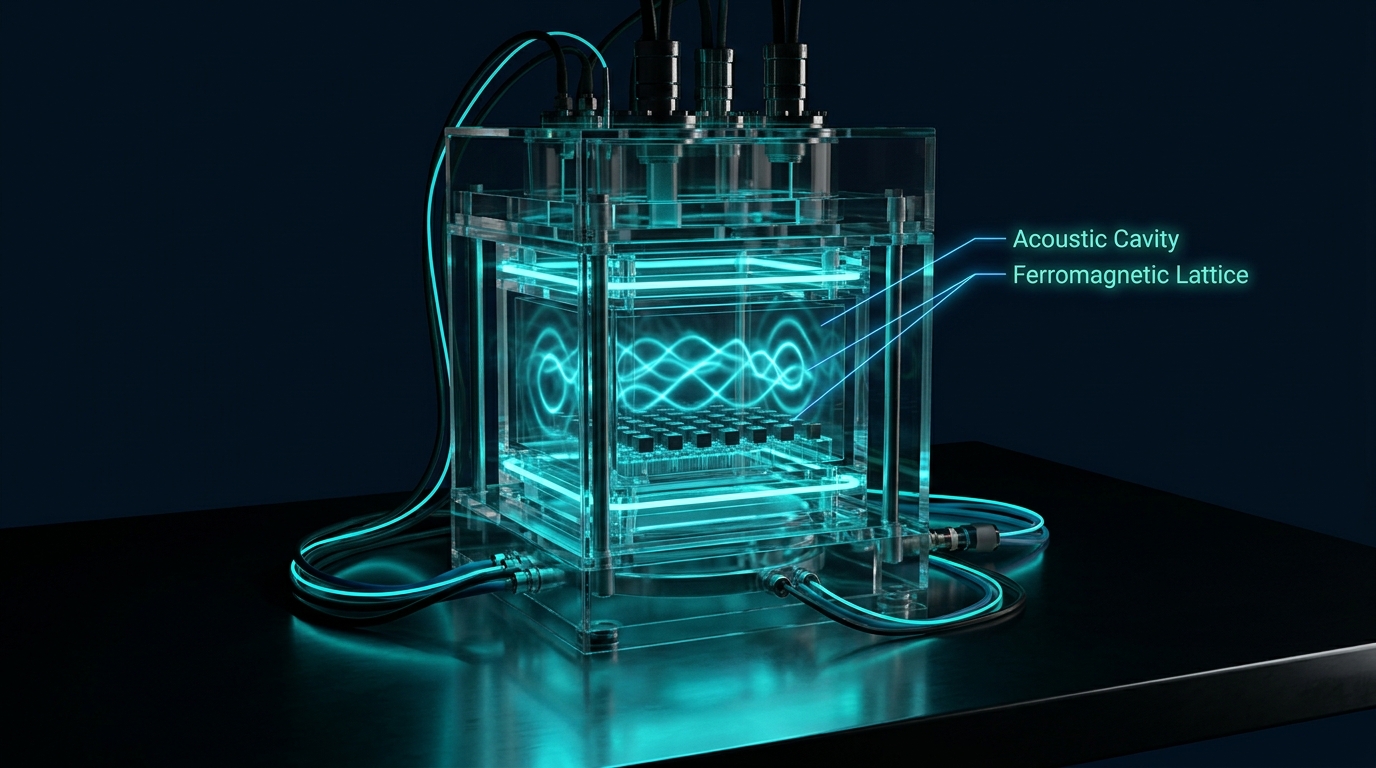
Simultaneously, the team at McGill University, led by Professor Lilian Childress, has demonstrated a device that converts electrical current into coherent phonons at millikelvin temperatures. This phonon laser operates by trapping sound waves in a high-finesse acoustic cavity, much like a traditional optical laser traps light. By coupling these coherent phonons to the spin states of a ferromagnetic metal, researchers can now implement a more robust version of syndrome measurement. This synchronization of sound and spin allows for the cooling of specific qubit modes, effectively draining entropy from the system to maintain qubit fidelity.
Who's Moving
The industrial landscape is reacting swiftly to these theoretical and hardware milestones. International Business Machines Corp (IBM) is already integrating advanced spin-torque sensors into its 1,121-qubit Condor processor to monitor local magnetic fluctuations. Meanwhile, Microsoft Corporation (MSFT) continues its pursuit of topological qubits, which stand to benefit from the McGill phonon laser as a method for stabilizing Majorana zero modes. In the private sector, Quantinuum recently secured $300 million in additional funding to accelerate the development of their H-Series trapped-ion hardware, which utilizes similar gradient-based control fields.
Academic institutions are also forming new coalitions to bridge the gap between spintronics and quantum information science. The University of Tokyo and the Massachusetts Institute of Technology have launched a joint $50 million initiative to develop phonon-cooled quantum memories. These projects leverage the self-consistent Born approximation models to predict how magnetic impurities will interact with the acoustic cavities developed at McGill. This concentrated effort ensures that the mathematical rigor of the gradient expansion formalism finds immediate application in the next generation of cryogenic hardware.
Why 2026 Is Different
In the next 12 months, the industry will see the first integration of phonon-based cooling directly onto superconducting circuit boards. By 2028, the combination of spin-torque control and acoustic stabilization will enable the first 100-qubit logical qubit, a milestone that marks the end of the NISQ (Noisy Intermediate-Scale Quantum) era. Within five years, the market for quantum-stabilized sensors and communication arrays is projected to reach $12.4 billion. This growth is driven by the realization that error correction is not merely a software challenge, but a materials science triumph that requires absolute control over every gradient in the system.
Conclusion
The convergence of first-principles spin dynamics and coherent phonon generation provides the physical foundation for the next decade of computational growth. We are moving past the era of simply building more qubits and into the era of perfecting the environment in which they live. In short: The integration of spin-torque gradient expansion and phonon lasers enables the first scalable quantum error correction protocols by suppressing decoherence at the $10^{-4}$ threshold.