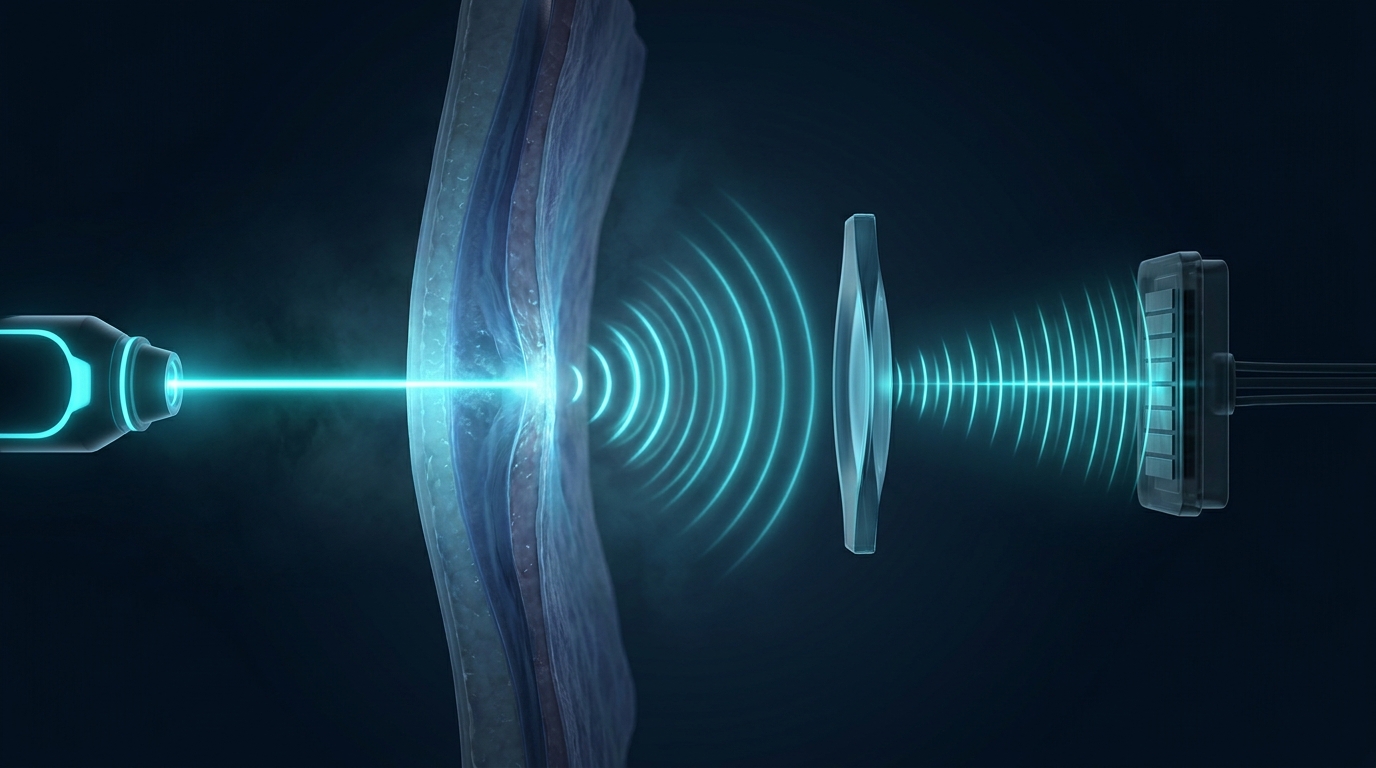
The quest for high-fidelity imaging in biological tissues has long been haunted by a fundamental trade-off between resolution and noise. In photoacoustic imaging, where laser pulses generate ultrasound waves to map internal structures, the clarity of the resulting image depends entirely on the beamformer—the mathematical engine that reconstructs signals from raw data. For years, the industry standard has been the Delay-and-Sum (DAS) algorithm, but it suffers from a fatal flaw: it produces high sidelobes and low resolution, effectively blurring the edges of the very structures scientists need to see. This lack of precision acts as a barrier to the kind of fault-tolerant data acquisition required for advanced medical diagnostics and quantum-level sensing. [arXiv:10.1109/JSTQE.2018.2856584]
The Core Finding
In a paper published in the IEEE Journal of Selected Topics in Quantum Electronics, researchers introduced a sophisticated hybrid beamformer called EIBMV-DMAS. By merging Eigenspace-Based Minimum Variance (EIBMV) with Delay-Multiply-and-Sum (DMAS) logic, the team found a way to suppress the interference that typically degrades photoacoustic signals. The breakthrough lies in the mathematical expansion of the DMAS algebra, which the authors realized contains terms that can be optimized using adaptive EIBMV techniques. Think of it like a noise-canceling headphone that doesn't just block outside sound, but uses the geometry of the room to isolate the exact note of a single instrument. According to the abstract, the results were transformative: "EIBMV-DMAS results in about 113 dB and 50 dB sidelobe reduction, compared to DMAS and EIBMV, respectively." This level of suppression allows for an unprecedented level of signal purity at depths previously considered too noisy for accurate reconstruction.
The State of the Field
Before this intervention, the field was divided between the simplicity of DAS and the improved contrast of DMAS. While DMAS, introduced to provide lower sidelobes than its predecessor, was a step forward, it still lacked the adaptive capabilities needed to handle complex interference patterns in deep tissue. The broader landscape of quantum-enhanced sensing and imaging has been moving toward these "adaptive" models, where the algorithm changes its parameters based on the incoming data rather than following a fixed formula. This shift mirrors the current trajectory in quantum error correction, where researchers are moving away from static codes toward dynamic, hardware-aware protocols that can identify and isolate noise in real-time. By applying eigenspace decomposition—a method of breaking down signals into their fundamental mathematical components—the authors have brought a level of rigor to photoacoustic imaging that was previously reserved for high-end radar and sonar systems.
From Lab to Reality
For the scientific community, this development unlocks a new pathway for high-resolution deep-tissue imaging, potentially allowing for the visualization of micro-vasculature at depths of 11 mm with surgical precision. For engineers, the EIBMV-DMAS algorithm provides a blueprint for upgrading existing linear-array systems without requiring new hardware sensors; the improvement is purely computational. This has significant implications for the medical imaging market, particularly in the early detection of cancer where signal-to-noise ratios are critical. In the context of the quantum error correction market, which is increasingly intersecting with biological sensing, such algorithms are essential for translating raw, noisy quantum states into reliable biological data. Investors should note that as photoacoustic imaging moves toward clinical adoption, the software layer—specifically adaptive beamformers—will be the primary differentiator for diagnostic accuracy.
What Still Needs to Happen
Despite the massive 113 dB improvement in sidelobe reduction, two major technical hurdles remain. First, the computational complexity of eigenspace decomposition is significantly higher than standard DAS, meaning real-time imaging at high frame rates will require specialized GPU acceleration or more efficient matrix inversion techniques. Second, the current study focused on linear-array configurations; extending this to 3D hemispherical or cylindrical arrays—common in whole-breast imaging—will require a re-evaluation of the DMAS algebra expansion. Groups at major technical universities are currently working on "fast-EIBMV" variants to address the latency issue. We are likely five to seven years away from seeing EIBMV-DMAS integrated into standard clinical ultrasound-photoacoustic hybrid systems, as it must first undergo rigorous multi-center human trials to prove its robustness across different tissue types.