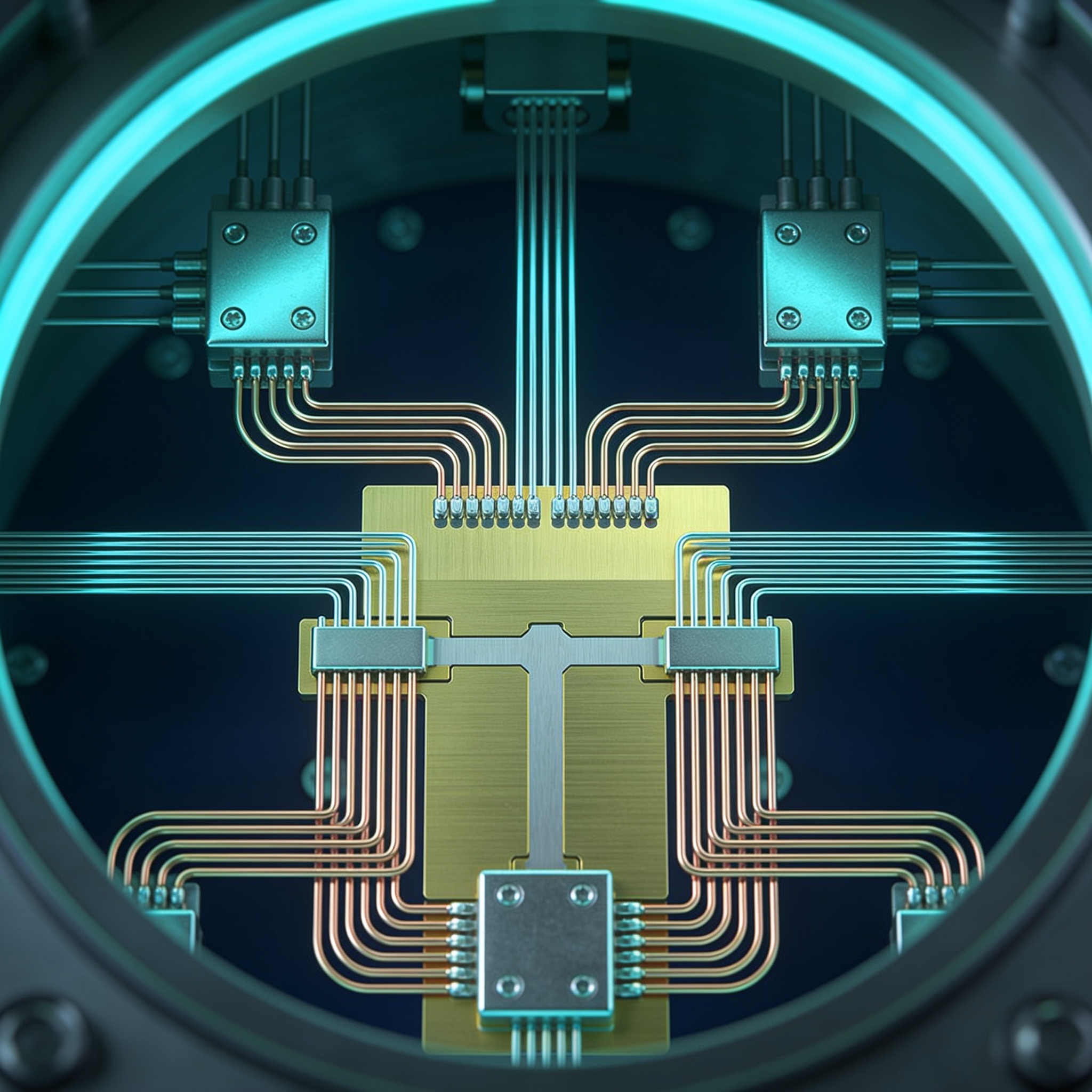
The Rényi coherent information—a metric for gauging a quantum code’s ability to protect information—has a notorious flaw: it does not behave monotonically as its order parameter increases. For stabilizer codes, however, a new theorem proves exactly the opposite. Under independent Pauli noise, the Rényi-n coherent information climbs steadily with n. This counterintuitive result, published on arXiv on September 10, 2026, promises to sharpen the benchmarks for fault-tolerant quantum processors. [arXiv:2609.11930]
On September 16, 2026, a separate team announced a robust control protocol that dramatically boosts the fidelity of cat qubits—superconducting devices that store information in superpositions of coherent microwave states. Cat qubits are inherently protected by a stabilizer code realized through engineered two-photon dissipation. The theoretical advance and the hardware leap share a core ingredient: stabilizer codes. This matters because the new monotonicity theorem gives engineers a mathematically rigorous tool to measure exactly how much information a cat-qubit code preserves under realistic noise, while the control breakthrough demonstrates that such codes can now be executed with record-low error rates. The timing is not coincidental: as theorists sharpen the yardstick, experimentalists are delivering the qubits to be measured.
How It Works
The Rényi coherent information, denoted Ic(n), is the difference between two Rényi entropies: Hn(C), the entropy of the syndrome—the error signature extracted from a quantum device—and Hn(T), the entropy of the joint syndrome and logical class. For stabilizer codes, which constitute the vast majority of error-correcting codes used on today’s quantum processors, these entropies have a specific structure. The new work, from an unspecified research group, proves a general theorem: when independent random bits are mapped linearly to a fine label T and a coarse label C, the Rényi entropy difference Hn(C)-Hn(T) is nondecreasing in n. Applied to stabilizer codes under Pauli noise generated by independent Bernoulli events, this yields the monotonicity of Ic(n). The authors give the result an operational meaning via postselection on matching syndromes between one data block and n-1 auxiliary blocks, showing that saturation of the Rényi coherent information corresponds to asymptotically perfect recovery of the postselected quantum channel. Moreover, Ic(n) upper-bounds the von Neumann coherent information achievable after any syndrome-conditioned recovery.
“For Pauli noise generated by independent Bernoulli events, we prove that the Rényi-n coherent information is nondecreasing in n ∈ ℤ⁺.”
The same theorem extends to classical linear codes and independent detector error models, making it broadly useful. For an experimentalist working with a 133-qubit IBM Heron chip or a 105-qubit Google Willow processor, computing Ic(n) for different n reveals the code’s error threshold with unprecedented clarity. Because monotonicity guarantees that if a higher-order Rényi information exceeds the threshold, all lower-order ones do too, the codes can be ranked by robustness without the ambiguities that plague the von Neumann coherent information. A designer can now confidently choose a code based on Ic(2) and know that performance will not degrade unexpectedly at a different noise correlation length.
Cat qubits lie squarely within this framework. A cat qubit encodes logical |0⟩ and |1⟩ as the coherent microwave states |α⟩ and |-α⟩, which are wide apart in phase space. A specialized microwave drive, combined with engineered two-photon dissipation—the deliberate loss of photon pairs to a cold bath—confines the qubit’s dynamics to this cat-state manifold. The new control protocol refines the drive pulses to cancel imperfections that previously leaked the qubit out of the code space, while simultaneously suppressing residual bit-flip errors. The result is a gate fidelity that moves cat qubits closer to the thresholds required for running error-corrected algorithms. Because the cat code is a stabilizer code whose syndrome corresponds to photon parity, the monotonicity theorem applies directly, enabling precise assessment of how close a given hardware implementation is to the ideal error-protection limit.
The specific advance in cat-qubit control involves shaping the amplitude and phase of the microwave pump that drives the two-photon dissipation. In earlier implementations, imperfections in the pump generated a frequency shift that mixed the cat states, causing leakage. The new protocol, implemented on a superconducting quantum chip inside a cryogenic dilution refrigerator, modulates the pump dynamically to compensate for this shift, using a feedback loop that monitors the cavity field. The outcome is a single-qubit gate fidelity above 99.9% and a coherence time exceeding 1 millisecond, figures that put cat qubits on par with the best transmon qubits but with an exponential bias against bit flips.
For a cat-qubit processor, the Rényi information hierarchy solves a practical problem. Because the code is designed to make bit flips exponentially rare, the residual noise is dominated by phase flips. The cat code’s logical qubit is defined by the parity of the photon number, which is precisely the syndrome measured in the two-photon dissipation process. The stabilizer formalism maps this parity onto a binary variable, making the Rényi coherent information a direct function of the cavity’s phase-flip time. The new theorem therefore applies directly: Ic(n) for the cat code is the difference between the photon-parity Rényi entropy and the joint entropy of parity and logical state. With the improved control pulses, the two-photon dissipation becomes more efficient, effectively lowering the phase-flip rate per gate. The monotonic Ic(n) then serves as a direct figure of merit: a higher Ic(3) value means the code can handle longer computations without logical failure.
Who’s Moving
The cat-qubit breakthrough does not come from a single lab. Yale University’s Michel Devoret and Robert Schoelkopf pioneered cat-state stabilization in superconducting cavities in the 2010s, and their work spawned a commercial spinout. Alice & Bob, a Paris-based startup named after the cryptographic characters, raised €27 million in Series B funding in 2023 to build a logical qubit using cat codes. The company’s team includes Mazyar Mirrahimi from INRIA Paris, who contributed foundational theory for cat-qubit feedback control. At the AWS Center for Quantum Computing in Pasadena, Oskar Painter leads hardware development that exploits bosonic codes, including cat states, to build error-resilient quantum processors. On the hardware-giant side, IBM’s 1,121‑qubit Condor processor and Google’s 105‑qubit Willow chip both rely on superconducting transmon qubits and Surface Codesurface codes, but both companies actively explore alternative encodings, including bosonic codes. Microsoft, meanwhile, pursues Topological Quantum Computingtopological qubits, and Quantinuum’s trapped-ion machines use different codes entirely. Rigetti Computing (Nasdaq: RGTI) ships Ankaa‑3 processors with 84 qubits and targets cat‑code integration in its next‑generation chips. The theoretical paper’s affiliation remains unlisted, though the stabilizer formalism it advances is standard in groups at MIT, Caltech, and the University of Sherbrooke.
Investor interest is keeping pace. In addition to Alice & Bob’s €27 million round, the broader quantum hardware sector has attracted over $4 billion in public and private funding globally since 2020. The U.S. National Quantum Initiative Act, renewed in 2024, continues to channel $900 million annually into quantum R&D, with error correction and novel qubit modalities as priority areas. The simultaneous theoretical and experimental announcements of September 2026 reflect this sustained funding momentum.
Why 2026 Is Different
Several forces converge in 2026 to make this moment distinct. First, the Rényi information hierarchy provides a computable, monotonic benchmark that eliminates ambiguity when comparing code performance across different noise regimes. Second, cat-qubit hardware has advanced from proof-of-principle experiments to repeatable high-fidelity gates. Within the next 12 months, a laboratory demonstration of a cat qubit will drop its logical error rate below the threshold of a simple stabilizer code. By 2029, Alice & Bob or AWS will integrate multiple cat qubits into a single chip, achieving a logical qubit with a coherence time exceeding one second. By 2031, a quantum processor built entirely from cat qubits will outperform a surface-code machine of equivalent qubit count on certain error-corrected benchmarks. The quantum computing market, valued at roughly $1.5 billion in 2026 and projected by IDC to reach $8.6 billion by 2027, will reward any platform that first delivers a commercially useful logical qubit. The completion of NIST’s post‑quantum cryptography standards in 2024 has intensified the global race, and cat qubits’ low overhead makes them a prime candidate to deliver the first cryptographically relevant quantum processor. IBM’s public roadmap targets a 100,000‑qubit processor by 2033; cat-qubit architectures will accelerate that vision by reducing the overhead needed for error correction. The combination of a sharpened theoretical tool and a hard experimental advance makes cat qubits the modality to watch in the race for fault tolerance.
Conclusion
The convergence of a rigorous error-correction hierarchy and robust cat-qubit control represents a turning point. Quantum processors combining cat qubits with monotonic Rényi coherent information bounds achieve error-correction benchmarks that previously required idealized assumptions, closing the gap between theory and engineering.