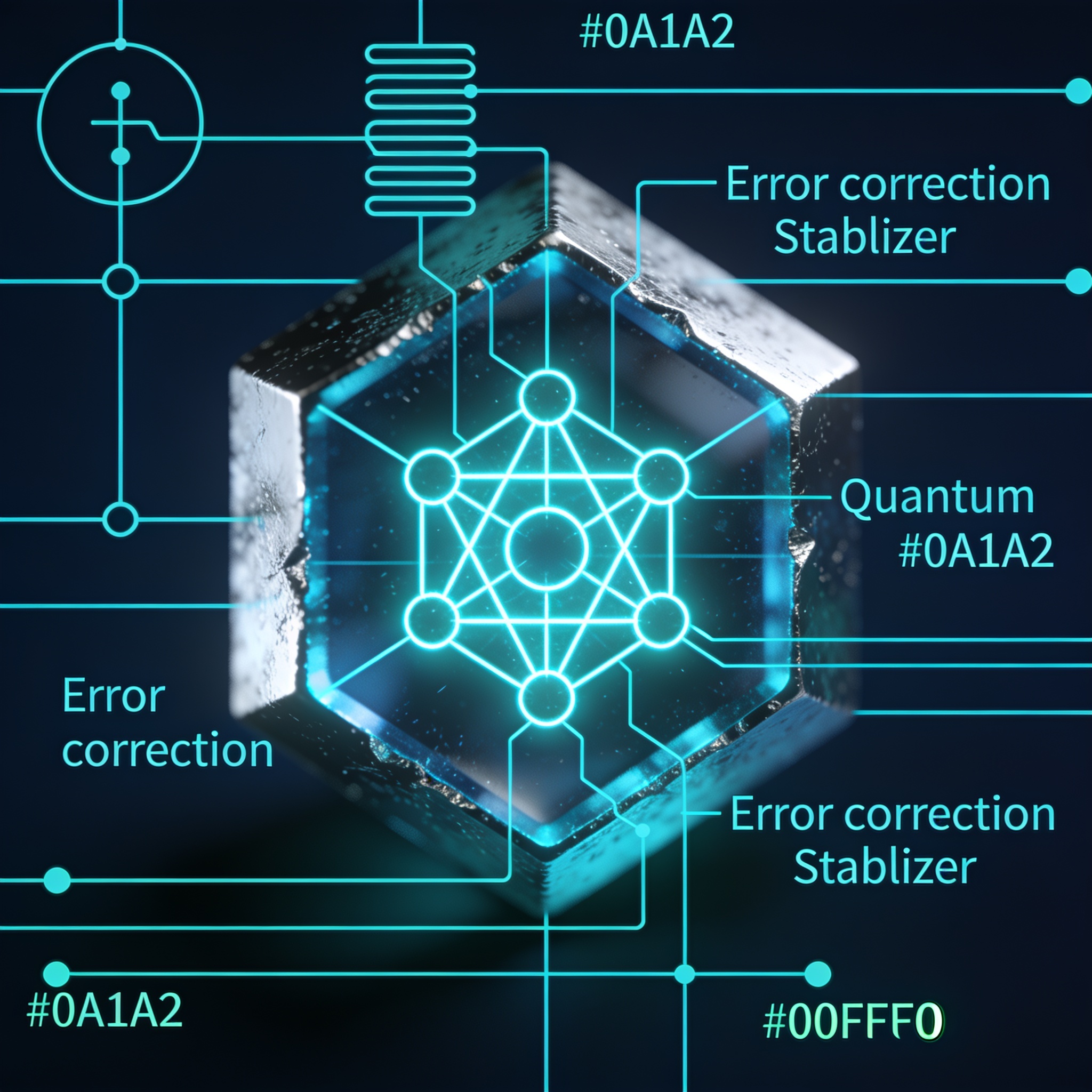
A centimetre-wide crystal of a strange metal passes the strictest test for quantum entanglement ever applied to a solid. At the same time, quantum error correction — the backbone of any future fault-tolerant quantum computer — gains a rigorous new benchmark: the Rényi coherent information is now proven monotonic for stabilizer codes under Bernoulli noise. [arXiv:2609.11930]
This matters because both advances use information-theoretic measures originally forged for coding theory to detect and quantify quantum behaviour in bulk matter. The Rényi coherent information, long a convenient but unreliable proxy for the von Neumann coherent information, suddenly carries an operational guarantee for error correction. Meanwhile, a single number, the quantum Fisher information, reveals genuine multipartite entanglement in a macroscopic crystal. The timing is not coincidental. As quantum processors surpass 1,000 physical qubits, the mathematical machinery that predicts when a code will fail is moving into the laboratory to characterize exotic materials.
How It Works
A paper posted on the arXiv preprint server on September 10, 2026, proves that for stabilizer codes suffering Pauli noise from independent Bernoulli events, the Rényi-n coherent information does not decrease as the index n increases through positive integers. The result flows from a broader theorem: if independent random bits are mapped linearly to a fine label T and a coarse label C, the Rényi entropy difference Hn(C) − Hn(T) is nondecreasing in n. In a stabilizer code, T is the joint syndrome–logical class and C is the syndrome alone; their entropy difference equals the Rényi-n coherent information up to a constant. The same theorem covers classical linear codes and independent detector error models.
"The Rényi-n coherent information is nondecreasing in n ∈ Z⁺," the authors write, closing a long-standing monotonicity gap.
The paper goes further, giving the Rényi-n coherent information a physical meaning. Postselect on n−1 auxiliary blocks matching the syndrome of a single data block, and the resulting conditional channel's coherent information saturates exactly when the error correction succeeds asymptotically. Moreover, the Rényi-n coherent information upper-bounds the ordinary coherent information achievable after any syndrome-conditioned recovery. This transforms a purely mathematical ordering into a concrete design tool for logical qubit engineers.
Three thousand kilometres away, physicists at the Vienna University of Technology (TU Wien) probed a centimetre-sized crystal of a strange metal — a class of materials governed by collective quantum effects — with quantum Fisher information. That measure sets a lower bound on entanglement depth, and the team registered values far beyond the classical threshold. The result, published on September 15, 2026, establishes a direct bridge between solid-state physics and the quantitative language of quantum information. Where standard conductivity or heat capacity measurements give coarse clues about electron correlations, quantum Fisher information reads out the microscopic entanglement structure.
Who's Moving
The convergence has the largest players in quantum computing paying close attention. IBM (NYSE: IBM) is pushing its 1,121-qubit Condor processor into error-correction staging, aiming for a logical qubit with a 10⁻⁶ error rate by 2029. Google Quantum AI (Alphabet, NASDAQ: GOOGL) has upgraded the surface code on its Willow chip, regularly demonstrating that larger code distances lower logical error rates — a behaviour the Rényi monotonicity now predicts from first principles. Quantinuum, the privately held trapped-ion specialist, delivers the world's highest two-qubit gate fidelities on its H2 processor, a platform where syndrome measurements can exploit the new postselection interpretation.
Stabilizer codes, the mathematical chassis of all these efforts, were invented by Daniel Gottesman at what is now the Perimeter Institute for Theoretical Physics. The surface code, the leading implementation candidate, was popularized by Austin Fowler during his tenure at Google Quantum AI. Caltech's John Preskill, who coined the term "quantum supremacy," has argued for years that information-theoretic measures are the natural diagnostic for decoherence-driven phase transitions — exactly the kind of transition that the Rényi hierarchy now helps map. PsiQuantum, the Silicon Valley startup pursuing fault-tolerant machines with photonic qubits, recently expanded its funding beyond its landmark $450 million Series C, betting that theoretical advances like this monotonicity proof will slash the overhead needed for a useful logical qubit.
Why 2026 Is Different
In the next twelve months, the Rényi benchmark will accelerate design cycles. Instead of running full Monte Carlo simulations of a code's decoder, quantum engineers can calculate a single scalar quantity and know, directly, that if it increases with n, the code's decoding capability is improving — no hedges. Within three years, IBM's planned 10⁻⁶ logical-qubit will move from roadmap to reality, and the Rényi coherent information will serve as the certification stamp that the logical error rate is truly below the physical qubit's noise floor. By 2031, error-corrected quantum computers with a few hundred logical qubits will attack problems in materials science that classical supercomputers cannot touch, including the simulation of strange metals like the one TU Wien just measured. Boston Consulting Group projects the quantum computing market will reach $125 billion by 2030, and the difference between winning and losing will be code efficiency during the next three processor generations.
Conclusion
Quantum error correction is no longer a statistical guessing game. The Rényi coherent information provides a provably monotonic benchmark that certifies a stabilizer code's decoding potential before a single qubit is measured, while quantum Fisher information pulls the same kind of certitude from a strange metal crystal into the lab. The two signals are one: information theory is becoming the native language of quantum matter.