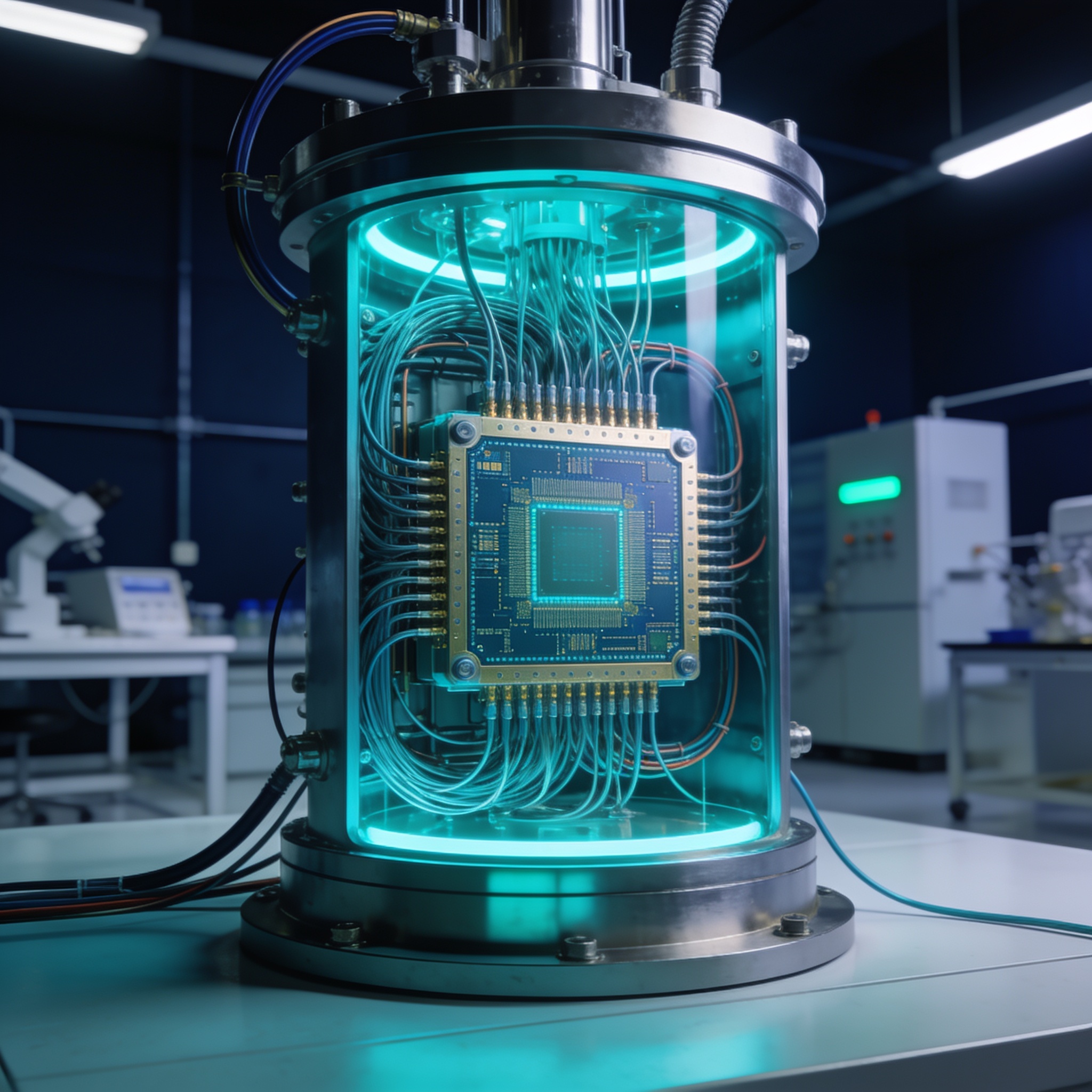
Rigetti Computing has finalized a definitive $100 million award from the U.S. Department of Commerce under the CHIPS and Science Act. The agreement, announced September 14, 2026, gives the government a minority equity stake in the publicly traded company. The funding is not a general-purpose grant. It targets three specific engineering bottlenecks that currently limit the size of Rigetti's superconducting quantum processors.
The award moves Rigetti from a non-binding preliminary memorandum of terms—signed earlier in 2026—to a legally binding contract. For the Department of Commerce, the equity component signals a shift from pure grant-making toward direct financial exposure to quantum computing commercialization timelines. For Rigetti, the capital is non-dilutive in the traditional sense but comes with a federal partner on the cap table.
What They're Actually Building
Rigetti builds superconducting quantum processors, the same modality pursued by IBM and Google. Its current flagship chip, the Ankaa-3, operates 84 qubits with a median two-qubit gate fidelity of 99.0% as of early 2026. The company's roadmap targets a 336-qubit system called Lyra by late 2027, followed by a multi-chiplet architecture that combines several smaller processors into a single logical system.
The three CHIPS-funded projects address the physical infrastructure required for that multi-chiplet transition. First: compact readout electronics that reduce the physical footprint of the control wiring currently required per qubit. Second: a high-capacity cryostat capable of cooling multiple chiplets simultaneously while maintaining signal integrity across longer cable runs. Third: enhanced fabrication capabilities at Fab-1, Rigetti's in-house foundry in Fremont, California, to produce and integrate multiple chiplets into a single quantum processing unit (QPU).
None of these projects directly improves qubit coherence times or gate fidelities. They address the engineering problem of connecting more qubits without the control infrastructure becoming the limiting factor. In superconducting systems, every qubit requires dedicated microwave control lines running from room-temperature electronics into a dilution refrigerator operating at millikelvin temperatures. The physical volume of those lines, the heat load they introduce, and the cost of the electronics scale poorly as qubit counts rise. Rigetti's bet is that solving these packaging and integration problems is a prerequisite to building a commercially useful machine, even if the underlying qubit quality remains constant.
Winners and Losers
The immediate beneficiary is Rigetti's balance sheet. The company reported $92.4 million in cash and equivalents at the end of Q2 2026, with a quarterly operating loss of $17.3 million. The $100 million award—disbursed in tranches tied to project milestones—extends the company's runway without requiring a dilutive equity raise at current market valuations.
Among competitors, the award puts pressure on other modular-superconducting approaches. IBM's Heron processor, introduced in late 2023, already uses a chiplet-style architecture with couplers between separate dies. Google's Willow chip, demonstrated in late 2024, achieved a landmark error-correction result on a 105-qubit device but has not publicly committed to a multi-chiplet roadmap. Rigetti's CHIPS-funded cryostat and readout work could close the packaging gap with IBM if executed on schedule.
IonQ and Quantinuum, which use trapped-ion qubits, are not directly affected. Their qubits do not require millikelvin cooling, and their scaling challenges involve different physics—primarily ion chain stability and gate speed. The CHIPS award reinforces the U.S. government's multi-modality bet: superconducting systems get CHIPS Act support, while trapped-ion and neutral-atom approaches have received separate DoD and DOE contracts.
For the quantum cloud market, the award matters indirectly. Rigetti sells QPU access through Amazon Braket, Microsoft Azure, and its own Quantum Cloud Services platform. If the Fab-1 expansion reduces per-qubit manufacturing costs, Rigetti could offer more competitive cloud pricing against IBM's pay-as-you-go model. That remains a 2028-or-later scenario.
The Bigger Picture
This is the second major CHIPS Act quantum award finalized in 2026. In January, the Department of Commerce committed $125 million to a consortium led by IBM and the University of Chicago for quantum workforce development and testbed infrastructure. The Rigetti award is smaller in dollar terms but more directly tied to specific hardware deliverables at a single company.
The equity-for-funding structure is unusual for CHIPS Act disbursements. Most awards to date, including the $6.6 billion to TSMC and $8.5 billion to Intel, have been structured as grants, loans, or loan guarantees. The Rigetti deal reflects the higher risk profile of quantum computing relative to semiconductor fabrication, where the government can underwrite proven manufacturing processes. By taking equity, the Department of Commerce aligns its return with commercial success rather than treating the funding as a sunk cost.
The award also signals that the U.S. government views domestic superconducting quantum fabrication as a strategic asset. Rigetti's Fab-1 is one of only two dedicated quantum foundries in the United States, alongside IBM's facility in Yorktown Heights. Maintaining independent fabrication capability—rather than relying entirely on IBM's ecosystem—appears to be a policy objective.
The Signal
The signal here is that Rigetti has secured the capital to attempt a multi-chiplet scaling path without betting the company on a single technology breakthrough. The three funded projects are engineering problems, not physics problems. They are difficult, expensive, and unglamorous—exactly the kind of infrastructure work that venture funding typically does not cover and that government programs are designed to underwrite.
What this reveals is that Rigetti's management sees the path to a thousand-qubit superconducting processor running primarily through better packaging, not better qubits. If the cryostat and readout projects deliver on their specifications, Rigetti could assemble a multi-chiplet QPU from Ankaa-class chiplets without requiring a generational improvement in gate fidelity. The fabrication work at Fab-1 is the gating item: producing multiple chiplets with consistent performance is a yield problem that no superconducting quantum company has solved at scale.
The milestone that would validate this award is a demonstrated multi-chiplet QPU with at least two interconnected chiplets running error-corrected circuits by late 2028. Until then, the CHIPS funding buys Rigetti time and equipment, not a guaranteed outcome.