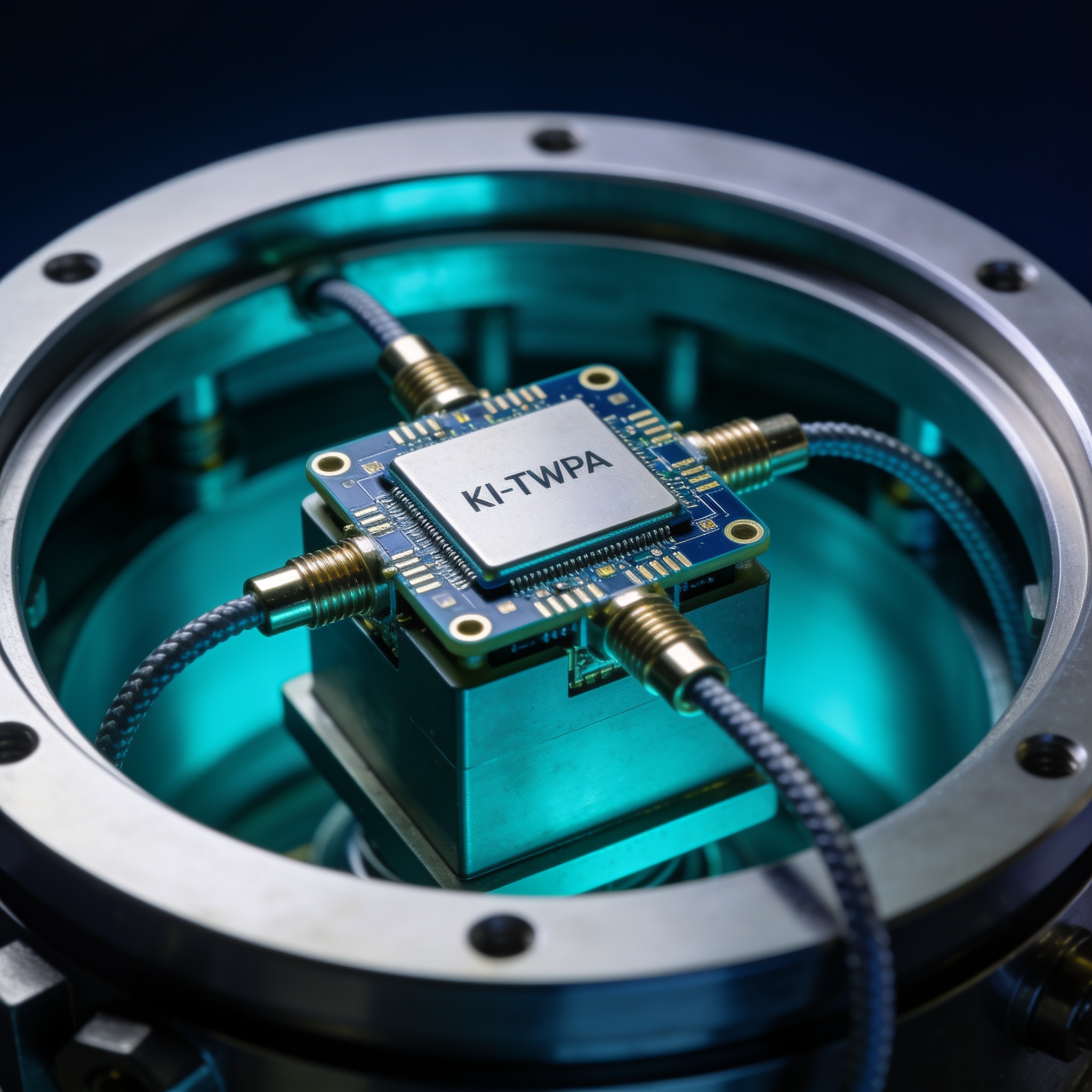
Quebec-based Qubic signed an up-to CA$1.5 million (US$1.1 million) contract with the Canadian federal government on September 11, 2026, for nine cryogenic parametric amplifiers. The deal, funded through the Innovative Solutions Canada Testing Stream, includes both KI-TWPA hardware and control software. First deliveries begin in fall 2026, with performance milestones due by spring 2027. The order arrives three months after the company closed an undisclosed seed round and one month after it sold an earlier unit to quantum orchestration firm Quantum Machines.
What They're Actually Building
Qubic's core product is a Kinetic Inductance Traveling-Wave Parametric Amplifier (KI-TWPA), a superconducting device that operates at millikelvin temperatures to amplify microwave signals from quantum processors. Every qubit readout chain requires a near-quantum-limited amplifier to lift the faint signal above classical noise without adding more than a photon's worth of excess noise. In contrast to conventional Josephson parametric amplifiers that use Josephson junctions as the nonlinear element, a KI-TWPA derives its nonlinearity from the kinetic inductance of a high-resistivity superconducting film. That architecture gives it a larger signal-handling saturation power—typically -110 to -105 dBm—and an instantaneous bandwidth of several gigahertz, making it suitable for multiplexed readout of dozens of qubits.
Critically, the nine contract units will ship with software that automates bias-point calibration, a pain point for dilution-refrigerator operators who otherwise spend hours manually tuning pump frequency and flux settings. The product aligns with an industry trend toward turnkey readout chains, where the amplifier, cables, and control electronics are validated as a single subsystem. In that respect, Qubic is closer to a cryogenic-photonics component supplier than to a quantum-computer builder. Its nearest roadmap competitor is the UK-based Quantum Microwave, which sells Josephson TWPA-based systems, and Finland's Silentium, which also commercializes travelling-wave parametric amplifiers for research labs and OEMs.
Winners and Losers
The immediate winner is Quantum Machines. Its Quantum Orchestration Platform already integrates with multiple amplifier families, and Qubic's prior sale places it as a preferred hardware partner. Customers who standardize on Quantum Machines' software stack get a pre-validated signal path, reducing integration risk. The Canadian test order also gives Qubic a beachhead to demonstrate performance data that can steer future procurement contracts under the country's National Quantum Strategy, which has allocated C$360 million through 2029.
Specialist amplifier houses face incremental pressure. Companies like Quantum Microwave and Low Noise Factory—whose high-electron-mobility transistor (HEMT) amplifiers still dominate commercial cryostats—must now show they can match parametric amplifier performance in bandwidth and noise temperature, or risk losing the high-end qubit-readout segment. Meanwhile, broader dilution-refrigerator integrators such as Bluefors and Oxford Instruments benefit regardless of amplifier design: every new component procurement expands the bill of materials. The government contract, while small, signals that quantum infrastructure spending is shifting from pure R&D grants to actual hardware buys, which tricks down to the entire supply chain over time.
The Bigger Picture
The Innovative Solutions Canada Testing Stream is a targeted procurement vehicle that bridges prototype-phase technologies and departmental deployment; a CA$1.5 million commitment for nine units is, by federal standards, a modest down-payment, not a production contract. However, it mirrors similar component-level orders elsewhere: in 2025, Germany's Federal Ministry of Education and Research placed contracts for superconducting parametric amplifiers through the QSolid programme, and the U.S. Department of Energy's Microelectronics Co-Design initiative routinely funds cryogenic amplifier research at national labs.
In the 2026 quantum landscape, practical infrastructure purchases are increasingly common. IBM's Quantum System Two ships with integrated cryogenic amplifiers from its own supply chain, and QuantWare has started offering pre-amplified QPU units to cloud providers. Qubic's win fits into this shift toward vendor-consolidated readout chains, even as the total market for standalone cryogenic amplifiers remains under $100 million. The June seed round, whose amount the company has not disclosed, and the May sale to Quantum Machines suggest that Qubic is following the same path as many quantum-component startups: secure a marquee anchor buyer, then leverage public R&D contracts to reach scale before the broader market matures.
The Signal
A $1.1 million government test order for nine amplifiers does not move the overall cryogenic amplifier market. What this reveals is that a government buyer is ready to write a real purchase order for a specialized quantum component rather than issue another innovation grant. The Canadian government's willingness to buy hardware with defined delivery milestones—fall 2026 to spring 2027—tells other procurement agencies that parametric amplifiers have moved past the science project stage. If Qubic publishes operational benchmark data from these installations—particularly noise temperature and dynamic range measurements in a live multi-qubit environment—it will give competitors and customers a calibration point that could accelerate component standardization across the industry.
In short: a modest public contract ratifies the supply chain for cryogenic quantum amplifiers, turning one startup's prototype into a line item on a government purchase order.