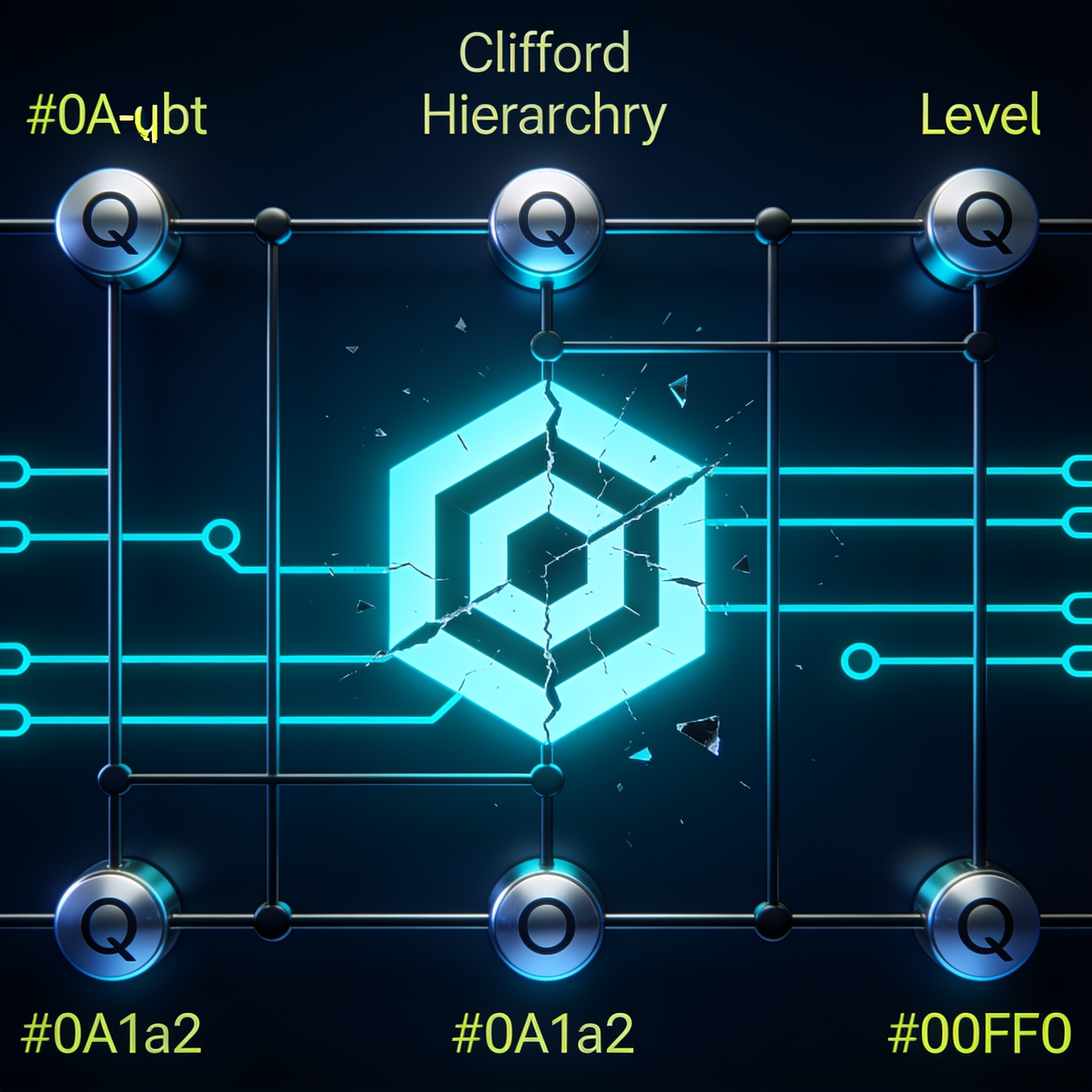
A single five-qubit gate has just shattered a 19-year-old conjecture about the structure of fault-tolerant quantum operations. The finding, posted to arXiv on September 10, 2026, strikes at the heart of quantum error correction, the essential ingredient for building useful quantum computers. It arrives the same week IonQ publicly claims a 20,000-qubit machine could break Bitcoin encryption in 26 days, reigniting debate about when—and whether—error-corrected machines will threaten classical cryptography. [arXiv:2609.11903]
This matters because the two events expose a central tension in quantum development. The generalized semi-Clifford conjecture, proposed by Zeng, Chen, and Chuang in 2007, described a clean structure for the gates that can be performed fault-tolerantly using gate teleportation. The new counterexample shows that structure is messier than anyone assumed. Meanwhile, IonQ’s timeline assumes a level of fault tolerance that does not yet exist. The timing is not coincidental: both stories underscore that quantum error correction remains the field’s hardest unsolved problem.
How It Works
The Clifford hierarchy is a nested sequence of quantum gate sets. Level one contains Pauli gates, level two adds the Clifford group, and higher levels include gates like the T gate and Toffoli gate. The hierarchy matters because gates in higher levels can be executed fault-tolerantly on encoded logical qubits using gate teleportation and magic state distillation—the standard recipe for universal quantum computation inside a quantum error correction code.
In 2007, Zeng, Chen, and Chuang conjectured that every gate in the hierarchy takes a specific form: a Clifford gate, followed by a permutation, a diagonal gate, and another Clifford gate—written as C₁ Π D C₂. They called these “generalized semi-Clifford” gates. In 2008, Beigi and Shor proved the conjecture holds for all third-level gates. For 18 years, no counterexample appeared. The new preprint demolishes that record. “We construct a five-qubit gate that is in the fifth level of the Clifford hierarchy but is not generalised semi-Clifford,” the authors write. The gate is not a pathological edge case; the paper shows how its form can be deduced from first principles.
The counterexample also proves something equally unsettling: the Clifford hierarchy is not closed under inverses. The inverse of the fifth-level gate does not belong to the fifth level. For quantum error correction architects, this is a headache. Fault-tolerant circuit design relies on the ability to invert gates without leaving the intended level of the hierarchy. If inverses can drop to a different level, the resource overhead for magic state distillation and gate compilation grows in ways the field has not yet quantified.
Who’s Moving
IonQ (NYSE: IONQ) made its 20,000-qubit claim in a weekly digest that circulated on September 12, 2026. The company builds trapped-ion quantum processors and has publicly targeted a 1,024-qubit system by 2028. A 20,000-qubit machine would require a leap in qubit fidelity, gate speed, and—crucially—quantum error correction. IonQ’s roadmap assumes the availability of logical qubits with error rates low enough to run Shor’s algorithm on elliptic curve cryptography, the backbone of Bitcoin security.
IBM (NYSE: IBM) fields its 1,121-qubit Condor processor, the largest superconducting quantum chip disclosed to date, and has demonstrated error mitigation on 100+ qubits. Google Quantum AI continues to push surface code implementations on its Sycamore-class devices. Microsoft pursues topological qubits, which promise hardware-level error protection but have yet to demonstrate a single logical qubit. The counterexample paper’s authors and institution remain undisclosed in the preprint, but the work draws directly on the framework built by Zeng, Chen, Chuang, Beigi, and Shor—researchers whose institutions span MIT, the University of Guelph, and the Perimeter Institute.
Why 2026 Is Different
In 12 months, expect at least two major hardware vendors to demonstrate logical qubits with error rates below the break-even threshold for the surface code. Within three years, the first fault-tolerant logical operations on 10–20 logical qubits will force a reassessment of gate compilation strategies in light of the new hierarchy constraints. Within five years, a machine capable of running Shor’s algorithm on 2,048-bit RSA keys—or Bitcoin’s secp256k1 curve—will move from speculative claim to engineering milestone. Analysts project the quantum computing market to reach $65 billion by 2030, but that number assumes error correction scales as planned. The counterexample injects fresh uncertainty into that assumption.
In short: quantum error correction remains the central bottleneck, and the discovery that the Clifford hierarchy lacks inverse closure adds a new layer of complexity to building fault-tolerant gate sets.
Frequently Asked Questions
What is the Clifford hierarchy?
The Clifford hierarchy is a nested sequence of quantum gate sets used in fault-tolerant quantum computing. Level one contains Pauli gates, level two adds the Clifford group, and higher levels include non-Clifford gates like the T gate. Gates in higher levels can be implemented on encoded logical qubits using gate teleportation and magic state distillation, making the hierarchy a blueprint for universal quantum computation inside error-correcting codes.
How does the generalized semi-Clifford conjecture relate to fault-tolerant quantum computing?
The conjecture proposed that all gates in the Clifford hierarchy have a simple structure—Clifford gates sandwiching a permutation and a diagonal gate. If true, this would simplify the design of fault-tolerant gate sets and reduce the overhead of magic state distillation. The new counterexample shows the structure is not universal, forcing error correction architects to handle a wider class of gates than previously assumed.
When will quantum computers be able to break Bitcoin encryption?
Breaking Bitcoin’s elliptic curve cryptography requires running Shor’s algorithm on a logical qubit count estimated between 2,000 and 20,000, depending on error rates and gate speeds. IonQ’s 2026 claim of 26 days on a 20,000-qubit machine assumes near-perfect logical qubits that do not yet exist. Most roadmaps place a cryptographically relevant fault-tolerant machine no earlier than 2030, and the new hierarchy counterexample may push that date further out.
Which companies are leading in quantum error correction?
IBM, Google Quantum AI, and IonQ are the most visible players. IBM’s 1,121-qubit Condor processor and Google’s surface code experiments on Sycamore-class devices represent the state of the art in superconducting qubits. IonQ’s trapped-ion approach offers higher native gate fidelities but slower speeds. Microsoft is pursuing topological qubits with hardware-level error protection, though no logical qubit has been demonstrated yet.
What are the biggest obstacles to fault-tolerant quantum computing?
The primary obstacles are decoherence, qubit fidelity, and the overhead of syndrome measurement in error correction codes. Even with physical error rates below 0.1%, the surface code requires thousands of physical qubits per logical qubit. The new finding that the Clifford hierarchy is not closed under inverses adds a compilation challenge: gate sequences must now account for the fact that inverting a gate may change its hierarchy level, increasing the number of magic states required.