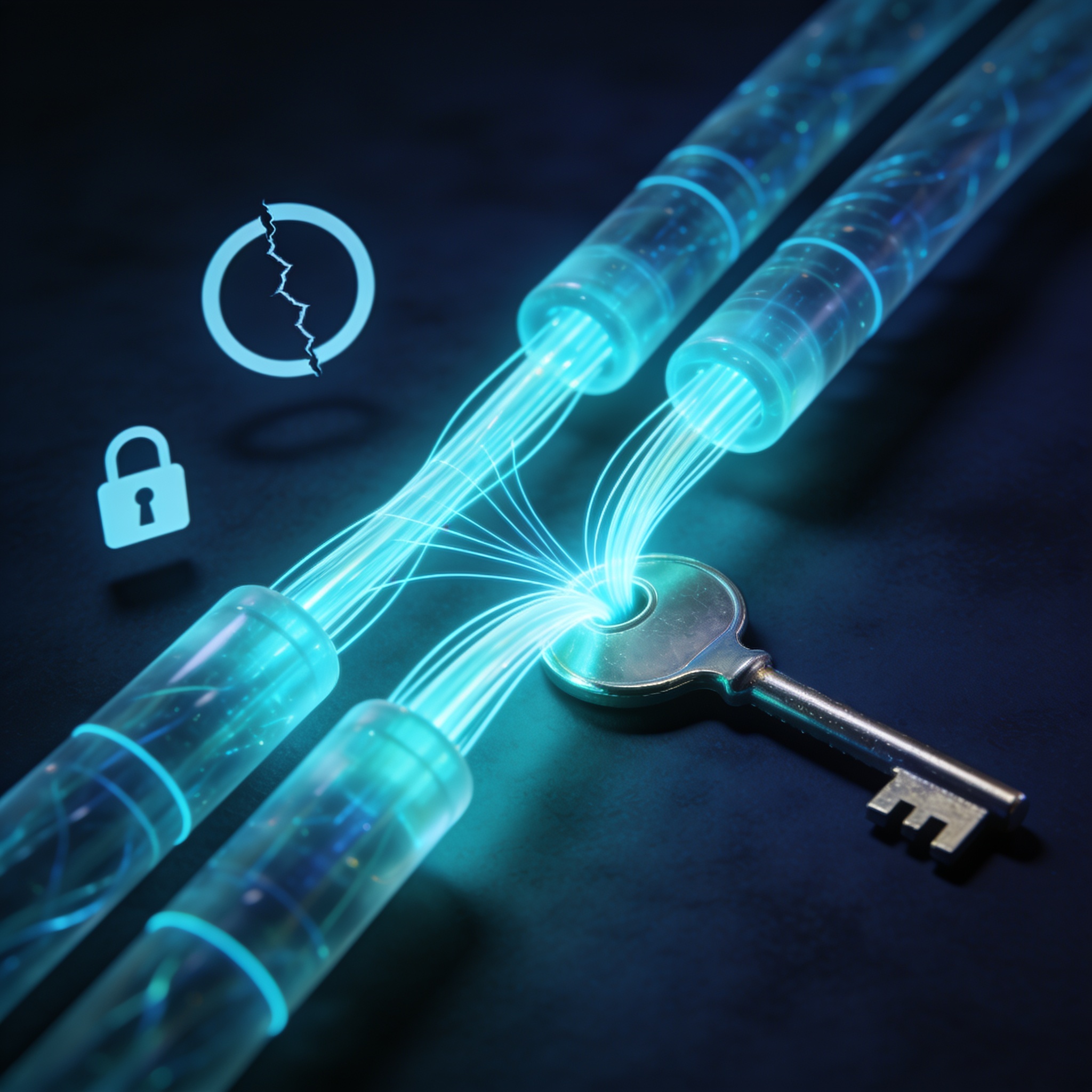
The problem is as old as quantum Shannon theory itself: if two noisy channels are each completely incapable of private communication, can they be cleverly combined so that privacy suddenly emerges? For classical memoryless wiretap channels the answer has always been no—a result that underpins the security architecture of the internet. But when the channels are quantum, the question has been an open defiance for nearly two decades. Now, a team of researchers has shown conclusively that the answer is yes. In a preprint posted to arXiv on 9 September 2026, they describe a concrete construction in which two quantum channels, each with precisely zero private capacity, combine to yield a strictly positive rate of more than 0.0001903 private bits per product use. The discovery is the first ever superactivation of private capacity, and it overturns the intuition that a channel’s private capacity alone determines its value for secure communication. [arXiv:2609.10520]
The Core Finding
The authors exhibit two specific channels. One is a four-level quantum channel carefully engineered to have no private capacity; the other is a qubit erasure channel that loses half of all qubits it transmits, also with zero private capacity. Used independently, neither channel can convey even a single secret bit. But when the sender encodes a message across both channels simultaneously and the receiver applies a fixed joint measurement, private information flows at a rate of at least 0.0001903 bits per joint use. This figure, while tiny, is mathematically provable and, crucially, strictly greater than zero. As the abstract states:
“Whether two channels with zero private capacity can jointly enable private communication is a longstanding open problem… we resolve this problem by exhibiting a four-level channel and a qubit erasure channel … whose joint use achieves more than 0.0001903 private bits per product use.”Think of it like combining two padlocks that are individually trivial to pick: when layered in a specific order, they become cryptographically secure. The encoding ensures the legitimate receiver’s information grows linearly with the number of uses, while the environment’s leakage grows only quadratically—a gap that, with classical error-correcting codes, can be amplified into a secret key.
The State of the Field
The quest for superactivation has driven quantum information theory since 2008, when Graeme Smith and Jon Yard demonstrated that two zero-quantum-capacity channels could combine to transmit quantum information—a phenomenon called superactivation of quantum capacity. The analogous question for private capacity, which measures the rate at which a channel can distribute secret keys immune to eavesdropping, remained stubbornly open. Several previous works had ruled out certain simpler candidates, but a general proof or disproof was missing. The new result breaks this logjam through an explicit numerical example, first identified with the assistance of large language models and later verified in the Lean 4 proof assistant. This synergy between AI-driven search and formal verification exemplifies a growing trend in mathematical physics, where computational exploration can unearth counterintuitive structures that would elude human intuition. Concurrently, the broader quantum network landscape is maturing rapidly: metropolitan quantum key distribution networks already operate in cities such as Tokyo and Vienna, while satellite-based quantum communication has achieved intercontinental links. Understanding the ultimate limits of private communication over noisy physical channels is therefore not just a theoretical curiosity but a foundational need for future quantum-secure infrastructure.
From Lab to Reality
For the scientific community, the work unlocks a new research frontier: characterizing the private capacity region of multiple channels and discovering other superactivation phenomena. It suggests that the additive, resource-centric view of channel capacities—long dominant in Shannon theory—is incomplete, and that communication value can be a genuinely non-linear function of available resources. For engineers working on quantum networks, the result could eventually inspire practical protocols for secure communication over noisy links, where combining two low-quality channels yields privacy that neither alone provides. Such protocols would integrate naturally with quantum error correction and fault-tolerant quantum computing: a logical qubit, protected by surface code error correction, could be transmitted over multiple physical channels that individually leak information, yet jointly preserve secrecy. The quantum cryptography and secure communication market, projected by some industry reports to reach $3.8 billion by 2030, stands to benefit from any principle that expands the set of usable physical links for secret-key generation. While immediate applications are distant, the demonstration that zero-private-capacity channels have hidden utility will likely spur investment in channel-combining architectures.
What Still Needs to Happen
The immediate obstacle is the minuscule rate: 0.00019 bits per use is orders of magnitude below the throughput of even experimental quantum key distribution systems. Amplifying this to practical levels will require concatenated coding schemes and fault-tolerant quantum error correction, which themselves demand logical qubits with gate fidelities well beyond today’s noisy intermediate-scale quantum processors. Another challenge is implementing the required channels with sufficient precision. The qubit erasure channel with exactly 50% erasure probability must be engineered as a controlled loss process, while the four-level channel demands careful alignment of quantum state discrimination measurements. Laboratories such as those of Ronald Hanson at QuTech, John Bollinger at NIST, and groups pursuing integrated photonic platforms for quantum communication are gradually approaching the control levels needed. However, the error rates for joint measurements across separate physical channels remain high, and maintaining coherence across multiple erasure channels is non-trivial. Realistic deployment of superactivation-based privacy amplification may be a decade away, contingent on progress in both quantum error correction and photonic qubit transduction.
Conclusion
The paper changes the narrative around secure quantum communication by proving that zero private capacity is not a terminal verdict on a channel’s usefulness. In short: quantum error correction-like principles reveal that two useless channels can team up to create a provably private link, delivering more than 0.00019 secret bits per use. The finding challenges the longstanding assumption that private capacity alone dictates a channel's security value and opens a new chapter in the theory of quantum Shannon information.