The strongest proof of quantum behavior is no longer a Bell inequality violation, because a system can be fully quantum and still offer no Bell-type test through the observables an experimenter can actually measure. That is the claim at the center of a September 9, 2026 arXiv preprint titled “For Whom Does Bell Hold?” The authors show that quantum vacuum fluctuations under Hamiltonian evolution leave a correlation signature that classical Hamiltonian systems cannot reproduce. The same correlation logic already powers photonic quantum computing, where single photons and quantum interference on beam splitters turn fragile coherence into measurable signal. [arXiv:2609.10535]
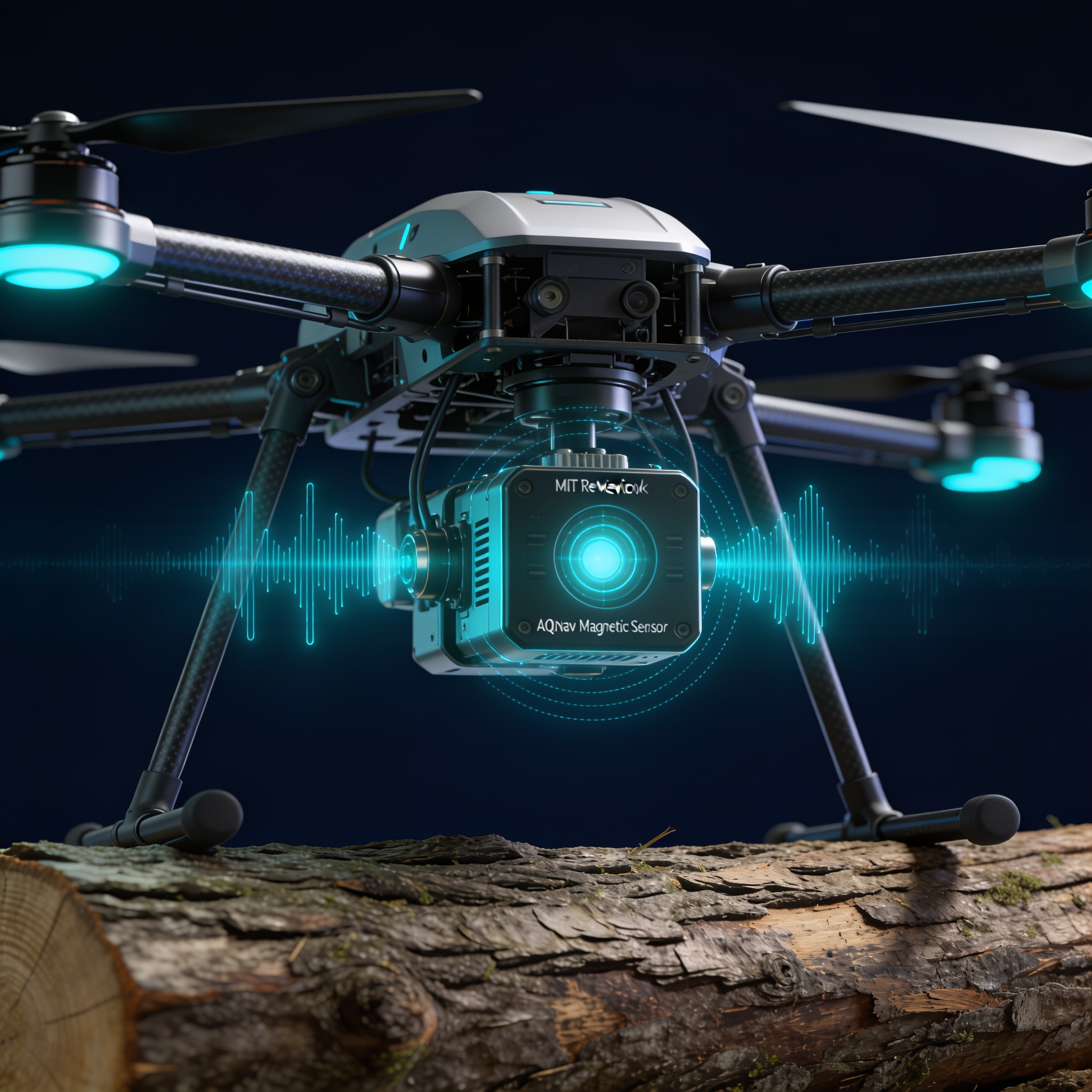
This matters because the preprint and a September 10, 2026 flight test by SandboxAQ and Northrop Grumman are not separate news cycles. The timing is not coincidental: quantum optics has spent two decades turning correlation measurements into engineering tools, and those tools have now left the optics table. SandboxAQ’s AQNav magnetic navigation system just completed the first operational flight test of MagNav on an expendable Lumberjack drone, processing sensor telemetry with Large Quantitative Models and geomagnetic anomaly maps for real-time positioning in GPS-denied environments. Both stories describe the same shift: quantum advantage is being measured through correlations in noisy observables, not only through isolated qubits.
How It Works
Bell inequalities were originally a test for local hidden-variable theories. In the standard optical version, entangled photons are measured at separated detectors, and the correlation statistics violate a classical bound. Photonic quantum computing Photonic Quantum Computing uses the same toolbox: a single photon serves as an optical qubit, a beam splitter produces quantum interference, and photon entanglement supplies the non-classical resource. The September 9 preprint generalizes Bell-style reasoning beyond that ideal case.
The preprint, whose arXiv metadata does not list authors, extends correlation-based Bell tests to closed systems undergoing Hamiltonian evolution. The motivating problem is cosmology: cosmic structure may have originated from quantum vacuum fluctuations, yet telescopes measure only classical observables. No instrument can close a Bell test on the early universe. The paper asks instead whether the statistical pattern of those observables carries a quantum-only signature.
“quantum vacuum fluctuations of closed systems undergoing Hamiltonian evolution produce unique correlations that are not mimicked by classical Hamiltonian systems.”
The clearest signal sits in frequency space. In a quantum vacuum, correlations remain generally time-independent and are controlled by the energy gap between ground and excited states. Classical Hamiltonian systems develop apparent poles at physical frequencies. Near those poles, classical evolution becomes dominated by a resonant Hamiltonian, producing time-dependent correlations that eventually dephase.
That difference gives a fingerprint for quantum evolution even when no Bell operator is available. Think of it as listening to the noise floor: a quantum vacuum stays quiet at frequencies where a classical oscillator would ring.
This lineage runs through the photon Bell experiments of John Clauser, Alain Aspect, and Anton Zeilinger, who shared the 2022 Nobel Prize in Physics. Their loophole-closing work created the toolkit that later became photonic quantum computing: single-photon sources, high-efficiency detectors, and phase-stable interferometers. The new paper changes the question from “do these photons violate Bell?” to “do these observables carry quantum-only correlations?” It also sharpens the boundary against other quantum evolution signals, including quantum optics, quantum walks, and quantum search.
Who’s Moving
SandboxAQ, the Alphabet spinout led by Jack D. Hidary, supplied the AQNav magnetic navigation system. Northrop Grumman Corporation (NYSE: NOC), led by CEO Kathy Warden, supplied the Lumberjack attritable drone and the visual navigation sensors. The September 10 flight was the first pairing of magnetic anomaly navigation with visual navigation on a one-way attack system. SandboxAQ has raised more than $500 million in total funding since its spinout, and its Large Quantitative Models now form the software layer for real-time alternative positioning, navigation, and timing.
Northrop Grumman’s Lumberjack is designed as an expendable platform, meaning it can be lost in combat without prohibitive cost. Pairing AQNav with visual sensors gives a one-way attack system redundant navigation when GPS jamming saturates the battlefield. That is an operational advantage, not a laboratory demonstration. The magnetometers are quantum sensors, not photonic qubits, but the correlation processing shares mathematical roots with quantum optics Quantum Optics.
In photonic quantum computing, the competitive landscape includes PsiQuantum and Xanadu, both building optical qubit architectures; Xanadu’s Borealis processor demonstrated quantum computational advantage in 2022. They compete with superconducting machines such as IBM’s 1,121-qubit Condor processor, which uses Josephson junctions at millikelvin temperatures. SandboxAQ’s play is adjacent: it commercializes Quantum Sensing and quantum-inspired software rather than qubits. But the correlation mathematics is shared.
Why 2026 Is Different
The next 12 months will see MagNav flight tests move from expendable drones to rotary-wing and fixed-wing platforms. Within three years, quantum-correlation navigation will become a standard layer in GPS-denied operations, because the sensors are small and the software update cycles are short. Within five years, the correlation discrimination described in the September 9 preprint will certify whether a candidate quantum hardware system—photonic or otherwise—actually evolves quantum mechanically.
Traditional GPS-denied navigation relies on inertial navigation systems, which drift over time, or terrain-contour matching, which requires pre-mapped terrain. MagNav reads Earth’s crustal magnetic field and corrects inertial drift with geomagnetic anomaly maps. The AQNav software-first architecture means the same system can move across platforms without replacing the physical sensor package. Analysts forecast the quantum sensing market will surpass $1 billion by 2028, with defense navigation among the fastest-growing segments.
The September 2026 paper and the flight test both mark the same transition. Quantumness is no longer certified only by closing loopholes in a photonic Bell experiment. It is certified by correlation structure in the data an operational sensor produces. That shift matters for photonic quantum computing vendors because it gives them a practical way to prove their machines are quantum, not just fast classical simulators.
The Bottom Line
Photonic quantum computing has spent years learning how to certify non-classical behavior through correlation statistics. The September 2026 paper and the SandboxAQ–Northrop Grumman flight test show that this certification problem is no longer confined to optical tables. In short: photonic quantum computing’s correlation methods now allow quantumness to be certified without Bell tests—and by September 2026 they are flying on Northrop Grumman drones.